
Connected Medicine: How Social Networks and ICT Drive Performance in Knowledge-Intensive Work
Individual performance in knowledge intensive work through social networks
This paper proposes a theoretical model to investigate how social network structure and Information and Communication Technology (ICT) use impact individual performance in knowledge-intensive work. Focusing on General Practitioners (GPs) in rural Australia, it validates a multifaceted framework where ICT acts as both a task-productivity tool and a facilitator of "Computer Supported Social Networks" (CSSN).
TL;DR
Individual performance in high-stakes, knowledge-intensive fields like medicine is often viewed as a result of personal expertise (Human Capital). This paper challenges that narrow view, arguing that a professional's social network structure and their utilization of Information and Communication Technology (ICT) are the true engines of performance. By studying rural General Practitioners (GPs) in Australia, researchers Kon Shing Kenneth Chung et al. demonstrate that "who you know" and "how you talk to them" are critical for maintaining the quality of care.
Academic Positioning: This work bridges the gap between Social Network Analysis (SNA) and Information Systems (IS), moving beyond simple productivity metrics to evaluate the "socially embedded" nature of technology.
The Problem: The "Isolation Paradox" in Knowledge Work
Professional expertise has a half-life. In rural medical practices, GPs face a double-edged sword:
- Knowledge Obsolescence: As practitioners age, technological and medical knowledge can decline without constant peer interaction.
- Structural Isolation: Geographically dispersed professionals lack the "water cooler" moments that allow for spontaneous knowledge transfer.
Existing studies suggest that ICT can help, but most rural practices use technology purely for administrative tasks (billing/records) rather than leveraging it for social connectivity.
Methodology: Mapping the Professional Ego
The researchers developed a conceptual model that relates social network properties to the "Process of Care."
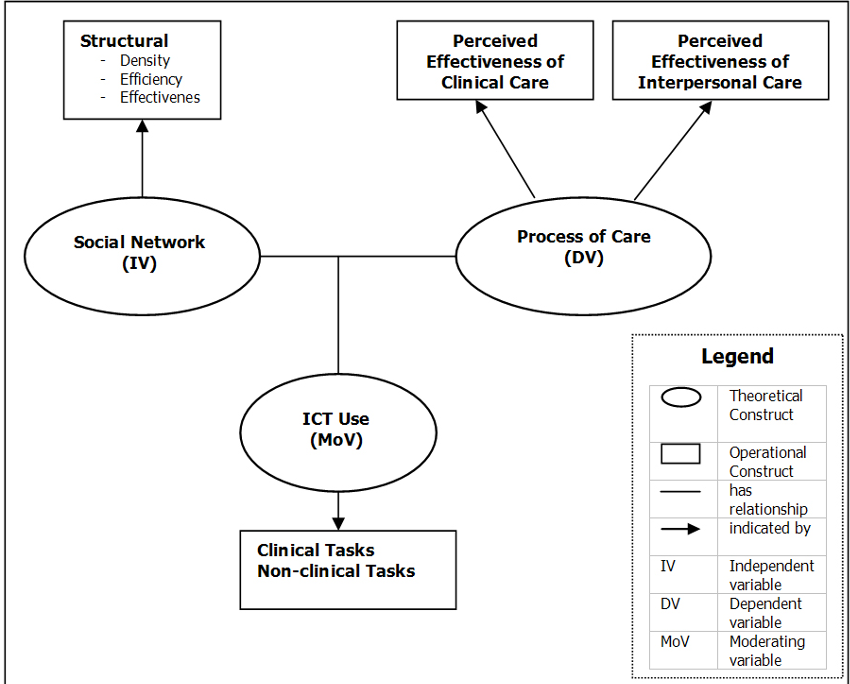
The methodology relies on three pillars:
- Process of Care (Performance): Measured via GP attitudes toward psychological orientation, communication, and appropriateness of consultation.
- Social Network Structure:
- Density: The interconnectedness of a GP's contacts (promoting trust and norms).
- Structural Holes (Efficiency/Effectiveness): Connections to diverse groups that aren't connected to each other (providing non-redundant, novel information).
- ICT Use: Categorized into clinical tasks (prescriptions) and internet/communication tasks (accessing journals, peer consultation).
The Core Insight: Why Net-Structure Matters
The paper draws a vital distinction between Strong Ties and Weak Ties:
- Strong Ties (Dense networks) are essential for transferring complex knowledge and providing emotional support.
- Weak Ties (Bridges across structural holes) are the primary source of innovation and novel insights.
The authors hypothesize that the most successful GPs are those who utilize ICT to maintain a "Computer Supported Social Network" (CSSN) that provides both the efficiency of information search (via weak ties) and the reliability of advice (via dense networks).
Preliminary Findings & Evidence
Through in-depth interviews, the study confirmed that there is no singular standard for "GP performance." Instead, GPs view their performance through the lens of Continued Medical Education (CME) and peer support.
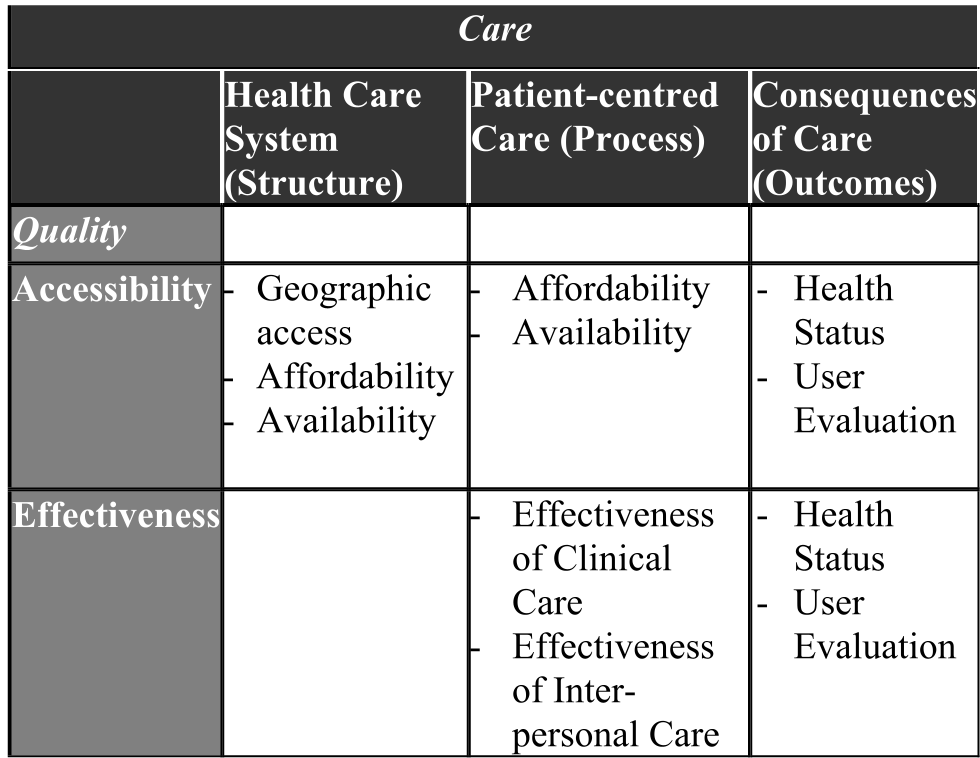
| Quality Dimension | Patient-centred Care (Process) |
|---|---|
| Effectiveness | Effectiveness of Clinical and Inter-personal Care |
| Evidence | GPs reported that peer networks make them feel "much more at ease" in solving complex clinical problems. |
Interestingly, while formal reports suggest rural GPs only use IT for administration, the interviews revealed a grassroots shift: GPs are increasingly using email and video conferencing to maintain family ties and seek psychiatric mentoring, suggesting that ICT is "shaping personal networks and re-drawing social boundaries."
Critical Analysis & Conclusion
Takeaway
The value of a social contact is far more profound than just "finding an answer." In knowledge-intensive work, the social network acts as an interpreter of help-seeking behavior. ICT is not just a tool for efficiency; it is a moderator that allows professionals to maintain optimal network structures regardless of physical geography.
Limitations
- Self-Reporting: The study relies on "attitudes to care" as a proxy for performance, which may not always correlate with objective clinical outcomes.
- Era-Specific: Written in 2007, the paper focuses on email and early video conferencing; today's researchers would need to account for instant messaging (WhatsApp/Slack) and AI-augmented clinical decision-making.
Future Outlook
This research provides a blueprint for studying the modern "remote-first" workforce. By measuring the efficiency and effectiveness of a professional's digital network, organizations can better design ICT tools that don't just "process tasks" but "engineer connections."
Source: Chung, K.S.K., Hossain, L., & Davis, J. (2007). Individual performance in knowledge-intensive work through social networks.