
Individual LBS Recommendation: Bridging Social Intimacy and Spatiotemporal Traces
An Individual Service Recommendation Model Based on Social Network and Location Awareness
The paper proposes an "Individual Service Recommendation Model" for Location-Based Services (LBS) that integrates social network community detection with user trajectory analysis. By combining a modified Dijkstra algorithm for social intimacy classification and an iterative experience-inference algorithm, it achieves personalized location recommendations.
TL;DR
This research introduces a novel framework for individual service recommendation by merging Social Network Analysis with Location Awareness. Instead of relying on generic performance metrics, the model filters relevant users through social "intimacy" and calculates location relevance using an iterative algorithm that balances user experience with stay-point popularity.
Context: Beyond Generic QoS
Traditionally, Web service recommendations focused on QoS (Quality of Service)—speed, reliability, and latency. However, two users in the same neighborhood might have vastly different interests. While GPS-based LBS exist, they are often battery-hungry and struggle indoors. The authors argue that the "Who" (Social Network) is just as important as the "Where" (Location Awareness) for a truly personalized experience.
Methodology: The Core Modules
The proposed model operates in three distinct phases:
1. Social Network Filtering (The "Who")
The system detects a community around a "center user." To determine who is most relevant to the target user, the authors adapt the Dijkstra Algorithm.
- Insight: Intimacy is defined by the shortest path length in the social graph. Users at distance (direct friends) are given higher priority than those at .
- Efficiency: By setting a threshold , the system only processes traces from the most "intimate" users, significantly cutting down on data processing time.
2. Location Awareness & Key Point Extraction
Rather than looking at every raw GPS coordinate, the model extracts Key Points.
- A Key Point is defined by a distance threshold () and a time threshold (). If a user stays within 300m for more than 20 minutes, that coordinate becomes a "Key Point," implying a semantic location like a restaurant or a museum.
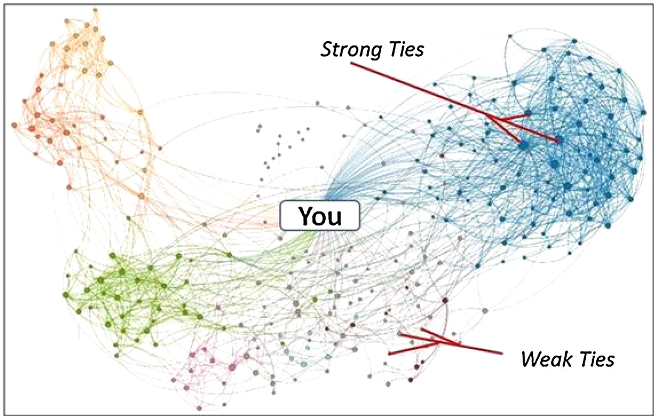 Figure: The overall model framework encompassing Social, Location, and LBS modules.
3. Iterative Experience Inference
The model uses a logic similar to the HITS algorithm (Hubs and Authorities). It builds a correlation matrix :
- User Experience (): High-experience users visit high-interest locations.
- Location Interest (): High-interest locations are visited by experienced users. Through an iterative power method (), the system calculates the weight of each user's contribution to the recommendation.
Empirical Results
Testing the model in a tourism scenario in Nanjing, the authors proved a critical hypothesis: You don't need all the data.
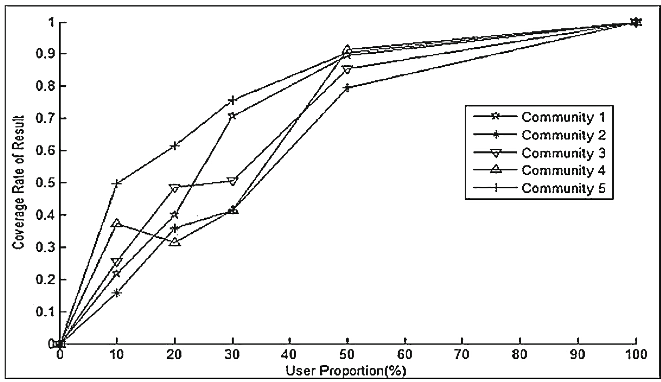 Figure: Simulation showing that 50-60% of filtered "intimate" users provide nearly 100% of the value of the full dataset.
The relevance calculation () further applies an attenuation factor . This accounts for the temporal sequence of visits—locations visited consecutively in a trace are more strongly linked than those visited hours apart.
Critical Insights & Future Directions
The brilliance of this model lies in its data-pruning strategy. By using social intimacy as a filter for spatiotemporal data, it avoids the "big data noise" that often plagues recommendation engines.
Limitations:
- The model assumes a static social graph; however, social relationships and "intimacy" are often dynamic.
- The current simulation relies on generated datasets; real-world deployment would require addressing sparse social data for new users (the "Cold Start" problem).
Conclusion: This work shifts the focus of LBS from purely geographic proximity to a more nuanced "Social-Spatial" relevance. It lays the groundwork for smarter, more efficient mobile assistants that understand not just where you are, but whose opinions you should value in that specific context.