
Reinforcement Learning in IPA Markets: The Convergence of Self-Interest and Social Good
Individual and Social Behaviour in the IPA Market with RL
This paper investigates the Iterative Price Adjustment (IPA) mechanism for distributed resource allocation, where agents use Q-Learning to optimize demand functions based on individual and social utility. The study explores the convergence of Reinforcement Learning (RL) in market scenarios and demonstrates that agents arrive at a Nash Equilibrium through resource-sharing.
TL;DR
Can self-interested agents in a distributed market learn to cooperate for the "greater good" without being told to? This paper analyzes the Iterative Price Adjustment (IPA) mechanism through the lens of Reinforcement Learning (RL) and Game Theory. It discovers that whether agents are rewarded for their own happiness or the market's total welfare, they quickly learn to share resources equally—achieving a Pareto-Optimal Nash Equilibrium in just a fraction of the time previously estimated.
The Problem: The Blind Spot of Market Mechanisms
In large-scale distributed systems like Grids or Cloud environments, allocating resources efficiently is a nightmare due to the lack of centralized control. While market mechanisms like IPA use a "law of supply and demand" (raising prices when demand is high), they usually treat agents as simple mathematical demand functions.
The Pain Point: These functions don't capture preferences. For example, an agent might value a low price more than a high volume of memory. Standard IPA doesn't "know" how to optimize for these private utilities. Prior work suggested RL could bridge this gap, but we didn't know why it worked so well or if it scaled.
Methodology: Mapping Markets to Games
The authors frame the IPA market as a Stochastic Game.
- States (): The current market price of resources.
- Actions (): The amount of resource an agent requests (demand).
- Transitions: A facilitator updates prices based on the rule: .
The Reward Conflict
The study compares two fascinating reward structures:
- Individual Reward: "I only care about my own utility function."
- Social Reward: "I am rewarded based on the Nash Product (the product of everyone's utility)."
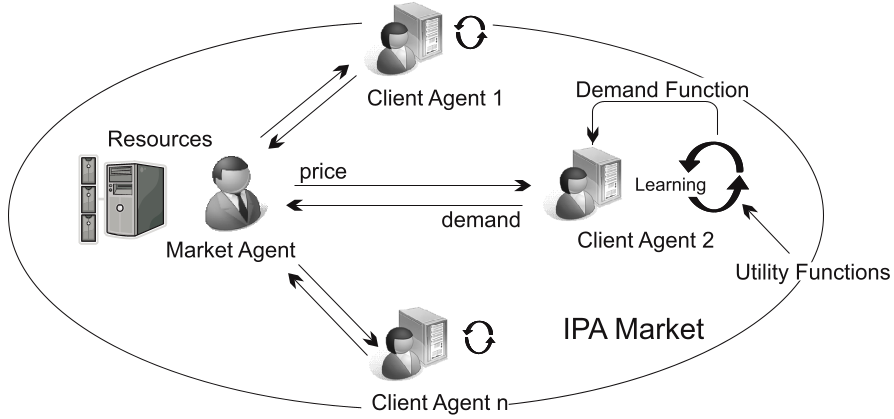 Figure 1: The interaction loop between RL agents and the IPA facilitator.
Experiments & Game Theory Insight
The researchers scaled the experiments from 2 up to 8 agents. Two major breakthroughs emerged:
- Efficiency: Stability was reached within 1,000 episodes, debunking previous assumptions that required nearly half a million episodes.
- Symmetry: Surprisingly, agents rewarded for individual gain behaved almost identically to those rewarded for social welfare. Both groups naturally converged on an equal share of the resources.
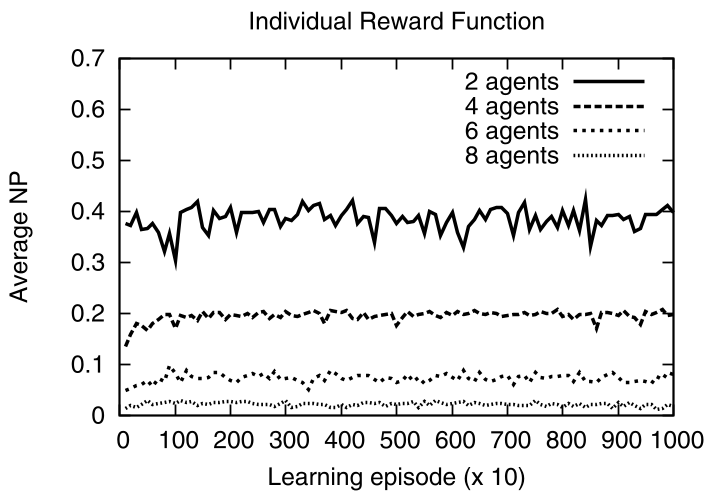 Figure 2: Average Social Welfare (Nash Product) across learning episodes for 2, 4, 6, and 8 agents.
Why does this happen? (The Game Theory Reveal)
To explain this, the authors simplified the market into a "Stage Game" (a single-state payoff table).
- In the Social Game, equal sharing is the only Nash Pareto-Optimal equilibrium.
- In the Individual Game, multiple equilibria exist, but Q-learning’s exploration-exploitation cycle naturally gravitates toward the "fair" middle ground because it provides the most consistent long-term reward.
Critical Analysis & Conclusion
Takeaway
The core contribution of this paper is the evidence that in a commodity market with symmetric agents, individual RL is "Socially Sufficient." You don't need to force agents to care about the group; under the IPA mechanism, their self-interest eventually steers them toward a socially optimal balance.
Limitations & Future Work
While the results are robust for symmetric agents, real-world markets are rarely equal. What happens if one agent has 10x the budget? Or if the resource supply changes dynamically? The authors acknowledge that the current IPA model doesn't account for complex Resource Providers (sellers) who might manipulate the supply.
Future research needs to tackle these "asymmetric" scenarios to see if the "equal-sharing" harmony holds or if the market devolves into a winner-takes-all game.
Academic Positioning: This paper serves as a vital bridge between empirical Multi-Agent RL (MARL) and classical Game Theory, providing a theoretical justification for RL success in market-based systems.