
Beyond the Tracker: Decoding the Invisible Labor of Migraine Management
Individual and Social Recognition: Challenges and Opportunities in Migraine Management
This study investigates the personal and social management of chronic migraines, an unpredictable and intermittent condition. Published in CSCW '15, the research highlights the necessity of "self-recognition" and "social recognition," proposing technology designs that move beyond simple tracking to support multi-faceted sense-making and social assistance coordination.
TL;DR
Migraine management is not just about tracking headaches; it is a complex form of "invisible work" involving intense self-discovery and social negotiation. This research from CSCW '15 argues that because migraines are unpredictable and intermittent, current health technologies—which focus on persistent conditions like diabetes—fail to support the subjective sense-making and social assistance patients actually need.
Context: A Disease of Intermittency
Most HCI research on chronic illness focuses on diseases where the impact is constantly present. Migraines, however, are chronic-episodic. They vanish for weeks and then strike with debilitating force. This "now-you-see-it, now-you-don't" nature creates a unique psychological and functional burden that the authors, Sun Young Park and Yunan Chen, explore through deep qualitative inquiry.
The "Diagnostic Agent": Why Tracking is Harder Than It Looks
The paper identifies that migraine patients must act as their own "diagnostic agents." Because clinicians often cannot observe the symptoms during a visit, the burden of proof falls entirely on the patient.
1. The Trigger Puzzle
Identifying triggers is a "labor-intensive process" of hypothetical-deductive reasoning. Triggers are rarely single items; they are often combinations (e.g., stress + hot weather + red wine).
- The Insight: Patients aren't just "counting" events; they are trying to link temporally disconnected episodes—connecting a headache today to a weather pattern from last summer.
2. Subjective Metrics
Standard 1-to-5 scales for pain or stress often fail. A patient’s "Level 3" stress might be a "Level 5" depending on their mood or sleep quality. The paper suggests that systems must allow for personalized, subjective tracking features (e.g., "meeting with the boss" as a metric rather than just "high stress").
 Figure 1: Patients develop highly localized, physical strategies like specific stretching or "emergency kits" that go beyond digital tracking.
The Social Dilemma: "Just a Headache?"
One of the most profound insights of the study is the distinction between Individual Recognition and Social Recognition.
- The Invisible Pain: Because symptoms like auras or nausea are internal, coworkers and peripheral social circles often trivialize the condition.
- The Disclosure Paradox: Patients with mild or intermediate symptoms often hide their condition, calling in "sick" rather than "migraine" to avoid the stigma of being perceived as "lazy."
The authors provide a breakdown of these diverse triggers and symptoms that complicate social communication:
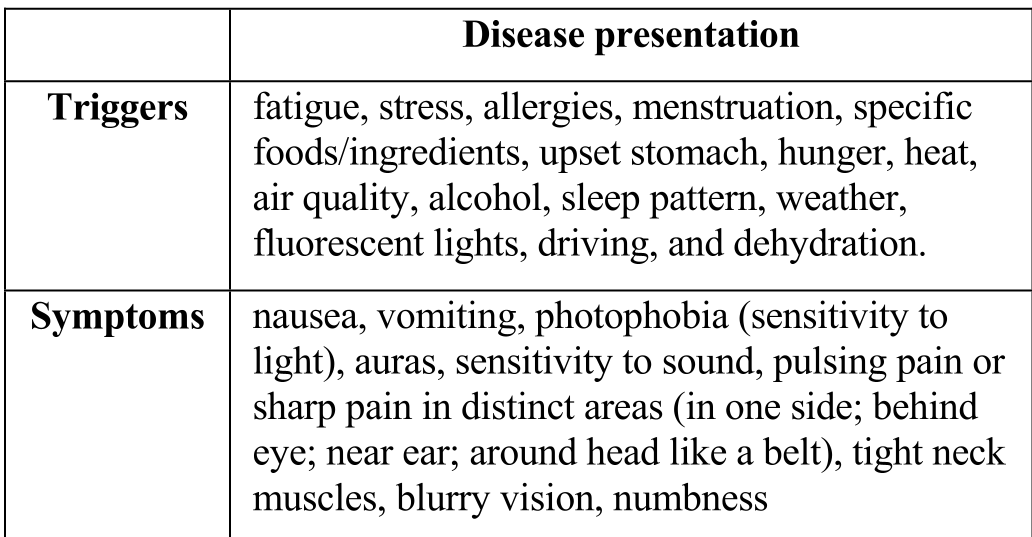 Table 1: The sheer variety of triggers makes it nearly impossible for non-sufferers to understand the patient's environment.
Design Opportunities for Future AI & Health Tech
The research concludes with several "provocations" for how we should build the next generation of health tools:
- Sustainable Association: Instead of just logging data, AI should proactively look back years into a user's history to find correlations between "separate" episodes (e.g., "You tend to get migraines when the temperature hits 90 degrees after a low-sleep week").
- Status Delivery Systems: We need tools that help coordinate help during an attack. A "Migraine Status" could automatically alert family to pick up the kids or tell coworkers that a meeting needs to be rescheduled, without the patient having to explain themselves while in pain.
- Engaging the "Underwater" Population: We must design for the 90% of sufferers who are undiagnosed or have mild symptoms, helping them solve their "puzzle" before the condition progresses.
Critical Perspective: The Gap in 2024
While this paper was written in 2015, the "Quantified Self" movement has evolved, yet many of these gaps remain. Current wearables (like Oura or Apple Watch) track physiological data well, but they still struggle to integrate the contextual and subjective life events that this paper identifies as the "smoking gun" for migraine triggers.
Conclusion
Migraine management is a collaborative effort between the self and the social network. By shifting our focus from "monitoring" to "sense-making" and "social coordination," we can move from simple trackers to truly supportive health ecosystems.
Main Citation: Park, S.Y. & Chen, Y. (2015). Individual and Social Recognition: Challenges and Opportunities in Migraine Management. CSCW '15.