
From Individuals to Populations: Bridging Process Algebra and Epidemiology
From Individuals to Populations: A Symbolic Process Algebra Approach to Epidemiology
The paper introduces a symbolic approach to epidemiology by bridging individual-based models and population dynamics using the Weighted Synchronous Calculus of Communicating Systems (WSCCS). It presents a rigorous rewriting method (the Stirling method) to automatically derive Mean Field Equations (MFEs), which are deterministic ODE-like approximations of stochastic individual interactions.
TL;DR
This research provides a rigorous framework to translate individual-based stochastic models into population-level deterministic equations. By using the WSCCS process algebra, the authors show that traditional equations like the Logistic and Beverton–Holt models aren't just arbitrary choices—they are the natural mathematical outcomes of specific individual interaction rules. The methodology was validated by accurately fitting the spread of HIV in the UK.
Problem & Motivation: The Gap in Modeling
Epidemiologists traditionally face a trade-off:
- Top-Down (ODEs): Easy to analyze symbolically but rely on "transmission rates" that are hard to measure and often oversimplify how individuals actually interact.
- Bottom-Up (Simulations): Capture realistic individual behavior but are computationally expensive and act as "black boxes" that are hard to analyze algebraically.
The authors' insight is to use Process Algebra as a middle ground. It allows for the precise, symbolic description of an individual (e.g., "how likely am I to get sick if I meet an infected peer?") and then uses a formal rewriting method to "zoom out" to the population level.
Methodology: The Stirling Method
The core of the paper is the transformation of WSCCS (Weighted Synchronous Calculus of Communicating Systems) into Mean Field Equations (MFEs).
1. Model Definition
An individual's life cycle is defined by actions (), probabilistic choices (), and parallel compositions (). For example, a birth/death process looks like this:
2. The Transition Table
The authors construct a table that relates agent states at time to their expected states at . This replaces expensive state-space exploration with a symbolic calculation of "entry" and "exit" activities.
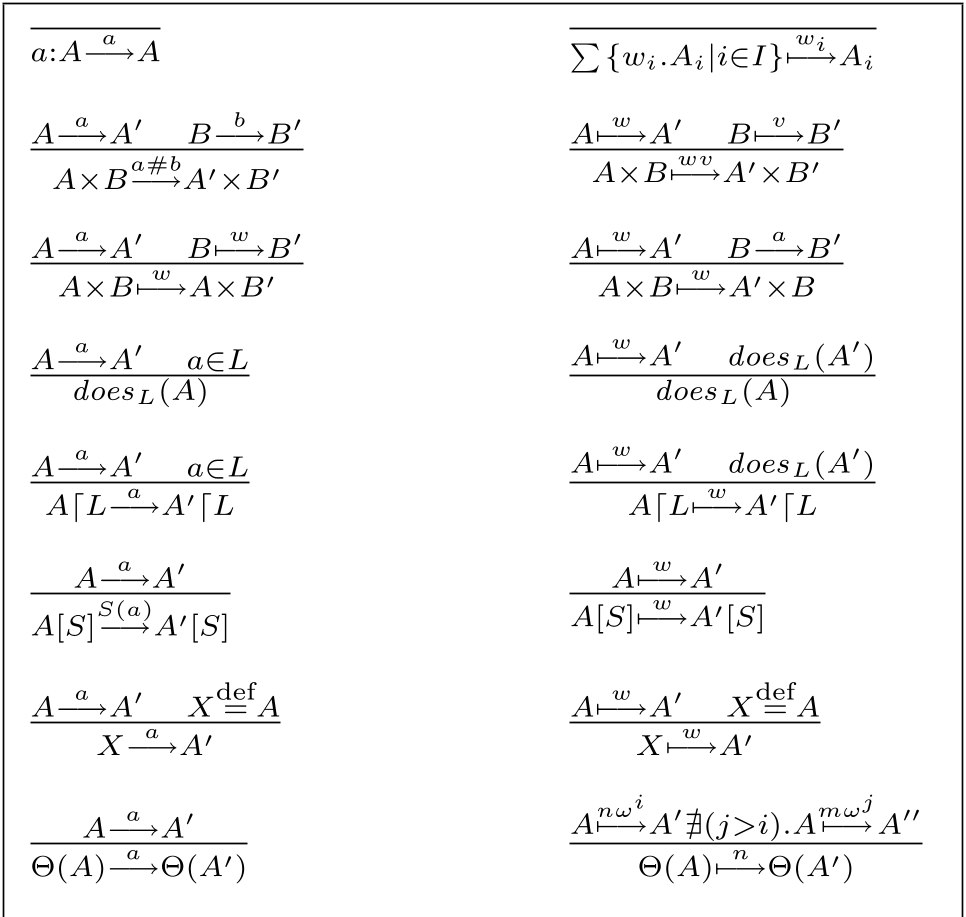
Table 1: The formal operational semantics used to derive system transitions.
3. Handling Resources
The paper uniquely models density dependence (population limits) by either:
- Functional Probabilities: Making or functions of the current population size.
- Explicit Resources: Introducing "Resource Agents." If an individual fails to synchronize with a resource agent (representing food or space), they die or fail to reproduce.
Experimental Results: Fitting Reality
The authors don't just stop at theory; they apply their derived MFEs to UK HIV data. By setting parameters for birth rates from national statistics, they used the MFEs to calculate the transmission probability ().
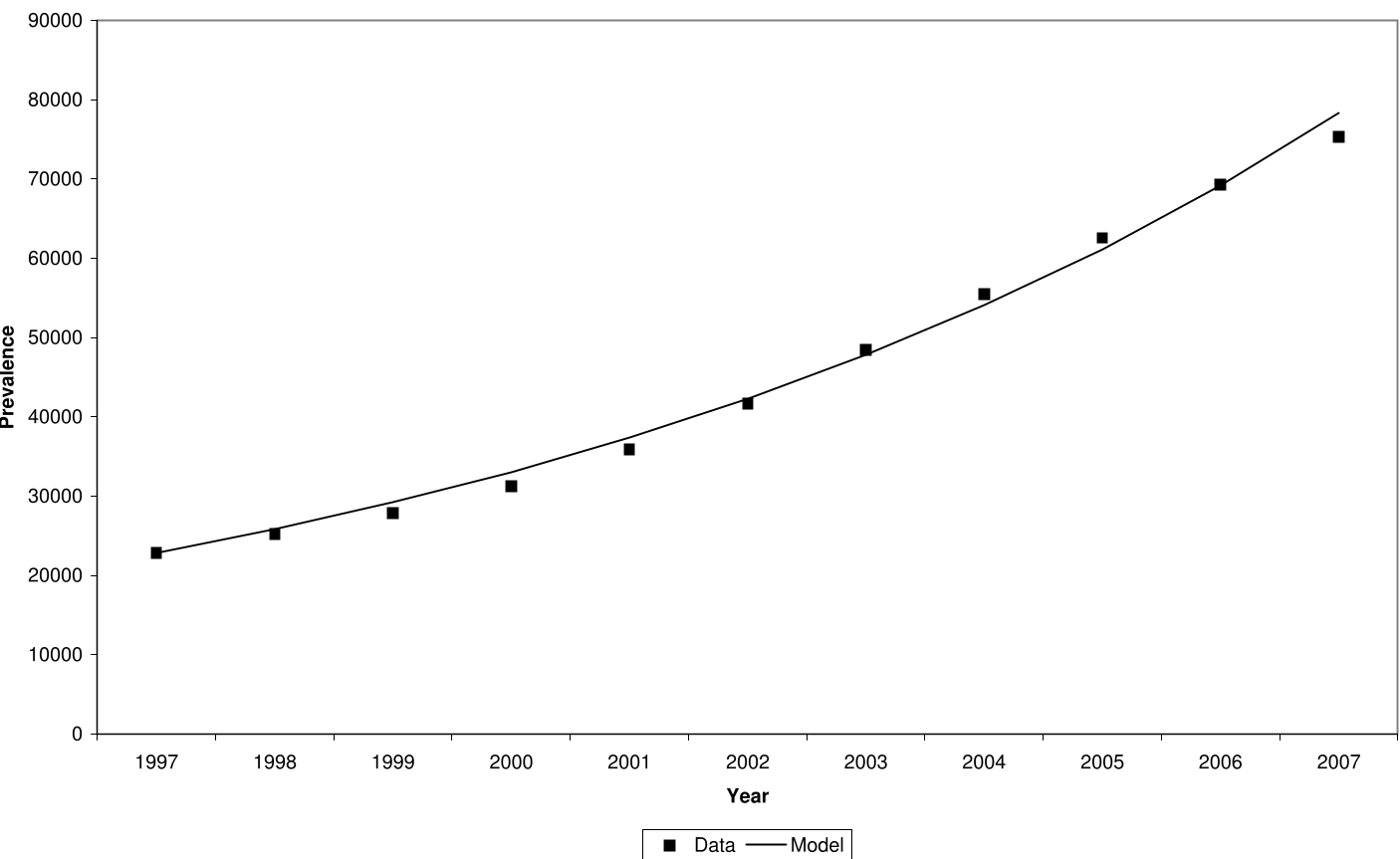
Figure 7: The derived Mean Field Equation (solid line) shows a remarkable fit to the actual HIV infection data (crosses) from 1997 to 2007.
Key finding: Even with a simple model where individuals make only one "infectious contact" per year, the formal MFE derived from individual rules captured the epidemic's trajectory better than many purely empirical models.
Critical Analysis & Takeaways
The brilliance of this work lies in its modular nature. If a biologist discovers a new behavioral trait in individuals, the modeller simply updates the process algebra agent definition, and the population-level ODEs are automatically updated via the Stirling method.
Limitations:
- Well-mixed assumption: The current MFEs assume everyone can interact with everyone (frequency dependence). It doesn't yet account for complex social networks or spatial structures.
- Discrete steps: The discrete-time nature of WSCCS might miss dynamics that occur at high frequencies in continuous time.
Conclusion: This paper is a cornerstone for Computational Biology. It proves that the "magic" parameters in our population models actually have a traceable, symbolic genealogy starting from the single individual. It invites future researchers to apply this "rewriting" logic to even more complex systems, such as multi-modal disease spread or socio-technical networks.