
IDESC: Pioneering Naturalistic Emotional Speech Recognition for Indonesian
Construction and analysis of Indonesian Emotional Speech Corpus
The paper introduces the Indonesian Emotional Speech Corpus (IDESC), the first naturalistic emotional speech dataset for the Indonesian language. It comprises over 1.5 hours of audio segmented into 2,179 utterances labeled with five discrete emotion categories, derived from real-world television talk shows.
TL;DR
Researchers from Institut Teknologi Bandung and Nara Institute of Science and Technology have developed IDESC (Indonesian Emotional Speech Corpus). This is the first corpus of its kind for the Indonesian language, moving away from "acted" emotions toward naturalistic, real-world data captured from diverse television talk shows. With over 2,000 segments, it provides a critical foundation for building Indonesian-speaking AI that can truly understand human sentiment.
The Motivation: Why "Acted" Emotion Isn't Enough
For years, the field of Affective Computing has struggled with a "reality gap." Most datasets used to train Emotion Recognition systems rely on professional actors. While actors can portray intense emotions, these performances are often stereotypical and lack the subtle prosodic shifts found in daily human-computer interaction (HCI).
In the context of the Indonesian language, the problem was even more severe: research was almost non-existent because there was no high-quality, labeled audio data to work with. The authors of IDESC sought to solve both the resource scarcity and the "naturalness" problem simultaneously.
Methodology: From Talk Shows to Labeled Data
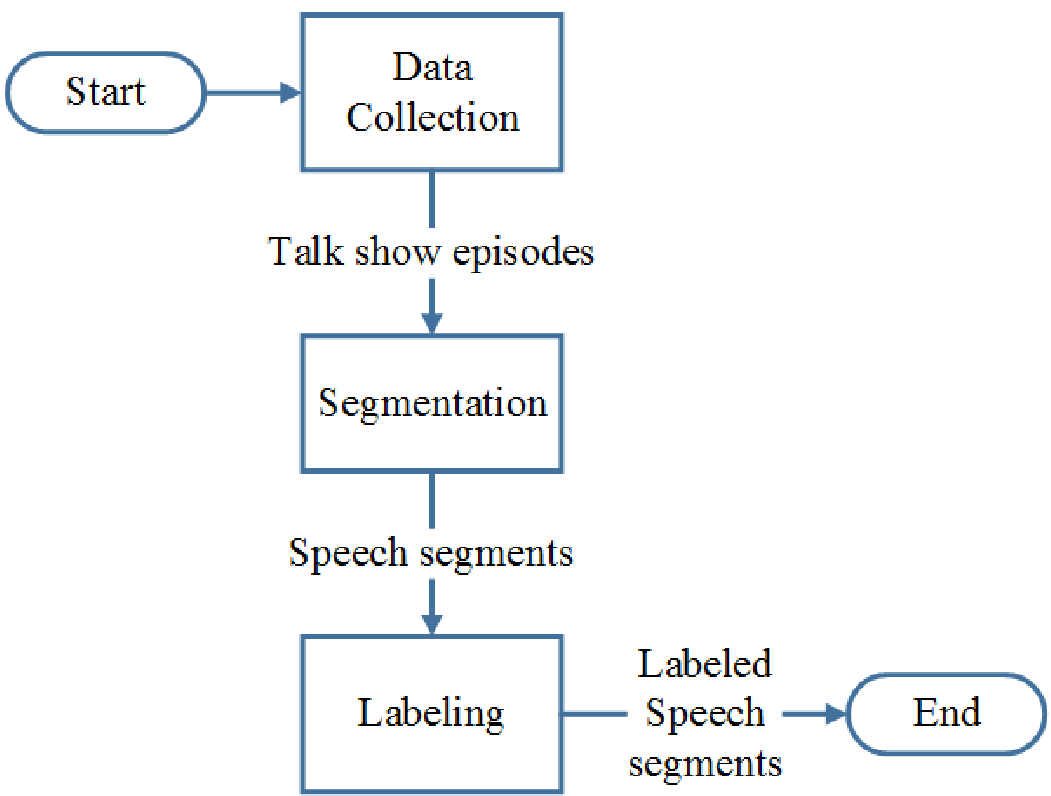
The construction of IDESC followed a rigorous three-step pipeline:
- Diverse Data Collection: Instead of a lab setting, the authors used audio from three popular Indonesian talk shows:
- Mata Najwa (Politics - high conflict/debate potential).
- Kick Andy (Humanity - focus on empathy and sadness).
- Just Alvin (Entertainment - casual and varied).
- Precision Segmentation: To avoid "emotion drift," the audio was manually segmented into 2,179 parts where each segment contains a single, consistent emotion. The average segment duration was found to be roughly 2.6 seconds, highlighting how quickly affective states shift in natural dialogue.
- Multi-Annotator Labeling: Five native speakers labeled the data across five categories: Neutral, Happiness, Anger, Sadness, and Contentment.
Key Insights & Experimental Results
The analysis of IDESC provides fascinating insights into how we perceive emotion:
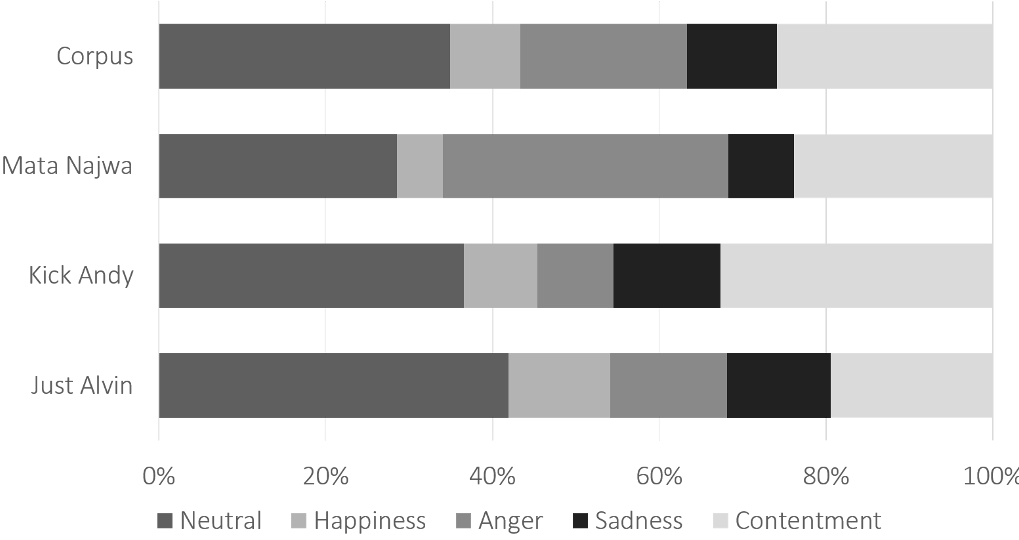
- Active vs. Passive Recognition: Annotators agreed most strongly on Anger (Fleiss’ Kappa = 0.55), while Neutrality was the hardest to agree upon (Kappa = 0.28). This suggests that high-arousal emotions have much clearer acoustic signatures than subtle or "flat" speech.
- Topic-Emotion Correlation: The study confirmed that the context of a conversation dictates the emotion. Mata Najwa (Politics) yielded the most negative-active emotions, while Kick Andy (Humanity) produced more passive-positive states like contentment.
- Segment Distribution: Most emotional expressions are brief, peaking between 1.0 to 1.5 seconds, which is a critical design consideration for future real-time emotion recognition algorithms.
Critical Analysis & Future Outlook
The primary strength of IDESC is its ecological validity—these are real people having real conversations. However, as the authors admit, the corpus is in its early stages. The current dataset size (1.5 hours) is small for modern deep learning (like Wav2Vec 2.0 or Whisper fine-tuning), and the labels are slightly imbalanced toward neutral and passive-positive states.
What's next? The researchers plan to expand the corpus with more speakers and more detailed transcriptions. For the broader AI community, IDESC serves as a blueprint for creating emotional datasets in other "low-resource" languages by leveraging the rich, naturalistic data already available in broadcast media.
Academic Reference: Lubis, N., Lestari, D., Purwarianti, A., Sakti, S., & Nakamura, S. (2016). Construction and Analysis of Indonesian Emotional Speech Corpus. Proceedings of the Institut Teknologi Bandung / NAIST.