
The Invisible Wall: Why Context-Blind Crowdsourcing Fails Mobile Coverage Analysis
Impact of Indoor-Outdoor Context on Crowdsourcing based Mobile Coverage Analysis
This paper investigates the impact of indoor/outdoor context on mobile network crowdsourcing, using a massive dataset of 8 million measurements from London and controlled validation experiments. It demonstrates that failure to distinguish between these contexts leads to significant bias in signal strength (RSSI) analysis, affecting the reliability of coverage maps.
TL;DR
Crowdsourcing has revolutionized how we map mobile coverage, but it has a "blind spot": it doesn’t know if you are inside or outside. This paper from SIGCOMM '15 reveals that mixing these two data streams (conflation) creates a distorted reality where outdoor signals look worse than they are and indoor dead zones are glossed over. By analyzing 8 million data points, the authors prove that a 15dBm "context gap" exists, necessitating a move toward context-aware sensing.
The "Conflation" Crisis in Network Mapping
Mobile operators and regulators (like Ofcom) increasingly rely on crowdsourced apps to determine where to invest in infrastructure. However, the industry has long ignored a fundamental variable: the user's environment.
The author's core insight is that spatial aggregation—grouping measurements by postcode or grid square—is dangerous without context. Because humans spend ~80% of their time indoors, "average" signal strength measurements are heavily biased toward indoor values. This leads to a paradoxical result where a network might provide "excellent" outdoor coverage, but the crowdsourced map shows "fair" or "poor" because it's being "polluted" by measurements taken behind thick concrete walls.
Methodology: Bridging Big Data and Ground Truth
To prove this bias, the researchers took a two-pronged approach:
- Macro Analysis: They used an OpenSignal dataset covering 58 sq. km of central London. Since the data lacked "indoor/outdoor" labels, they used a GPS-fix heuristic: if a GPS lock was acquired, the measurement was "Outdoor"; otherwise, it was "Indoor."
- Micro Validation: They developed a custom app to collect 5,000 ground-truth records in Edinburgh, where users manually tagged their location.
Architecture of the Problem
The study focused on RSSI (Received Signal Strength Indicator) for 3G networks. As seen in the architecture of their analysis, cell sectors provide the most valid granularity for comparison.
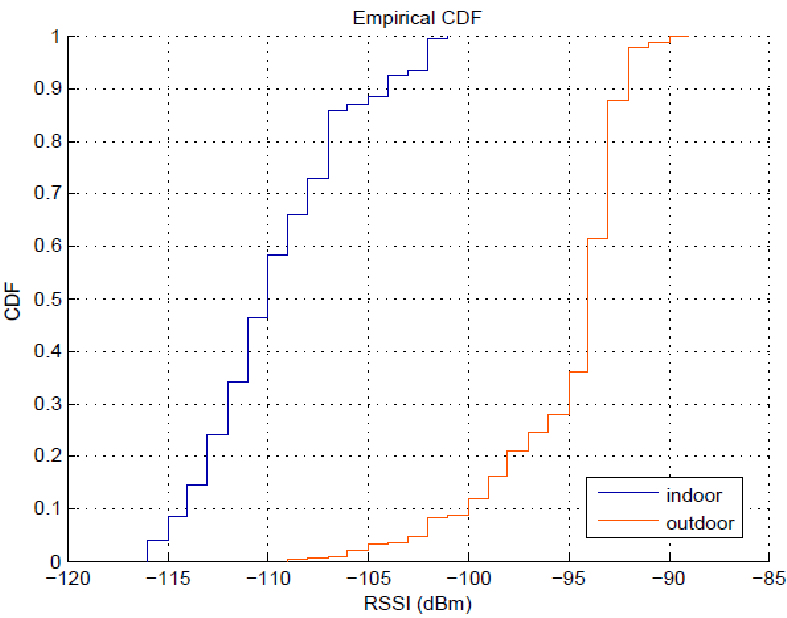 Figure 1: The clear demarcation between indoor and outdoor signal distributions, with a median gap often exceeding 15dBm.
Key Findings: The 15dBm Gap
The results were striking across the board. In specific cell sectors, the median RSSI for outdoor users approached "Excellent" thresholds (>-91.7dBm), while indoor users in the same sector were often below the "Poor" threshold (<-105.5dBm).
- The Aggregation Bias: When "combined" (the orange bars in Figure 2), the data almost always mirrored the indoor performance due to the higher volume of indoor samples.
- The Postcode Risk: The authors mapped specific London postcodes (like SE1 0XN). When conflated, the area appeared "Fair." When split, the outdoor map turned "Excellent" while the indoor map turned "Poor." This distinction is critical for emergency services (E-911) and urban planning.
 Figure 2: Performance differences across 25 cell sectors, highlighting how combined metrics mask the true outdoor performance.
Critical Insight: The Energy-Context Paradox
The paper highlights a major hurdle for the future of crowdsourcing: Energy Efficiency.
- GPS is the gold standard for location but drains battery rapidly.
- Network-based location is efficient but imprecise (error margins of 100s of meters).
The authors argue that we cannot rely on GPS for context detection if we want users to keep these apps running. They advocate for Semi-Supervised Learning approaches that use low-power sensors (light, magnetic fields, and battery temperature) to detect whether a user is indoors or outdoors without waking up the power-hungry GPS radio.
Conclusion & Future Outlook
This work serves as a formal warning to the mobile measurement community: averaging data without context is a form of signal corruption.
As we transition into 5G (and eventually 6G), where signal attenuation from building materials is even more punishing due to higher frequencies (mmWave), the lessons of this 2015 study become even more urgent. Future crowdsourcing systems must be "context-first" to provide an honest picture of our connected world.
Limitations: The study primarily looks at 3G (1900/2100 MHz). Lower frequency bands (like 700/800 MHz) used in modern LTE/5G may penetrate buildings better, potentially narrowing—but not eliminating—the context gap.