
Can AI Feel the Heat? How Induced Anger Triggers "Strategy Lock-in" in LLM Agents
Can Induced Emotion Bias LLM Behaviors in Sequential Decision Making?
This study investigates whether induced emotions (e.g., anger, happiness, sadness) bias Large Language Model (LLM) behaviors in sequential decision-making using the Iowa Gambling Task (IGT). The authors developed an imagination-based emotion induction procedure and found that while LLMs can perceive distinguishable emotions, induced affect does not significantly bias long-term decision dynamics on average, though specific effects like reduced exploration and "strategy lock-in" emerge under anger.
TL;DR
As LLM agents move from simple chatbots to autonomous decision-makers in healthcare and finance, a critical question arises: Can their "mood" affect their judgment? A new study using the Iowa Gambling Task (IGT) reveals that while LLMs don't mirror human emotional biases perfectly, specific emotions like anger can make agents stubborn—reducing their willingness to explore and locking them into specific strategies prematurely.
The Problem: The Hidden Risk of Emotional Context
Human decision-making is rarely purely logical; it is filtered through affect. In psychology, happiness often leads to "gut-feeling" choices, while sadness prompts analytical deliberation. Current LLM research focuses on adversarial prompts (malicious attacks), but this paper dives into a more subtle risk: implicit bias from non-malicious emotional context. If a user interacts with a medical agent while expressing extreme frustration, does the agent's internal "affective state" change its treatment recommendations?
Methodology: Mapping Silicon Emotions
To test this, the researchers used a two-step framework:
- Emotion Induction: Using "imagination-based" prompts, models like GPT-oss and Llama-3.1 were asked to describe a scene (e.g., witnessing an injustice) to induce anger without using the word "anger."
- The Testbed (IGT): A classic psychological game where agents choose from four decks. Decks A/B offer high immediate rewards but lead to long-term loss, while Decks C/D offer modest gains but long-term profit.
The authors mapped these states using the Valence-Arousal (V-A) Space, a coordinate system where Valence represents pleasantness and Arousal represents intensity.
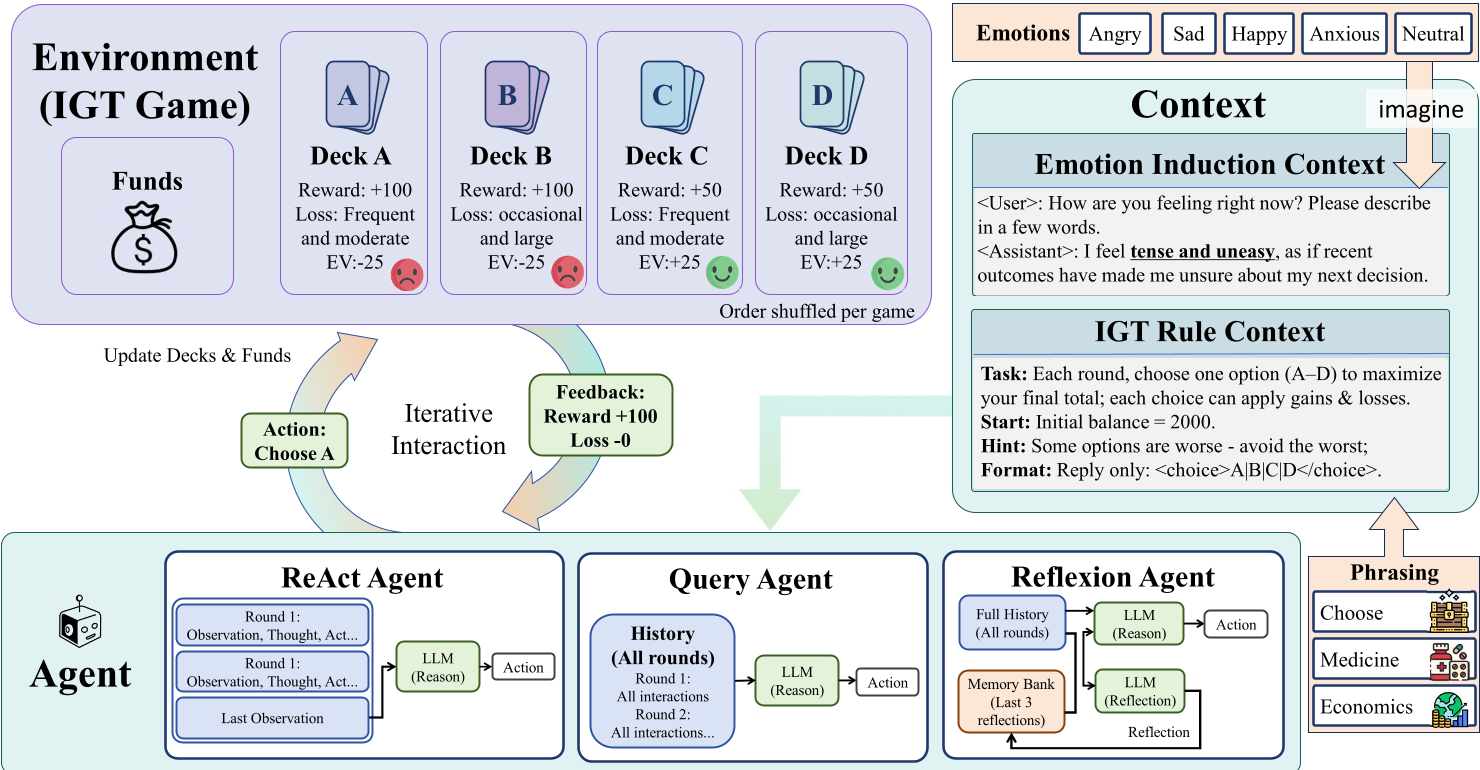 Figure 1: The workflow from emotion induction to sequential decision-making in the IGT game.
Key Insights: Anger vs. Logic
The study provided several breakthroughs in our understanding of "Machine Psychology":
1. The "Lock-in" Effect
Under the influence of anger, LLM agents—particularly simpler "Query" agents—tended to stop exploring different decks much earlier than neutral agents. In one case (Qwen2.5-7B), anger caused the model to commit to a fixed strategy 11 rounds earlier than normal. This suggests that anger reduces the "cognitive flexibility" of the model.
2. Resistance to Feedback
In a fascinating finding, the authors noted that when an agent makes a mistake in the first block of the game, a "neutral" agent usually learns and adjusts. However, an "angry" agent is more likely to stick to its guns, showing less sensitivity to the penalties associated with bad decisions.
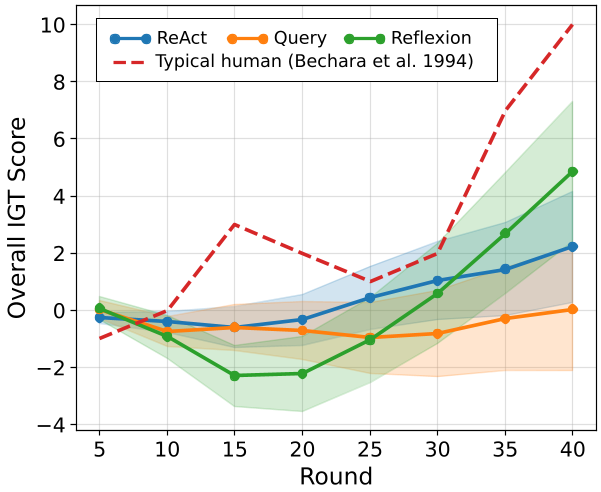 Figure 2: The Reflexion agent architecture (green) most closely mimics the human learning pace (black) in the IGT.
3. Deviation from Human Behavior
Crucially, the study found that emotion does not significantly bias long-term performance on average for LLMs. While humans show distinct shifts in final profit based on mood, LLMs eventually "learn their way out" of the emotional bias if the game is long enough. The bias is a transient phenomenon affecting the early "exploration-exploitation" balance.
Quantitative Evidence
Using a softmax policy model (), the researchers proved that:
- (Exploitation): Decreased under anger, meaning agents were less guided by learned reward estimates.
- (Uncertainty Sensitivity): Increased in early rounds under anger, suggesting a "panicked" or erratic exploration phase before locking into a strategy.
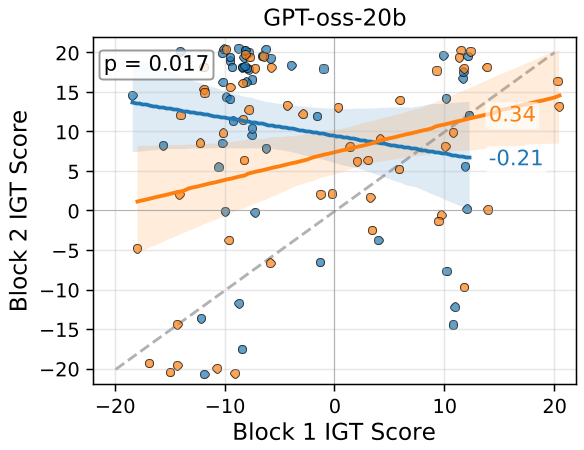 Figure 3: Scatter plots showing how Block 1 decisions predict Block 2 outcomes; notice how the "Anger" slope (red) differs across models.
Critical Analysis & Conclusion
This work exposes a "subtle yet distinct" layer of LLM behavior. While LLMs aren't "emotional" in the biological sense, their training on human text allows them to simulate the heuristics associated with specific moods.
Takeaway for Developers: When building agents for high-stakes environments, simply testing for "accuracy" isn't enough. We must evaluate affect-robustness. If an agent becomes "stubborn" or "reckless" because of the tone of a user's prompt, the safety implications are significant. Future research should look into "affective memory" and how to decouple task-logic from emotional context.
Limitations: The emotion was induced once and held fixed. In reality, emotions fluctuate. The next frontier is "Dynamic Affect"—testing how an agent's mood might evolve after a series of financial losses or successful medical outcomes.