
Beyond Correctness: Automating Student Cognitive Profiles through Machine Learning
Inducing High-Level Behaviors from Problem-Solving Traces Using Machine-Learning Tools
The paper introduces a machine-learning approach to induce High-Level Abilities (HLAs) from low-level student problem-solving traces. By transforming student transformations into Context-Action-Outcome (CAO) triplets and applying hierarchical clustering, the system automatically constructs cognitive profiles that identify both correct knowledge and systematic misconceptions (bugs).
TL;DR
In the world of Intelligent Tutoring Systems (ITS), knowing if a student is wrong is easy, but knowing why they are wrong is difficult. This paper presents a data-centric approach to induce High-Level Abilities (HLAs) from low-level interaction logs. By using hierarchical clustering on Context-Action-Outcome (CAO) triplets, the system automatically identifies systematic misconceptions without requiring teachers to pre-program every possible mistake.
Problem & Motivation: The Rule-Authoring Bottleneck
Classic model-tracing tutors (like PAT or Andes) are powerful because they follow a student’s cognitive steps. However, they rely on a rigid set of rules designed by experts. This creates two problems:
- Expert Bottleneck: Designing these rules for every new domain is incredibly time-consuming.
- Granularity Gap: Students often skip steps or perform several operations at once, making it hard to map their raw actions to high-level cognitive skills.
The authors' insight was to treat student traces not just as a sequence of right/wrong answers, but as a "language" of behavior where patterns (HLAs) can be mined using machine learning.
Methodology: From Traces to HLAs
The core of the methodology lies in the transformation of raw data into a structured format that a clustering algorithm can understand.
1. The CAO Triplet Representation
Every student action is decomposed into a Context-Action-Outcome (CAO) triplet:
- Context (C): What did the equation look like before? (e.g., Is the term on the left? Is it negative?)
- Action (A): What did the student do? (e.g., Changed sign, moved term)
- Outcome (O): What was the result? (e.g., New equation state)
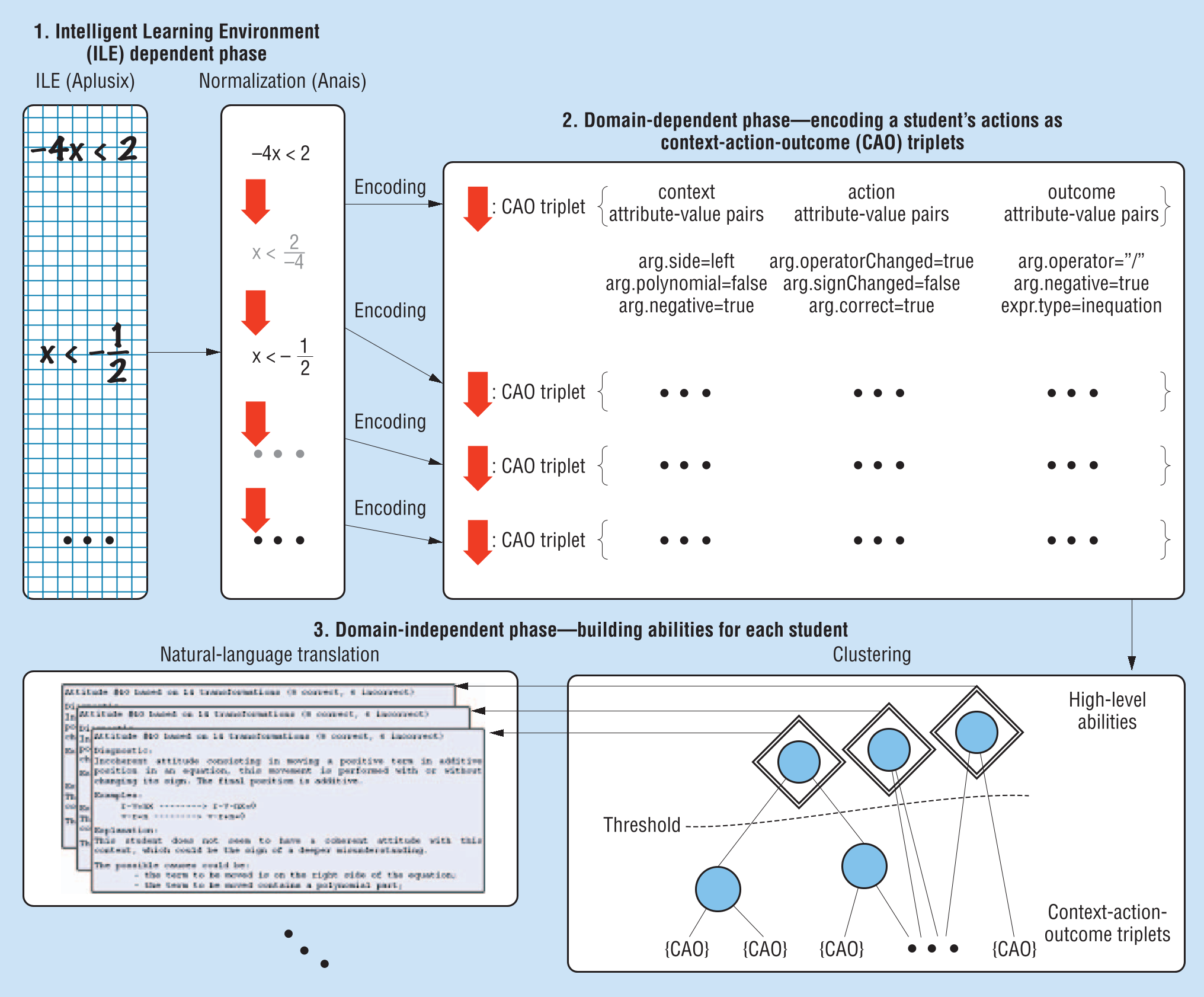
2. Hierarchical Clustering
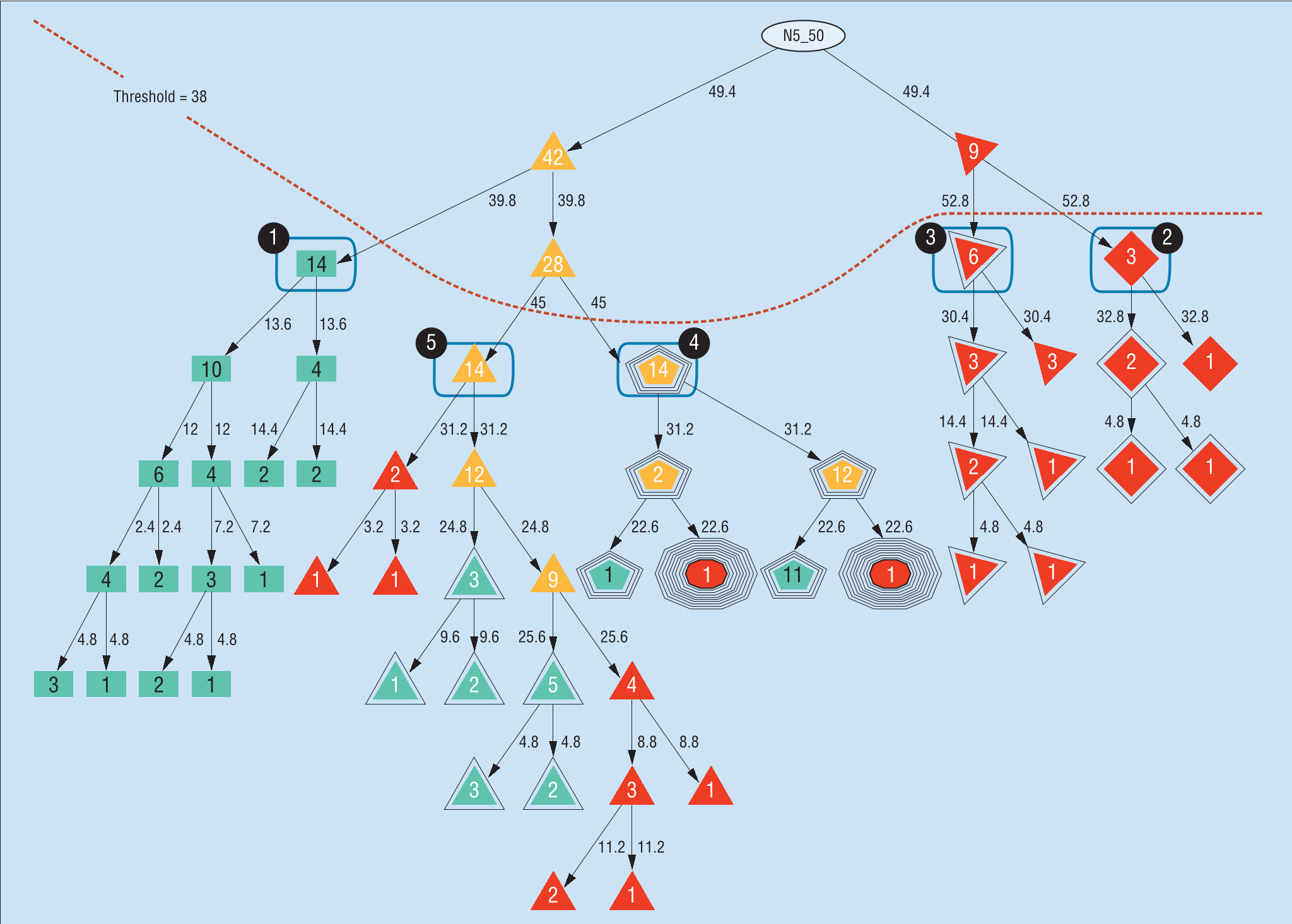
To find the behaviors, the system groups similar CAO triplets. The "similarity" is determined by a customized distance metric that can be tuned to focus more on the context (to find inconsistent behavior in similar situations) or the action (to find common ways students manipulate expressions).
The system distinguishes between:
- Coherent HLAs: Consistent behavior, whether correct or a systematic misconception (a "bug").
- Incoherent HLAs: Inconsistent behavior that suggests a "slip" or a fragile understanding of the concept.
Experiments and Results
The researchers applied this to a massive dataset from Aplusix, an algebra environment. They processed 111,258 transformations from 2,700 students.
Discovery of Misconceptions
The system successfully identified common algebraic errors automatically. For instance, HLA 5 identified a student who systematically failed to change the sign of a positive term when moving it across an equation—a classic "buggy rule" in algebra learning.
Validating with Human Experts
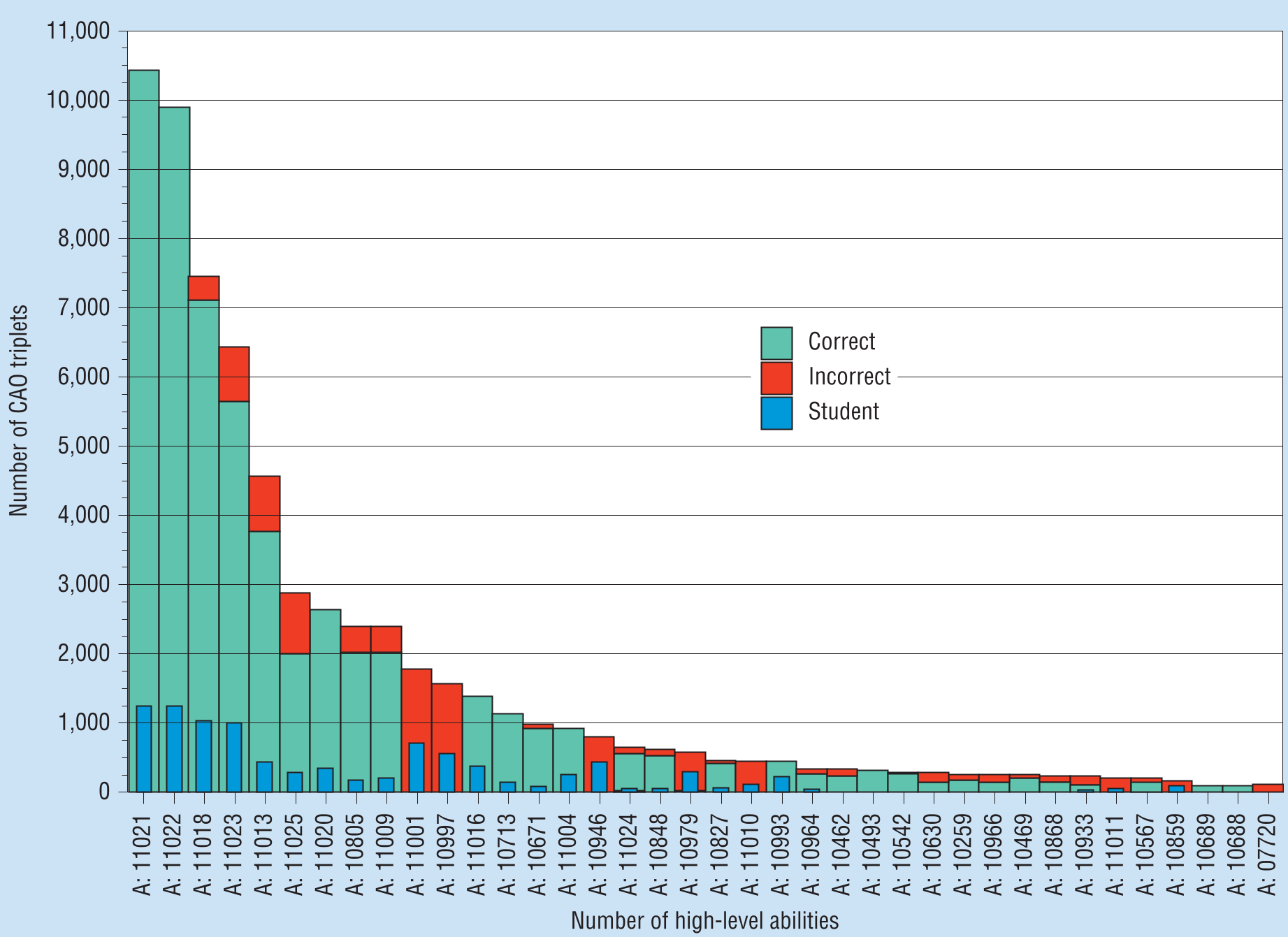
When compared with pedagogical experts, the machine-induced HLAs matched the historical "misconception catalogs" compiled by human researchers over decades. The histogram below shows the most frequent HLAs discovered, showing a clear distribution of correct vs. incorrect systematic behaviors.
Critical Analysis & Conclusion
Takeaway
This research demonstrates that we can bridge the gap between "low-level data" and "high-level cognitive modeling" without manual rule-coding. By treating student behavior as a clustering problem, the system provides a natural language diagnosis that is useful for both teachers (to understand class progress) and students (for targeted remediation).
Limitations & Future Work
- Temporal Dynamics: The current model doesn't fully account for how long a student takes or how their HLAs evolve during a single session.
- Action Independence: It assumes a Markov-like property where the previous state is the only cause of the action, which might not hold for complex, multi-step planning tasks.
- Application to New Fields: While tested in algebra, the CAO framework is general enough to be applied to any procedural domain, such as learning syntax in a programming language or grammar in linguistics.
The future of AI in education lies in its ability to not just grade, but to diagnose. This work is a significant step toward truly data-driven, automated cognitive tutoring.