
Industry 4.0 Briefcase: Bridging the Gap Between the Classroom and the Smart Factory
Industry 4.0 Briefcase: An Innovative Engineering Outreach Project for Professions of the Future
The paper introduces "Industry 4.0 Briefcase," an innovative engineering outreach project designed for undergraduate students to bridge the gap between theoretical academic knowledge and Fourth Industrial Revolution (I4.0) technologies. By integrating machine learning, data mining, and industrial automation through a one-week intensive mixed-methods program, the project achieved high student engagement and clear educational gains.
TL;DR
The "Industry 4.0 Briefcase" project is a targeted educational intervention designed to prepare undergraduate students for the "Professions of the Future." By condensing complex topics like Machine Learning, Data Mining, and Industrial Automation into a one-week intensive program, researchers at Ege University successfully raised student technical proficiency and career motivation, achieving satisfaction rates of over 95%.
Problem & Motivation: The "Silo" Trap in Engineering Education
Despite the rapid global shift toward Industry 4.0, higher education often remains trapped in specialized silos. Computer scientists understand algorithms, while business students understand supply chains, but neither group is frequently given the chance to see how these worlds collide in a smart factory.
The authors argue that existing outreach models—typically "Robot Camps"—target younger students and lack the depth required for the professional world. There is an urgent need for interdisciplinary, high-intensity modules that force students to apply theory to real-world industrial data in collaborative environments.
Methodology: The "Briefcase" Framework
The core philosophy of the "Briefcase" is the integration of multiple I4.0 pillars into a single, portable educational experience. The project utilized a mixed-methods approach, balancing quantitative mini-projects with qualitative digital feedback loops.
The 5-Day Intensive Pipeline:
- Foundations: Product Lifecycle Management (PLM) and I4.0 theory.
- Intelligence: Data mining using "Basket Analysis" on retail data.
- Operation: Industrial automation and SCADA systems (Human-Machine Interface).
- Prediction: Machine learning and regression models for supplier selection.
- Reality: A technical visit to a German textile factory implementing I4.0 at scale.
 Figure 1: The daily academic and practical workflow of the project.
Experiments & Results: High Success in "Learning by Doing"
The results from the 18 participants (drawn from Computer Engineering and Management Information Systems) were overwhelmingly positive.
Quantitative Success
Students didn't just attend; they produced results. The mini-projects required them to generate reports and solve actual datasets.
- Industrial Automation: 95% average success rate.
- Data Mining: 91% average success rate.
- Machine Learning: 89% average success rate.
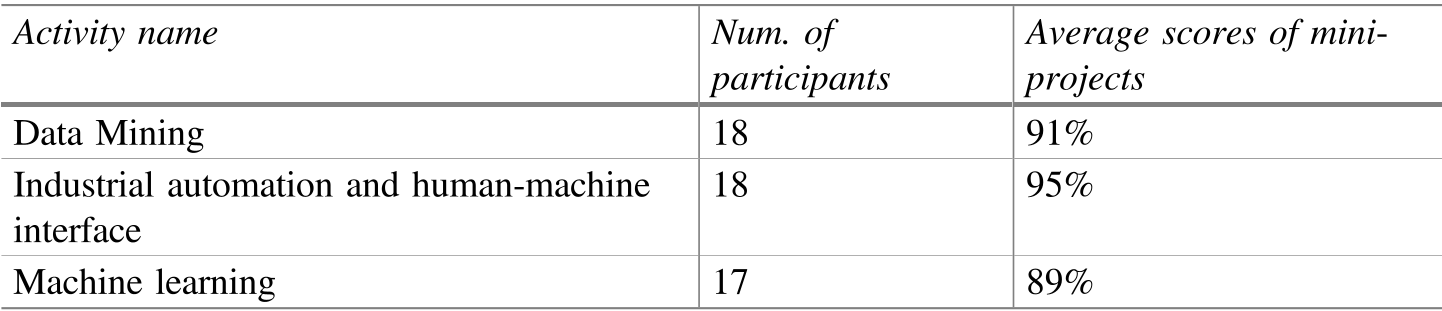 Figure 2: Average scores across the core technical modules.
The Qualitative Edge
Feedback gathered via Adobe Connect virtual classrooms and focus group interviews revealed a clear trend: the highest satisfaction came from active participation. Students specifically cited the "Technical Trip" (100% satisfaction) as the element that "clicked" their theoretical understanding into place.
Critical Analysis & Conclusion
Takeaway
The "Industry 4.0 Briefcase" serves as a blueprint for universities worldwide. Its success suggests that engineering education should move toward short-burst, high-impact interdisciplinary workshops rather than relying solely on semester-long, theory-heavy courses.
Limitations & Future Outlook
While the success rates are high, the study was limited by a small sample size (18 students) and a short duration (1 week). Students noted that the schedule was "exhausting" and "started too early in the morning."
The next phase of this research should explore scalability. How do we bring the "Briefcase" to 1,000 students instead of 18? The answer likely lies in the further integration of e-learning and augmented reality to simulate the factory tours that proved so vital to this project's success.