
Twitter Under the Microscope: How Public Data Leaks Your Browsing History
Inference Attack on Browsing History of Twitter Users Using Public Click Analytics and Twitter Metadata
This paper presents a novel inference attack that uncovers the browsing history of Twitter users by correlating publicly available Twitter metadata with aggregated click analytics from URL shortening services (e.g., bit.ly, goo.gl). The authors demonstrate that individual click events can be de-anonymized with high accuracy (average precision up to 0.94-0.99 for certain platforms) without needing malware or script injection.
TL;DR
Researchers have uncovered a startling privacy flaw: by combining aggregated click analytics from services like bit.ly or goo.gl with Twitter metadata, it is possible to reconstruct a user's browsing history. Unlike traditional hacks, this requires no malware—only the data currently shared by default on the public web.
The Motivation: Moving Beyond Traditional History Stealing
For years, browser history stealing was the domain of "active" attacks. To see where you’ve been, an attacker usually needed to:
- Trick you into visiting a malicious page (CSS sniffing).
- Compromise your network (DNS cache snooping).
- Infect your device with tracking scripts.
The authors of this paper noticed a "passive" alternative. URL shorteners are ubiquitous on Twitter, and many provide public analytics to show how many people clicked a link, from which country, and on what device. While this data is "aggregated" (e.g., "10 clicks from iPhone in the US"), its high-resolution updates allow an attacker to watch for a single-digit change and link it to a specific tweet interaction.
Methodology: The Art of Metadata Correlation
The attack relies on a simple but effective matching engine. Every tweet contains metadata—the "source" (e.g., Twitter for iPhone) and the user's profile location.
The Attack Pipeline
- Profiling: The attacker identifies a target's device (iPhone/Android) and country from their Twitter activity.
- Monitoring: The attacker monitors the click analytics of shortened URLs that appear on the target's timeline.
- Matching: When a click analytics log increases by exactly one, the attacker checks if the new platform and country match the target's profile.
The Advanced Time Model
To make the attack practical, the authors introduced a Time Model. By analyzing when a user typically posts, they can estimate their active hours. This 1) reduces the "noise" of clicks from other time zones and 2) lowers the computational cost of the attack by skipping monitoring during the target's sleep cycles.
Experimental Results: High Precision Exposure
The researchers tested their theory in both simulated and real-world environments.
- Platform Accuracy: Clicks from iPhones and Androids were identified with over 94% precision in simulations.
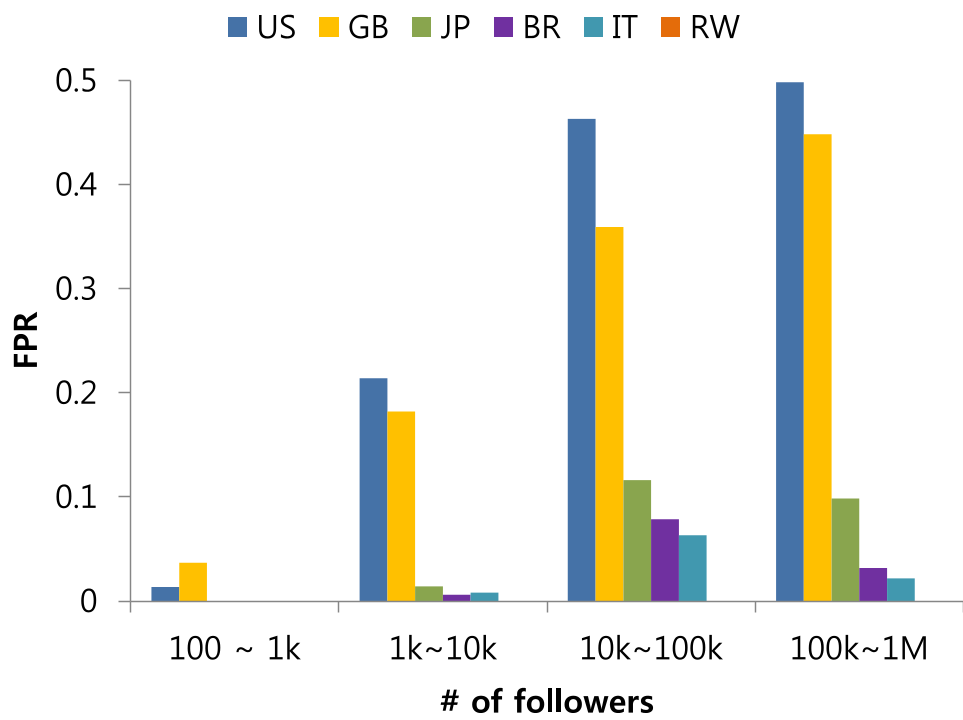
- Location Impact: Accuracy is highest for users in "unique" locations (e.g., Rwanda) compared to high-density zones like the US, where thousands of users might share the same profile.
- Real-World Success: In a test tracking real retweets and favorites, 95.2% of the URLs users eventually interacted with were correctly identified by the inference engine as "visited."
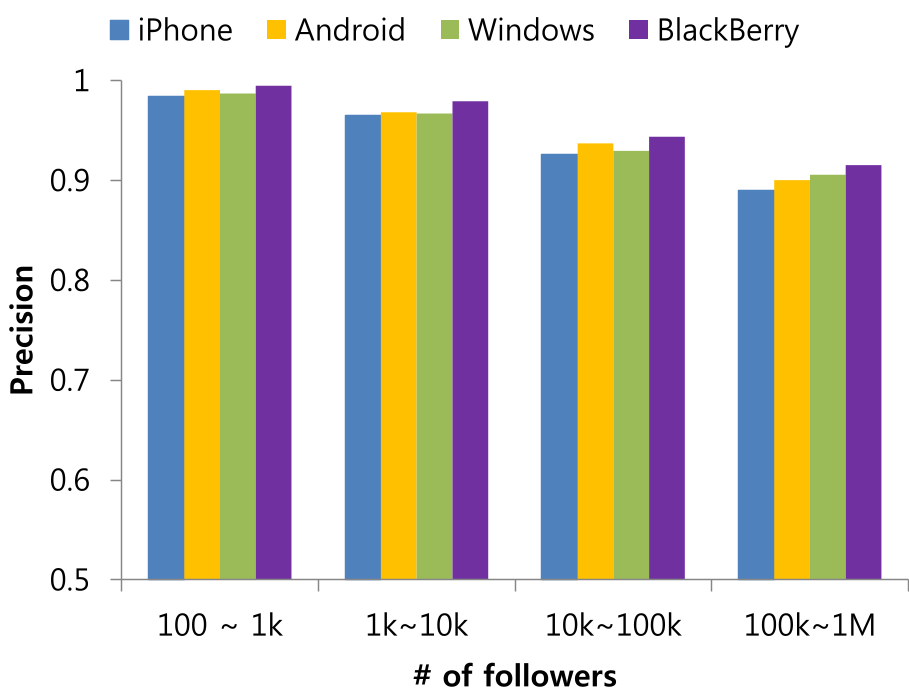 Figure: Precision remains remarkably high even as the follower count (potential noise) of the account posting the link increases.
Critical Analysis: Is "Aggregation" Enough?
This paper proves that aggregation is not anonymization. If an aggregate count updates in real-time or small batches, it becomes a side-channel for individual behavior.
Limitations
- Dynamic Profiles: If a user travels or switches devices, the static profile used by the attacker fails.
- High-Volume Links: For viral links (thousands of clicks per minute), the "change by one" signal is lost in the noise.
Future Outlook
The authors suggest that URL shorteners should implement update delays or differential privacy (adding mathematical noise to the counts). For the user, the lesson is clear: your device metadata is a fingerprint, even when it's hidden behind a "shortening" service.
Conclusion (Takeaway)
This work demonstrates that privacy is often lost not through the failure of one system, but through the correlation of two seemingly safe datasets. As social media platforms continue to expose "Source" tags and location data, and utility services offer public analytics, the potential for passive, zero-knowledge surveillance only grows.