
Hadamard Autoencoders: Resurrecting Social Networks from 1% Data
Inference in Social Networks from Ultra-Sparse Distance Measurements via Pretrained Hadamard Autoencoders
The paper introduces a pretraining-based Hadamard Autoencoder (HA) framework designed to reconstruct social network topology from ultra-sparse hop-distance measurements. By leveraging domain randomization on synthetic Barabási-Albert and Powerlaw cluster graphs, the model achieves state-of-the-art recovery performance even when less than 1% of pairwise distances are available.
TL;DR
In the realm of social network analysis, "missing data" isn't just a nuisance—it's the norm. Most current algorithms collapse when data density drops. This paper introduces a Hadamard Autoencoder (HA) approach that uses domain randomization (pretraining on synthetic graphs) to infer the full topology of a network from as little as 0.1% to 1% of distance measurements, significantly outperforming classical Matrix Completion.
The Sparse Data Crisis
Whether analyzing criminal syndicates or vast friendship networks, we rarely have the full picture. Collecting distance data (hop counts) is computationally expensive or physically impossible.
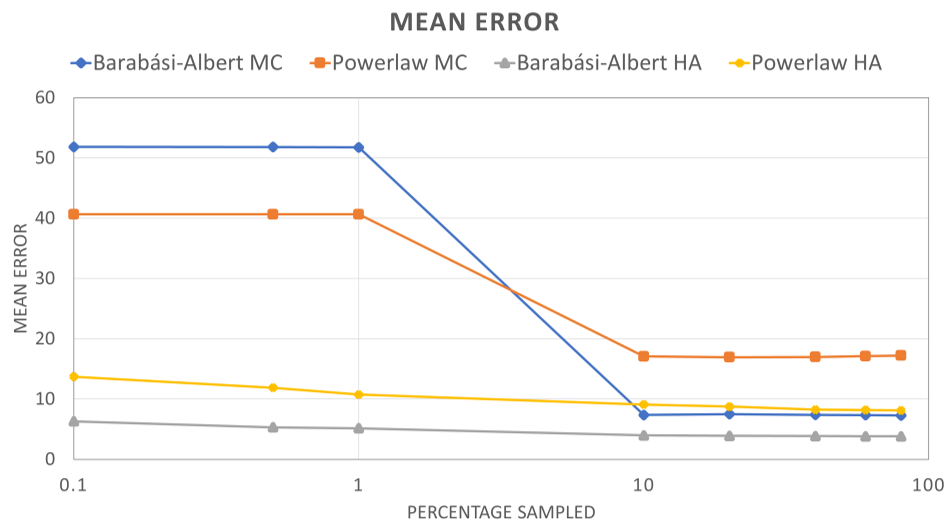
- The Problem with SOTA: Methods like Low-rank Matrix Completion (LMC) rely on the linear dependence of matrix rows. While mathematically elegant, they exhibit a "cliff-edge" failure mode: once you have fewer than 10-20% of the samples, the error skyrockets.
- The Insight: Social networks aren't just random; they follow specific "Scale-Free" architectures (Powerlaw distributions). If a model can learn the essence of these structures from synthetic data, it can "guess" the missing pieces of a real network with startling accuracy.
Methodology: Learning the Graph Manifold
The authors pivot from deterministic optimization to deep learning. The architecture uses a Hadamard Autoencoder, characterized by its unique loss function:
Where acts as a binary mask, ensuring the network only learns from what is actually observed, ignoring the "zeros" that represent missing data.
Domain Randomization & Pretraining
Instead of training on the specific target network (which is too sparse to learn from), the authors generate thousands of variations of Barabási-Albert (BA) and Powerlaw Cluster graphs.
- Variety: They vary parameters like edge density and triangle probability.
- Transference: Because real social networks (like Facebook) share these scale-free properties, the autoencoder treats the real network as just another "variation" of its training data.
Experiments: Facebook vs. The Machine
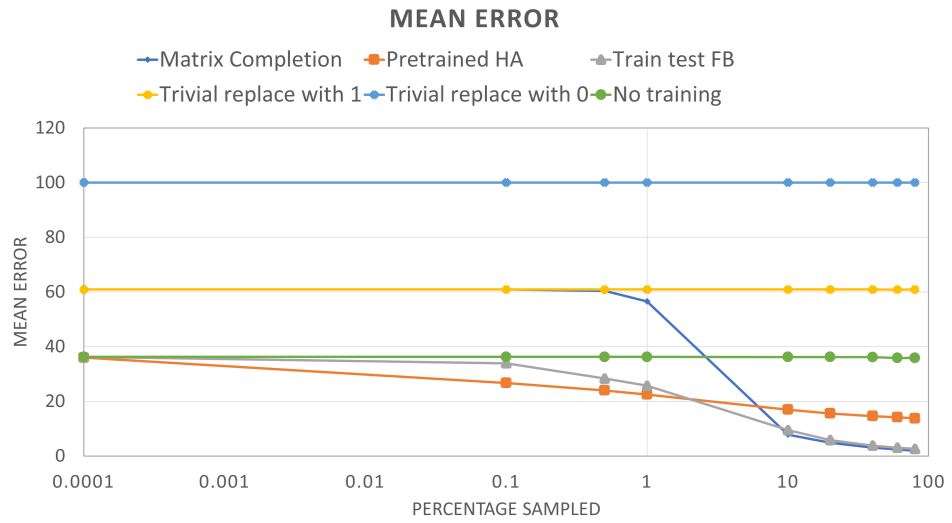
The researchers tested their model on a real-world Facebook dataset (744 nodes) against the deterministic LMC baseline.
- Ultra-Sparse Performance: At 1% sampling, the HA model maintained a Mean Error of 0.2, while LMC jumped to 0.6.
- Graceful Degradation: As data became scarcer, the HA's performance faded slowly, whereas LMC failed catastrophically as soon as sampling hit the "ultra-sparse" zone.
Critical Insights & Takeaways
The most surprising discovery? Even a non-trained Autoencoder (with random weights but a fixed hidden layer dimension) outperformed some baselines. This suggests that the bottleneck architecture of an autoencoder itself acts as a structural prior (Inductive Bias) that matches the low-rank nature of networks.
Limitations & Future Work
While the results are impressive for undirected graphs, real-world networks are often directed (e.g., Twitter followers). Extending this pretraining logic to directed, weighted graphs remains the "final boss" of topological inference.
Conclusion: By combining the "Physics" of network science (Powerlaw models) with the "Flexibility" of Deep Learning (Autoencoders), we can now map the skeleton of social structures that were previously considered invisible.