
Leveraging Big Code: Breaking the Specification Bottleneck with Collective Intelligence
Inferring Behavioral Specifications from Large-scale Repositories by Leveraging Collective Intelligence
This paper introduces a large-scale framework for automatically inferring behavioral interface specifications (pre/post-conditions) from "Big Code"—collections of millions of open-source projects. By leveraging the Boa infrastructure, the authors propose a collective intelligence approach to bootstrap API specifications, aiming to solve the lack of formal documentation in widespread libraries like the JDK.
TL;DR
Formal specifications are the "Holy Grail" of high-assurance software, yet they remain tragically rare due to the sheer human effort required to write them. This paper proposes a paradigm shift: instead of writing specs, we should infer them by mining the collective intelligence of millions of open-source projects. Using the Boa infrastructure, the authors aim to automate the creation of behavioral specifications (pre/post-conditions) for widely-used APIs like the JDK.
The "Snowball Effect" of Missing Specs
In the world of formal methods, verification is only as good as the specifications available for the dependencies. The authors highlight a grim reality: only 7% of the JDK APIs are formally specified. When core libraries lack formal descriptions, developers building on top of them face a "skyrocketing" cost to verify their own systems.
The root cause is a self-perpetuating cycle:
- Specs are hard and expensive to write.
- Therefore, core libraries don't have them.
- Therefore, specifying applications that use these libraries becomes a budget-busting task.
To break this cycle, we need to move away from the "manual labor" of specification and toward automated inference powered by "Big Code."
Methodology: The Three-Pronged Attack
The authors don't just look at code in isolation; they look at how the entire world uses that code. Their strategy is divided into three distinct techniques:
1. Consensus-Based Inference
If 10,000 different developers check if (x != null) before calling a specific function, it is highly likely that x != null is a formal precondition.
- Insight: Most clients work, and broken ones eventually get fixed in the revision history. By analyzing the "consensus" of how an API is interacted with across millions of lines of code, we can synthesize its rules.
2. Similarity and Differential-based Inference
Code clones are a feature, not a bug, for inference.
- Insight: Similar code should have similar specifications. By clustering (code, specification) pairs from widely-used code, the system can extrapolate specs to rarely-used code that shares similar design patterns.
3. Decomposition-based Inference
For unique, complex code, the authors look at its evolutionary history.
- Insight: By decomposing code into fragments based on its revision history and treating function signatures as an alphabet, they can compose a target specification from smaller, previously inferred pieces.
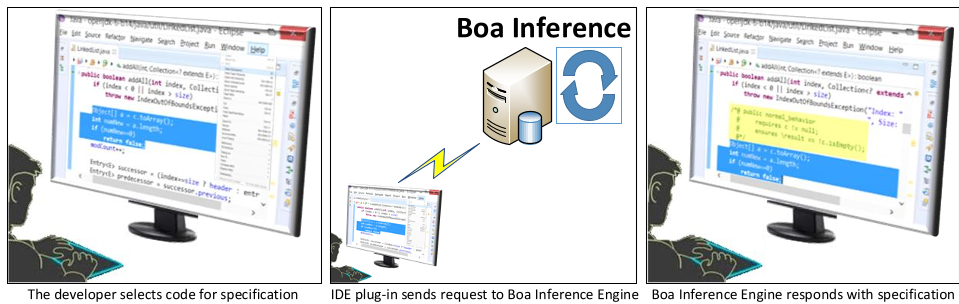 Fig 1: The envisioned developer experience—push a button, get a synthesized specification via the Boa infrastructure.
Infrastructure: The Power of Boa
The technical backbone of this research is Boa, a domain-specific language and infrastructure designed for mining ultra-large-scale software repositories. Boa abstracts away the complexity of traversing billions of AST (Abstract Syntax Tree) nodes, allowing researchers to run queries across 700,000+ GitHub/SourceForge projects as easily as querying a database.
Experimental Results & Potential Impact
By applying these techniques to the "Big Code" available in Boa, the authors are working toward:
- Modular Verification: Allowing formal analysis of massive codebases by providing the missing API specs.
- Predictable Maintenance: Reducing the need for reverse engineering by providing checkable contracts.
- Code Synthesis: Making automated code generation practical by using specifications as the "query" to find or build matching modules.
Critical Insight: Why This Matters Now
While prior work focused on dynamic analysis (running tests) or static analysis of single projects, this work recognizes that context is king. By analyzing how a piece of code behaves across the entire ecosystem of open source, we can filter out "noise" (bugs) and focus on the "signal" (intended behavior).
Conclusion & Future Outlook
The era of "Big Code" provides a data-driven path to solving the verification bottleneck. While the paper acknowledges the difficulty of specifying "rarely-used" code, the move toward a global, open-source knowledge base of specifications could fundamentally change how we build high-assurance systems. In the future, your IDE might not just suggest code—it will suggest the contract that ensures your code actually works.