
The Privacy of Metadata: Can We Guess Your Private Messages from Your Public Friends?
Towards Inferring Communication Paerns in Online Social Networks
This paper investigates the feasibility of inferring private communication patterns (who messages whom) from publicly available data like friendship graphs and public "wall" posts. Using a Bayesian framework and a large-scale dataset from the Netlog social network, the authors evaluate whether metadata—stripped of content—can leak interaction secrets.
Executive Summary
TL;DR: Does your public activity on social media—like who you follow or who you "like"—secretly reveal who you are texting in private? This study analyzes a massive dataset from the Netlog network to find out. The verdict: Luckily for privacy, your public social graph is a surprisingly poor predictor of your private conversations.
Academic Positioning: This work bridges the gap between Network Topology (the "map" of friends) and User Activity Modeling (the "traffic" of messages). While previous SOTA research focused on inferring attributes (like age or politics), this paper focuses on inferring relationships through metadata alone.
The "Broken" Promise of Social Privacy
We often think that if we use encryption or avoid posting sensitive content publicly, we are safe. However, there is a hidden threat: Metadata Correlation.
The authors identify a critical tension:
- OSN Providers see everything—even if you encrypt, they see when and to whom you send bits.
- Public Data Collision: If you post on Bob's wall every day, an observer might assume you also message him privately. If this correlation is strong, "private" messaging isn't really private; it’s an open secret.
Methodology: The Math of Uncertainty
The researchers used a dataset from Netlog (a Belgian OSN) containing 3.8 million users. They modeled the network as a "mixed multigraph" where:
- F (Edges): Publicly visible friendships.
- P (Arcs): Public wall posts.
- M (Arcs): The "Hidden" Variable — private messages.
They utilized Shannon Entropy to quantify how much an adversary "learns" about private messages (Variable ) by looking at public evidence (Variable ). If the conditional entropy is much lower than the base entropy , the privacy leak is high.
 The study categorizes users into "Active" and "Strictly Active" to filter out noise from dormant accounts.
Key Findings: The Great Disconnect
1. Popularity $
eq$ Intimacy The data shows that having more friends does not mean you send more private messages to each one. In fact, users seem to have a "communication budget." Whether Alice has 10 friends or 1,000, she usually only messages a tiny inner circle of about 5-10 people.
2. The Failure of Graph Features
The authors tested if Mutual Friends or the Jaccard Coefficient (how much your friend circles overlap) could predict private chats.
- Physical Intuition: You might expect that if Alice and Bob share 100 mutual friends, they are likely to chat privately.
- The Reality: The data showed no such trend. You might share many friends because you went to the same high school, but that doesn't mean you are currently speaking to each other.
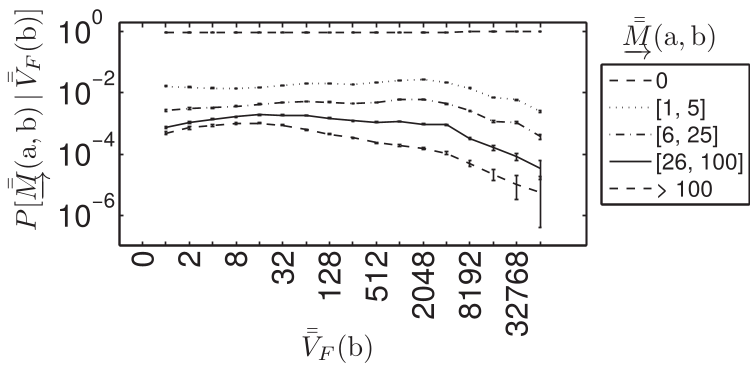 Figure 8: Probability of messages sent based on friend count. The flat lines indicate that friendship degree is a poor predictor of messaging volume.
3. Public vs. Private Communication
One might think public posts and private messages are interchangeable. However, the study found that while people who post to each other are slightly more likely to message, there is no volume correlation. High public activity does not scale into high private activity.
Critical Insight: Why This Matters for Obfuscation
This paper isn't just a win for privacy; it's a blueprint for Traffic Obfuscation Tools.
If you want to hide your real messaging patterns by sending "dummy" messages (noise), those dummies must look "real." If public and private data were highly correlated, a tool would have to generate dummy public posts to justify dummy private messages. Because this paper proves they are uncorrelated, developers can generate private-message noise without worrying about matching it to a user's public social graph.
Conclusion & Limitations
The study concludes that metadata is not destiny. In Netlog, your public "Social Noise" does not betray your "Private Signal."
Limitations:
- Platform Specificity: Netlog may behave differently than modern "Closed-Loop" apps like WhatsApp or Signal.
- Lack of Semantics: The researchers didn't look at what was in the posts (e.g., "Check your DMs!"), which would likely increase inference accuracy.
- Future Work: The authors suggest using more complex features like Centrality or Random Forests to see if deeper patterns exist.
Takeaway: Your "inner circle" remains largely invisible to those looking only at your "outer circle" of friends.