
Beyond Check-ins: Mining the Invisible Social Fabric of Campus Life through WiFi Trajectories
Inferring Demographics and Social Networks of Mobile Device Users on Campus From AP-Trajectories
The paper introduces Dinfer and Sinfer, a bipartite framework for inferring user demographics (gender, social role) and social networks from anonymized WiFi Access Point (AP) trajectories. By utilizing a Graph-Regularized Non-negative Tensor Factorization (NTF) approach on campus-scale data, the authors achieve state-of-the-art performance in user profiling without relying on semantic location metadata.
TL;DR
Researchers from Xi'an Jiaotong University have developed a framework to "deanonymize" the social and demographic characteristics of campus users using nothing but raw WiFi connection logs. By moving beyond simple "co-location" to fine-grained "co-leaving" and "co-presenting" events, they've demonstrated that your smartphone's movement patterns reveal who you are and who your friends are—even without knowing exactly where you are in a building.
The Problem: The "Context-Free" Trajectory Gap
Most location-based profiling research (e.g., predicting age or gender from Foursquare check-ins) relies on semantic context. If a user spends every morning in a "Yoga Studio," the model identifies them as health-conscious. However, in a campus environment, GPS often fails indoors, and WiFi APs might only be labeled by technical IDs rather than "Library" or "Cafeteria."
Furthermore, existing social inference models focus almost exclusively on co-coming (arriving at the same time). But in the real world, strangers arrive at a lecture at the same time; friends leave together and stay together for specific durations.
Methodology: The Dinfer & Sinfer Architecture
The authors tackle this through a two-stage process:
1. Sinfer: The Social Inference Engine
Instead of just counting how many times two devices are near the same AP, Sinfer uses Pointwise Mutual Information (PMI).
- The Logic: If two people are always at a popular cafeteria at noon, it’s probably a coincidence. If they are together at a obscure AP in a research lab at 11 PM, it’s a social tie.
- The Features: It looks at Co-Coming, Co-Leaving, and Co-Presenting Duration. They found these are complementary; some friends arrive together, others meet inside and leave together.
2. Dinfer: Demographic Inference via Tensor Factorization
How do you turn sparse connection logs into a "Persona"? The authors use a 3D Tensor (User AP Time).
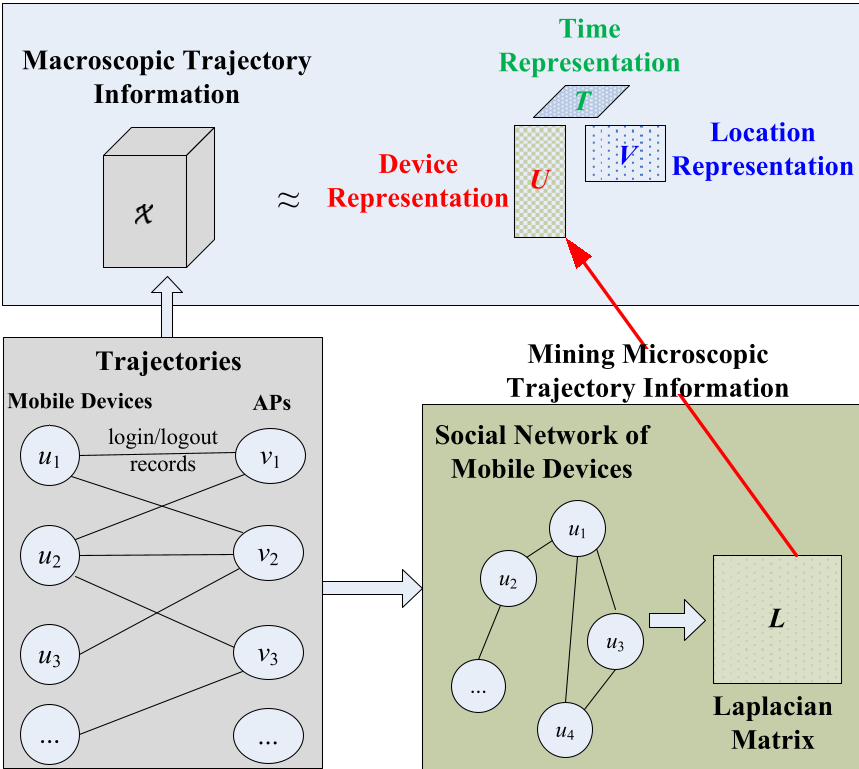
They factorize this tensor into latent matrices (User), (AP), and (Time). The masterstroke is the Social Regularization: they force the "User" vectors in the latent space to be close to one another if Sinfer says they are friends. This is based on the principle of Homophily—birds of a feather move together.
Key Experimental Insights
The researchers tested this on two massive datasets from "Campus A" and "Campus B," involving over 52,000 devices.
The Power of Micro-Stats
When comparing macroscopic features (average login counts) vs. microscopic features (specific co-occurrence events), the latter was vastly superior for identifying classmates.

As shown above, Sinfer identified classmates with nearly 60% accuracy in the Top-20 list, more than double the performance of standard Jaccard or Cosine similarity metrics.
Demographic Accuracy
By leveraging the social graph, Dinfer achieved a significant boost in classification:
- Gender: ~71% F1-score.
- Social Role (Faculty vs. Student): ~63% F1-score.
- Insight: Models that ignored the social connection (NTF/NMF) performed significantly worse, proving that "who you know" is as important as "where you go" for profiling.
Critical Analysis & Conclusion
This work represents a significant step in Passive Sensing. It proves that network administrators (or anyone with access to AP logs) can build highly accurate profiles of users without requiring GPS or explicit check-ins.
Limitations: The method assumes a certain level of density. In rural or low-traffic areas, the co-occurrence events might be too sparse for Sinfer to build a reliable graph. Additionally, the rise of MAC address randomization in modern iOS/Android versions poses a challenge to long-term tracking unless the user remains logged into the campus RADIUS server.
Future Outlook: As we move toward "Smart Campuses," this logic could be used to optimize facility usage or even predict student drop-out rates based on declining social engagement and changing movement patterns.