
Decoding Social Ties: Inferring Friendship from Mobility Fingerprints
Inferring Friendship from Check-in Data of Location-Based Social Networks
The paper proposes two machine learning models (Model I and Model II) to infer social friendships from Location-Based Social Network (LBSN) check-in data. It leverages "social homophily" by analyzing co-location frequency, temporal intervals, and location popularity (entropy), achieving state-of-the-art performance on the Gowalla dataset.
TL;DR
Can we tell if two people are friends just by looking at where they check in on apps like Yelp or Foursquare? This paper says yes, provided we look beyond simple "coincidences." By introducing temporal flexibility and "Location Entropy," the authors build models that outperform previous benchmarks, proving that a shared visit to a quiet cafe is worth far more than a hundred shared visits to a busy train station.
Background: The Mobility-Social Link
Human mobility isn't random. It is governed by our social circles—we go where our friends go, or we go with them. While early research relied on intrusive GPS tracking or questionnaires, the rise of Location-Based Social Networks (LBSNs) like Gowalla and Foursquare has provided a goldmine of data. However, previous attempts to predict friendship from these "check-ins" had a fatal flaw: they assumed friends had to be at the same place at nearly the same time.
The "Entropy" Insight: Not All Locations Are Equal
The core contribution of this work is the nuanced treatment of Location Entropy.
- High Entropy: A train station or airport (visited by many people, diverse backgrounds).
- Low Entropy: A private office or a specific neighborhood gym (visited by a consistent, small group).
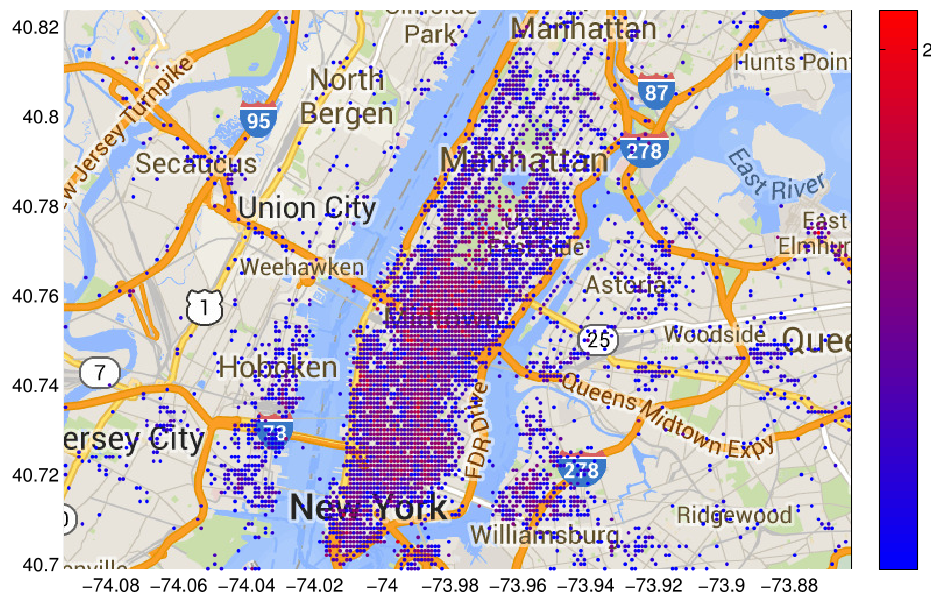
The authors argue that a "co-occurrence" at a low-entropy location is a significantly stronger indicator of friendship. To visualize this, they mapped location entropy across New York, showing how Midtown hubs contrast with the "quieter" residential zones of Manhattan.
Methodology: Two Specialized Models
The authors tackled the problem from two angles:
1. Model I: The "Single-Spot" Inference
Suppose you only have data for a single location. Can you still predict friendship? The authors used a Logistic Regression classifier with seven features, including the Time Interval Sequence (TIS). Instead of a binary "were they there at the same time?", TIS calculates the gap between every visit, capturing "delayed recommendations" (e.g., a friend visiting a restaurant a week after their buddy suggested it).
2. Model II: The "Global Mobility" Profile
When all check-in data is available, the authors propose Weighted Number of Co-locations (WL) and Weighted Number of Co-occurrences (WO). These metrics use an exponential decay function of entropy () to ensure that popular "public" spots don't drown out the signal of "private" social hubs.
Experimental Battleground
Using the Gowalla dataset (6.4M check-ins), they tested their models against the "CS Model" and "EBM" (Entropy-Based Model).
- Spatial Precision: They found that the smaller the "grid cell" (location size), the higher the accuracy. At a 0.001° scale (roughly block-level), the model becomes highly predictive.
- The SOTA Edge: Model II consistently stayed above the EBM baseline. Unlike EBM, which fluctuates based on the chosen time window (τ), the authors' method is robust because it doesn't "throw away" data involving long time gaps.
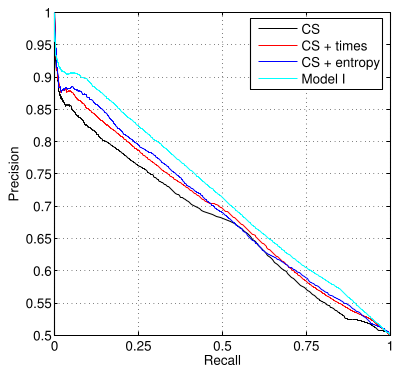 Fig 2: Model I shows that combining time intervals and entropy yields the best ROC/Precision-Recall curves.
Critical Insight & Analysis
The paper's triumph lies in its Inductive Bias: the assumption that social relationships are temporal-flexible. By proving that 30% of friends don't co-occur within a 30-day window, they effectively debunked the "strict coincidence" requirement used in earlier literature.
However, there is a limitation: the model treats all time of day equally. As the authors suggest for future work, a check-in at 2 AM on a Saturday is a much stronger social signal than a 10 AM check-in on a Tuesday.
Conclusion
This research moves us closer to a world where our digital footprints can accurately reconstruct our social fabrics. For city planners, it offers a way to see how communities actually interact; for marketers, it provides a surgical tool for friend-based recommendations. The takeaway is clear: to understand social networks, you must first understand the "entropy" of the places where users spend their lives.