
Intruder or Welcome Friend: Deep Profiling Group Membership in Social Networks
Intruder or Welcome Friend: Inferring Group Membership in Online Social Networks
The paper introduces a machine learning framework to infer group membership in Online Social Networks (OSNs) by leveraging personal, topological, and group affiliation features. Using the Bagging algorithm with J48 decision trees, the methods achieve a high predictive accuracy (Average AUC ~0.80) across two distinct real-world datasets, Ning and TheMarker.
TL;DR
Can a machine learning model guess which online groups you belong to, even if your profile is private? This paper demonstrates that by analyzing your friends' connections, your personal demographics, and your other group memberships, algorithms can predict your group affiliations with high accuracy (AUC ~0.8). This work has profound implications for OSN security, from automatic screening of group applicants to identifying malicious "intruders."
The Core Challenge: Beyond Simple Graph Partitioning
Most academic work on "Community Detection" treats groups as isolated islands. In reality, Online Social Networks (OSNs) like Facebook or LinkedIn are messy; users belong to dozens of overlapping groups. The problem the authors address is Group Membership Inference: given a user and a target group, can we predict if they belong there?
Existing methods often lacked:
- Multi-faceted Data: Ignoring personal attributes or the fact that users belong to multiple groups.
- Overlapping Awareness: Failing to model the "hyper-edge" nature where one person exists in many communities simultaneously.
Methodology: The Three Pillars of Inference
The authors treat this as a binary classification task. For any user and target group , they extract three types of features:
- Personal Characteristics (PRS): Age, gender, and residence. This relies on Homophily—the idea that "birds of a feather flock together."
- Group Affiliation (GRP): A bit-vector of your other memberships. If you are in a "Data Mining" group, you are statistically likely to be in a "Big Data" group.
- Network Topological (TPL): These are the most technically interesting. They look at the "Group-Neighborhood" —specifically, how many of your friends are already in the target group and how connected those friends are to each other.
 Figure 1: Mathematical formulation of Ingroup-Common-Friends (ICF), a key metric for determining how localized a user's social circle is within a specific group.
Feature Highlight: The 2-Hop Reach
The feature GRP_F_L2(v,h) is particularly clever. It counts "friends of friends" who are members of group but are not your direct friends. This captures the "latent" interest in a group even if your immediate social circle hasn't joined yet.
Experiments and Results
The researchers tested their approach on two vastly different networks: TheMarker (a Hebrew business network) and Ning (a platform for group creators).
Key Findings:
- The "ALL" Advantage: Combining all features usually wins, but the "best" single feature set is network-dependent.
- TheMarker: Group affiliation (GRP) was the strongest signal. Because users joined many groups (avg 2.4), the patterns of co-membership were highly predictive.
- Ning: Topological features (TPL) were more dominant. Since users had fewer group memberships, the physical structure of the friendship graph carried more weight.
- Performance: In some cases, AUC reached as high as 0.934, a near-perfect prediction.
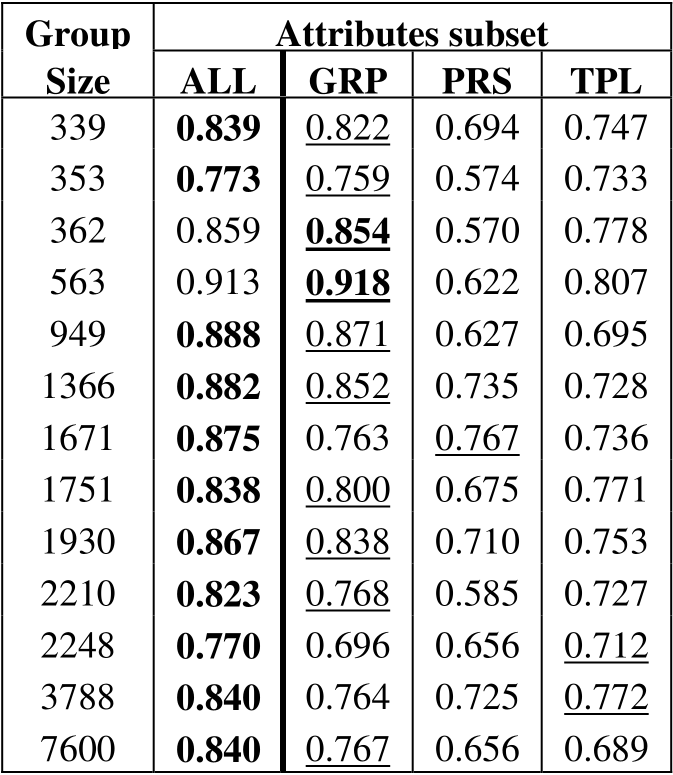 Table 1: AUC performance across different attribute subsets. Note how "ALL" consistently provides the most robust results.
Group Clustering and Information Gain
One of the paper's more novel contributions is the visualization of group relationships. By calculating Information Gain, the authors could see which groups "explain" others. They discovered that groups naturally cluster into meta-communities—for example, if a model knows you are in a "Marketing" group, it gains massive information about your likelihood of being in a "Digital Strategy" group.
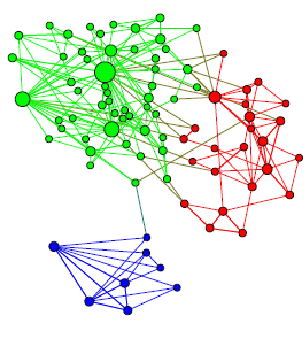 Figure 2: A graph representing Information Gain between groups. The clustered nature shows that groups are not independent; they form hierarchical or topical constellations.
Critical Insight & Conclusion
This paper shifts the perspective from finding groups to validating them.
Takeaway for OSN Platforms: These models are ready-to-use for security. If an account with "PRS" features of a 40-year-old man tries to join a group for "Middle School Students" and has zero "TPL" connections to existing members, the system can flag them as a high-risk intruder immediately.
Limitations: The study uses Bagging with J48 (Decision Trees), which was SOTA at the time but lacks the nuance of modern Graph Neural Networks (GNNs). A GNN could potentially learn these topological features automatically rather than requiring manual engineering.
However, the core message remains: your social context is a digital fingerprint. Even if you hide your interests, your friends and your profile give you away.