
Understanding Asymmetric Influence: The Flow Shell Model for Social Cascades
Inferring Information Propagation over Online Social Networks: Edge Asymmetry and Flow Tendency
This paper introduces a methodology to infer information propagation paths in online social networks using limited data—specifically, user relationship graphs and chronological event participation logs. The authors propose the Flow Shell (FS) model to quantify "Information Potential Energy," a novel metric for identifying influential nodes based on edge asymmetry and flow tendency.
TL;DR
Information doesn't just spread; it flows down a "gradient." This paper analyzes the Douban network to reveal that social relationship edges are effectively asymmetric in information transfer. By proposing the Information Potential Energy concept and the Flow Shell (FS) model, the authors provide a way to identify top-tier influencers using nothing more than a list of "who participated when."
The Problem: Mining Insight from Sparse Data
In the era of privacy-conscious APIs, researchers rarely get to see the "Direct Message" or the specific "Share" button click that triggered a cascade. Often, we only see the result: a list of users who joined an event, sorted by time.
The central challenge is: How do we reconstruct the invisible paths of influence from these simple timestamps? Previous models like the Linear Threshold or Independent Cascade models often assume we know the "influence weights" of edges beforehand. This paper flips the script by deriving those weights from observed historical behavior.
Methodology: From Time Sequences to Potential Energy
The authors' approach follows a rigorous three-step logical chain:
1. Extracting the Diffusion Topology
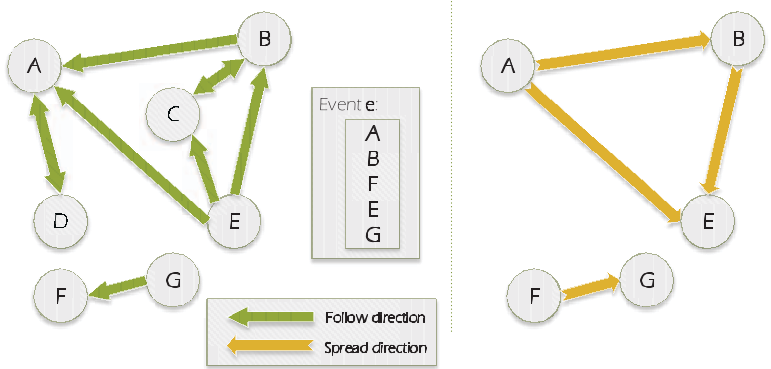
By combining the static "Follow" graph with the dynamic "Chronological Participation" list, the authors build a directed acyclic graph (DAG) for each event. If User A follows User B, and User B joined an event before User A, a potential propagation edge is drawn from B to A.
2. The Discovery of Edge Asymmetry
The most striking insight is the Flow Ratio (FR). In a perfect friendship, information might flow 50/50. Yet, the data shows that in 86.6% of cases, information flows in only one direction. This suggests a hierarchical structure—an "Information Potential Energy" where some users are natural "sources" (high energy) and others are "sinks" (low energy).
3. The Flow Shell (FS) Model
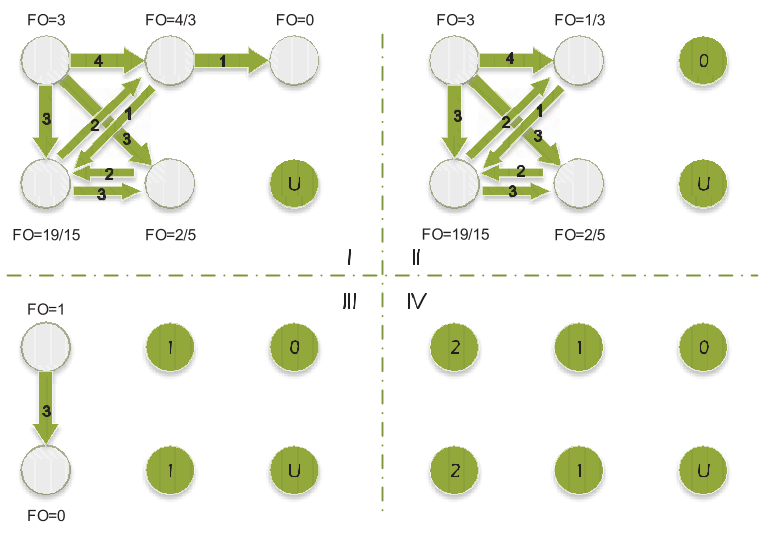
To quantify this, the authors developed the FS model. It works similarly to "peeling an onion":
- Calculate Flow Out (FO) values for all nodes.
- Iteratively remove "sink" nodes (those who mostly receive but don't pass on information).
- Nodes removed last are the "Kernel"—the high-potential sources that drive the network.
Experimental Validation: High-Energy Nodes are Real Influencers
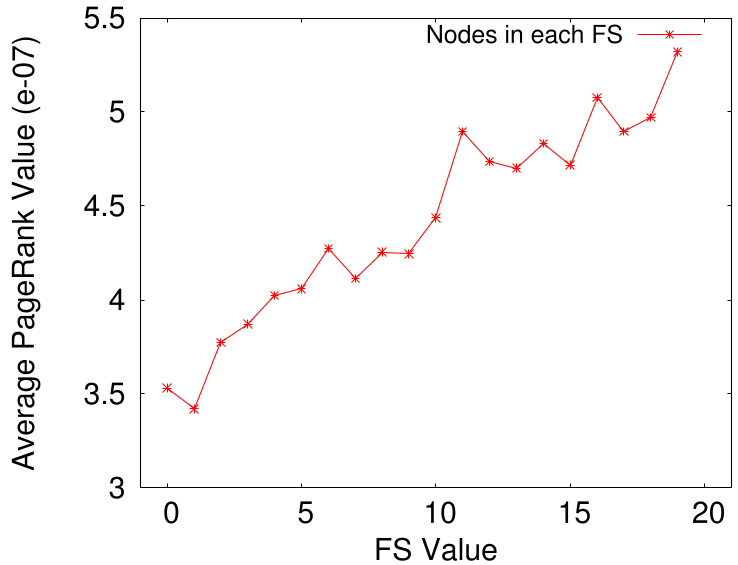
The researchers tested their model on nearly 1.5 million Douban users. To verify if "Potential Energy" actually meant "Influence," they compared FS values with PageRank.
The results were conclusive: As the FS value (Potential Energy) increases, the average PageRank also increases. This confirms that high FS nodes are not just active participants; they are structurally significant hubs that messages are statistically more likely to pass through.
Critical Insight & Conclusion
The Flow Shell model is a powerful tool for industry practitioners (like recommendation system engineers or digital marketers) because of its computational efficiency. Since it relies on local FO value recalculations rather than global matrix inversions, it scales well to huge datasets.
Takeaway: Stop treating social links as bidirectional "friendships." Treat them as "pipes" with a specific flow direction. Identifying the users at the "top of the hill" (highest potential energy) is the most efficient way to seed a viral campaign or predict the spread of news.
Limitations: The model currently assumes the "Follow" graph is the primary conduit. Future work could integrate "Weak Ties" (non-followers who share interests) to capture the 71.2% of current "isolated" participants who might still be part of the flow via discovery algorithms.