
Beyond the Tweet: Decoding User Identity via Celebrity Followings and Class Influencers
Inferring Latent Attributes of an Indian Twitter User using Celebrities and Class Influencers
The paper proposes a multi-feature machine learning approach to infer latent attributes (Gender, Age, and Political Affiliation) of Indian Twitter users. By introducing a novel feature called "Class Influencers" and leveraging celebrity metadata (Age, Gender, Genre), the authors achieve high classification accuracy, reaching 83.6% for gender and 86.5% for political affiliation.
TL;DR
Inferring who a user is (their age, gender, or politics) from just their tweets is notoriously difficult due to slang and short-form noise. This paper introduces a breakthrough for the Indian Twitter landscape by looking not just at what people say, but who they follow. By defining "Class Influencers"—key accounts that act as demographic anchors—the researchers pushed classification accuracy for political affiliation to a staggering 86.5%.
Problem & Motivation: The Noise in the Signal
Most demographic inference research treats the user as an island, analyzing their text for linguistic markers. However, in the Indian context, the challenge is twofold:
- Linguistic Noise: Tweets are rife with "Hinglish," abbreviations, and camel-cased hashtags, which often break standard NLP tools.
- Privacy by Design: Twitter doesn't require users to disclose age or gender, creating a massive data gap for social analytics.
The authors' insight is grounded in homophily: the sociological principle that "birds of a feather flock together." If you follow specific regional icons, those icons likely reveal more about your identity than a misspelled tweet ever could.
Methodology: The Power of the "Popular Neighborhood"
The methodology moves beyond simple text analysis by integrating four distinct feature sets:
1. Linguistic and Behavioral Features
The system uses the LIWC (Linguistic Inquiry and Word Count) dictionary to track pronouns, emotional terms, and swear words. For example, female users were found to use more "kinship" terms and "happy" emoticons, while male users leaned toward "technology" and "money."
2. Popular Neighborhood (Celebrity Metadata)
The researchers mapped 9,366 "celebrities" (defined as verified accounts or those with >10k followers). They didn't just look at the celebrity's name; they scraped Wikipedia and Freebase to find the celebrity's own age, gender, and genre.
- Insight: Males are twice as likely to follow other males than females.
3. The Novel "Class Influencer" Feature
This is the paper’s crown jewel. A "Class Influencer" is an account that shows a high statistical bias (e.g., >70%) toward a specific class.
- Example: The handle 'MissMalini' is followed by 75% females in the dataset. Follow her, and the probability of being female skyrockets.
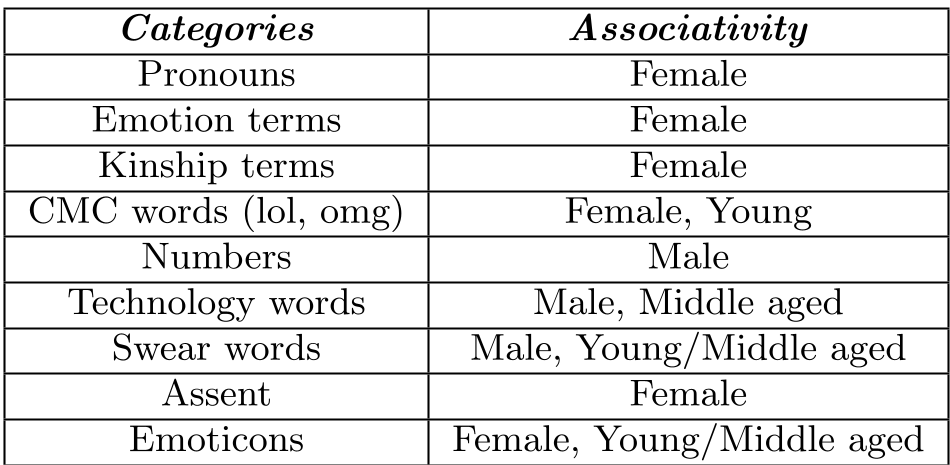
Experiments & Results: The "Influencer" Edge
The study evaluated Gender (Male/Female), Age (Young/Middle/Old), and Politics (BJP/AAP).
The results (using 10-fold cross-validation) demonstrate that while individual features are okay, the combination is lethal.
| Configuration | Gender Accuracy | Age Accuracy | Political Accuracy |
|---|---|---|---|
| Tweet Behavior (T) | 65.9% | 57.2% | 66.8% |
| Class Influencer (I) | 79.1% | 65.6% | 83.1% |
| Full Combined Model | 83.6% | 66.4% | 86.5% |
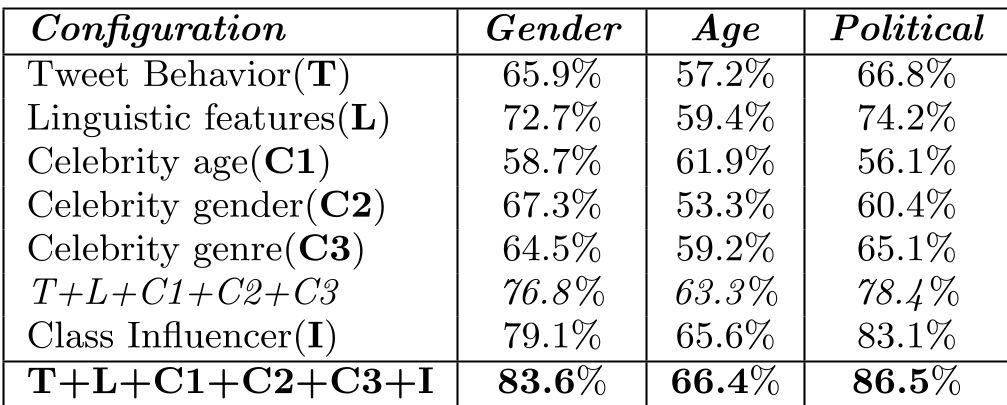
The success of the "Class Influencer" feature (I) is particularly striking—it outperformed the combined weight of all traditional tweet behavior and linguistic features (T+L) in every category.
Critical Analysis & Conclusion
Takeaway
Identity on social media is social. The "Class Influencer" method is a massive win for Social Information Retrieval. It proves that external knowledge bases (Wikipedia) can be used to enrich sparse social media data, turning a simple "Follow" click into a rich demographic signal.
Limitations & Future Work
- Stereotype Reliance: The linguistic analysis relies on traditional gender norms (e.g., males talk about money; females talk about family), which may evolve over time.
- Scalability: The dataset used is relatively small (approx. 300-800 users per category). Testing this on millions of users would require more automated "bot filtering" and dynamic influencer identification.
- Temporal Decay: Influencers rise and fall. A political leader's following during an election year may look very different a year later, necessitating a "regular update" cycle for the feature set.
Ultimately, this work serves as a blueprint for how we can infer the "latent" truths of users by looking at the digital company they keep.