
IDSR: Decoding Latent Social Networks from Cascades for Dynamic Recommendation
Inferring Latent Network from Cascade Data for Dynamic Social Recommendation
The paper introduces Implicit Dynamic Social Recommendation (IDSR), a unified matrix factorization framework that reconstructs latent social networks from cascade data (temporal action timestamps). Unlike static models, it captures drifting user preferences to achieve state-of-the-art accuracy on Zomato, MovieLens, and Douban datasets.
TL;DR
The Implicit Dynamic Social Recommendation (IDSR) model moves beyond "static" friendship links. By analyzing the timing of user actions (cascades), it reconstructs a latent social network that captures evolving preferences. It doesn't just ask "who are you friends with?" but "who is influencing your choices right now?"
Background: The Illusion of Explicit Social Links
In the world of social recommendation, we usually rely on Explicit Networks (like a "Follow" button on Twitter). However, these are often "noisy": a user might follow a hundred people but only trust the taste of three. Furthermore, many platforms (like Taobao) lack an explicit social graph entirely.
The second major hurdle is User Preference Drift. A user's interest in movies or fashion is not a constant; it shifts. Static social recommendation models fail to capture this because they treat a link established five years ago with the same weight as one formed yesterday.
Methodology: From Cascades to Influence
The core innovation of IDSR is treating user actions as Cascades. If User A rates a movie and User B rates the same movie shortly after, there is a probabilistic likelihood of influence.
1. Dynamic Social Network Inference
The model uses an Exponential Parametric Likelihood to infer the transmission rate () between users.
- Physical Intuition: If the time gap between User 's action and User 's action is small, the calculated hazard function (instantaneous infection rate) is high.
- Formula Insight: The likelihood of a cascade is defined by the probability that a node survives "uninfected" until a certain time , given its parents' actions.
2. The Unified Objective Function
Instead of inferring the network and then recommending (a two-step process that propagates error), IDSR solves a joint optimization problem:
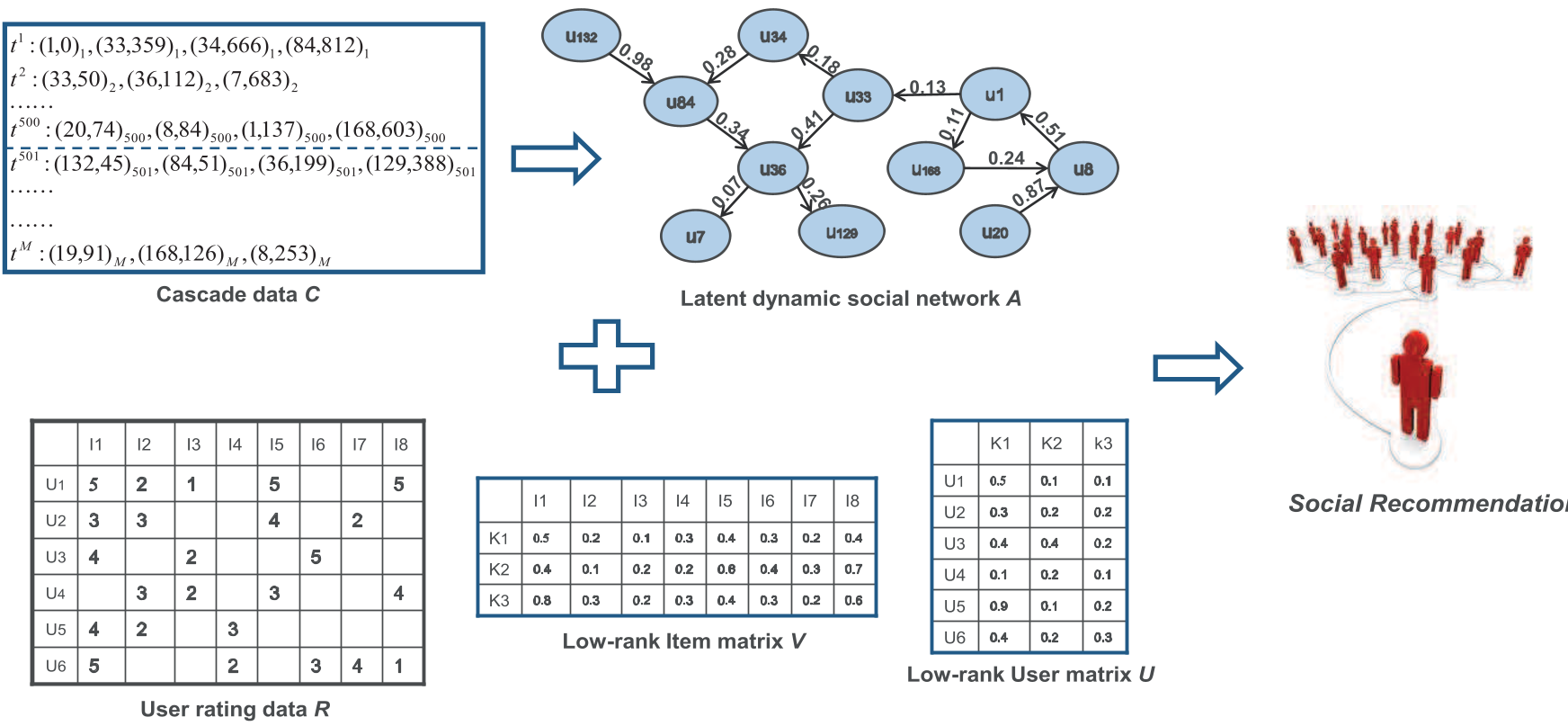
The loss function balances:
- Network Likelihood: Fitting the social structure to the temporal cascades.
- Social Regularization: Forcing "connected" users to have similar latent preference vectors ().
- Matrix Factorization: Minimizing the error between predicted and actual ratings ().
Experiments & Evidence
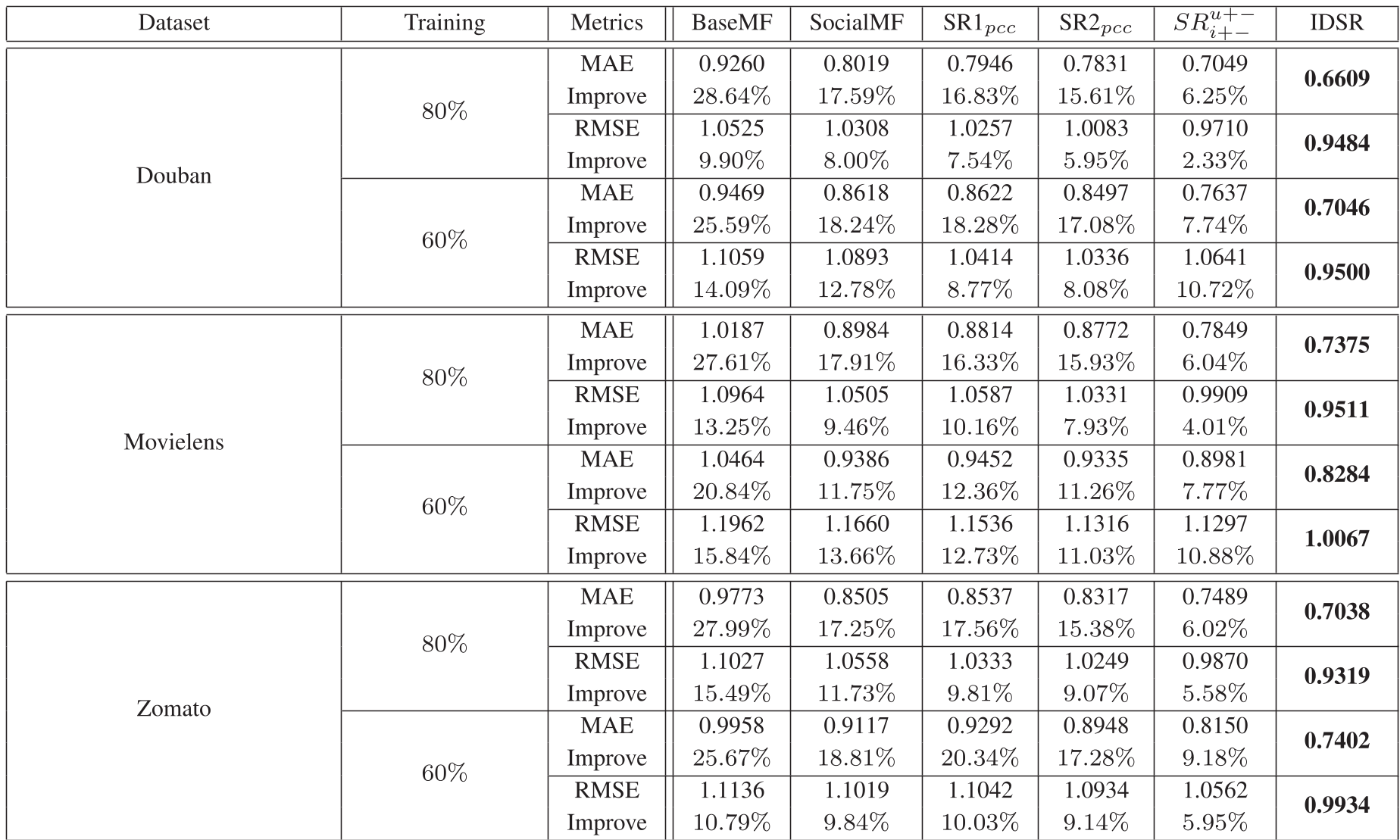
The authors tested IDSR on Zomato (Sydney restaurant reviews), MovieLens, and Douban.
Superiority over SOTA
IDSR consistently beat competitors like SocialMF and SR2pcc. By inferring the strength of relationships rather than assuming all "friends" are equal, IDSR provides a much cleaner signal for Collaborative Filtering.
The "Freshness" Factor
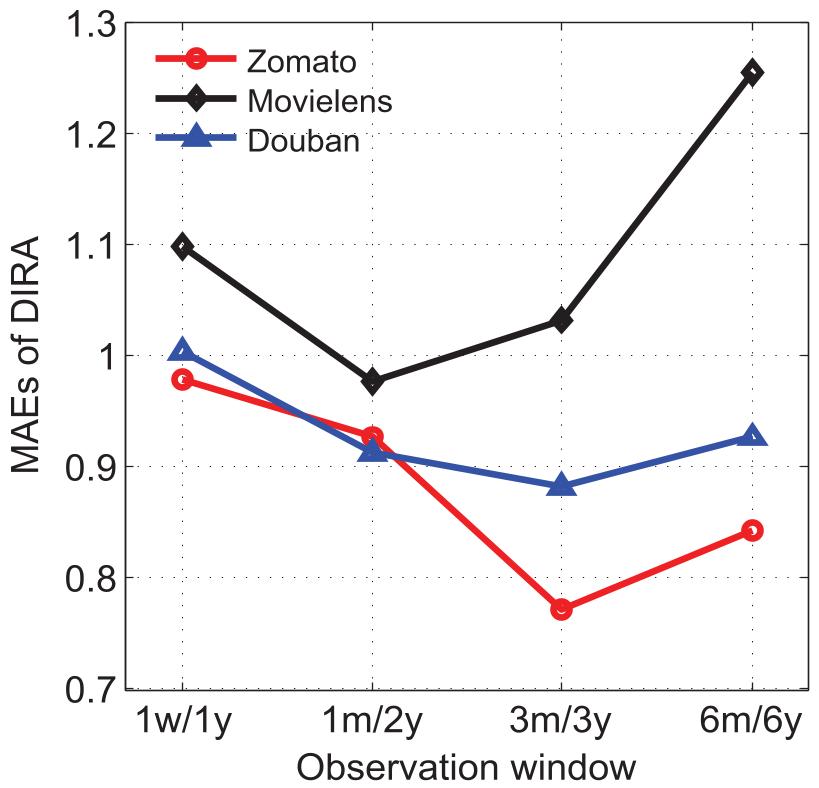
A critical finding in the ablation study (Figure 2) was the impact of Data Freshness. As the time distance between training data and target ratings increased, the error (MAE/RMSE) grew. This validates the author's premise: the most recent cascades are the most informative for current recommendations.
Critical Insight & Conclusion
IDSR proves that Time is a Feature, not just a Coordinate. By using the relative timing of actions to build a latent graph, we can bypass the privacy and noise issues of explicit social networks.
Limitations: The model currently assumes an exponential decay for influence. In reality, different types of items (e.g., viral news vs. classic movies) might follow different diffusion patterns (e.g., Power Law). Additionally, the computational complexity scales with the number of cascades, which may require distributed computing for hyperscale platforms.
Future Outlook: This work opens the door for "Implicit-as-Primary" social systems where the recommendation engine effectively discovers the community structure of the user base without asking for it.