
O2O-Inf: Breaking the Privacy Barrier by Inferring Online Ties from Offline Footprints
8581_Inferring Online Social Ties from Offline Geographical Activities.
The paper introduces O2O-Inf, a novel semi-supervised inference framework designed to uncover hidden online social ties using only offline geographical activities (check-ins and social events). By integrating multi-dimensional co-location features with a graph-based link propagation model, it achieves high accuracy in both social network inference and geo-link prediction.
TL;DR
Is your "private" social circle truly hidden? This paper presents O2O-Inf, a framework that reconstructs online social networks using purely offline geographical signals like check-ins and event RSVPs. By moving beyond simple "meeting frequency" and employing a sophisticated Link Propagation Model, the authors can predict friendships with high accuracy even for users who have never physically met in the data.
Background Positioning: This work bridges the gap between Trajectory Data Mining and Social Network Analysis. Unlike traditional link prediction that requires a partial graph, O2O-Inf treats the social network as a hidden variable to be inferred from physical-world interactions.
The "Iceberg" Problem: Why Simple Co-location Fails
Most online social ties are "only the tip of the iceberg." For the average researcher or service provider, the actual graph is unobservable. However, GPS-equipped devices record our lives 24/7. One might assume that if Alice and Bob are at the same cafe, they are friends. But this creates two major fallacies:
- The "Commuter" Noise: Strangers living in the same suburb might "co-locate" daily without ever speaking.
- The "Silent" Friendship: Real-world friends often don't check-in simultaneously or may even live in different cities, leaving no direct spatial overlap.
Methodology: The O2O-Inf Architecture
The framework attacks these challenges through a dual-engine design:
1. Feature Modeling (PCT + Graph Features)
To distinguish friends from "random encounters," the authors look at:
- Personal Factor: Does this location really matter to you (e.g., your home vs. a random mall)?
- Collective Factor: Is the meeting place a private residence (high tie probability) or a busy airport (low tie probability/high entropy)?
- Temporal Factor: Strangers have short, repetitive meeting windows; friends have varied, long-term interaction gaps.
To solve the "Silent Friendship" problem, they introduce Graph Features (GPF/GCF). They construct a Co-location Graph where edges represent spatial affinity. By applying measures like Adamic-Adar or Random Walk with Restart (RWR) on this graph, they can infer a link between Alice and Bob if they share many common "co-location neighbors," even if they never met each other directly.
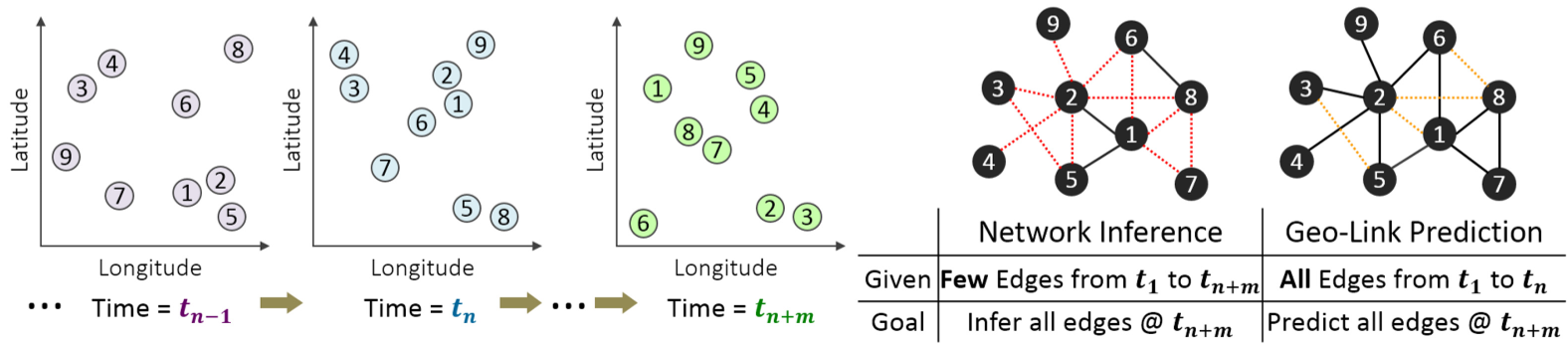 Note: The system extracts direct co-location features and propagates them through a structural graph to capture higher-order transitivity.
2. The Link Propagation Model (LPM)
This is the "brain" of the system. Instead of using a standard classifier that treats every node pair as independent, LPM treats the problem as a Semi-Supervised Learning task on a Linkage Graph.
- Nodes in Linkage Graph: Each node represents a pair of users.
- Edges: Connect user-pairs that have similar behavioral features.
- The Goal: Minimize the "entropy" of connection labels. If we know Pair A is a friendship, and Pair B looks exactly like Pair A in terms of PCT features, the model propagates the "Friend" label to Pair B.
Experimental Breakthroughs
The authors tested O2O-Inf on massive datasets from Gowalla and Meetup.
SOTA Comparison
O2O-Inf consistently achieved AUC and F1 scores above 0.75-0.85, significantly outperforming baselines like Random Forest and SVM. The reason for this gap is the Label Imbalance—in real social networks, the number of "non-friends" is massive. While standard ML models struggle with this skew, the Link Propagation Model handles it by clustering similar behaviors in the Linkage Graph.
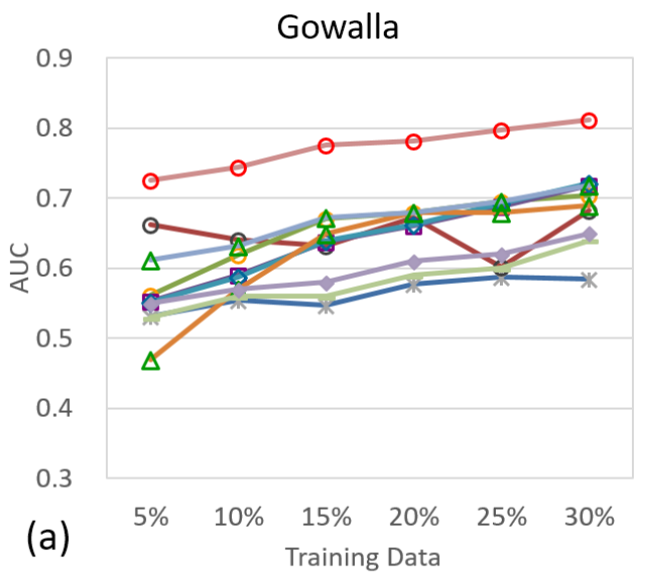 The charts clearly show O2O-Inf (solid line) maintaining superior performance across different training data volumes compared to traditional classifiers.
The Power of Graph Features
The ablation study revealed that using simple co-location features is decent, but Graph-based features (GPF/GCF) are the "secret sauce." They provided a substantial boost by correctly identifying friends who had zero direct co-locations but shared similar mobility "echoes" in the co-location graph.
Critical Insight & Conclusion
The Takeaway is clear: Geographical data is a high-fidelity mirror of our social lives. O2O-Inf succeeds because it recognizes that social behavior isn't just about "being in the same place," but about "moving in similar ways through similar contexts."
Limitations:
- Computational Cost: Constructing a Linkage Graph where each node is a user pair () is extremely expensive for billion-scale networks.
- Privacy Implications: This method highlights a massive privacy leak—even if you hide your friend list, your GPS history can reveal it with ~80% accuracy.
Future Outlook: The O2O-Inf framework paves the way for better Location-Based Services (LBS). Imagine a world where your phone recommends new friends or events not because you "liked" a page, but because your lifestyle trajectories naturally align with a specific community—an "algorithmic serendipity."