
Inferring Personality of Online Gamers: The Power of Multi-View Fusion in Virtual Worlds
Inferring Personality of Online Gamers by Fusing Multiple-View Predictions
This paper presents a multi-view framework for predicting the "Big Five" personality traits of online gamers using data from World of Warcraft (WoW). By fusing predictions from behavioral traces, character/guild name text analysis, and social network metrics, the authors achieve reliable personality profiling for 1,040 players.
TL;DR
Researchers from the Palo Alto Research Center (PARC) have developed a method to predict a player's real-world personality—specifically the "Big Five" traits—by analyzing their digital footprint in World of Warcraft. By combining how players fight (behavior), what they call themselves (text), and who they hang out with (social), the system achieves a significant predictive correlation, proving that our digital avatars are mirrors of our true psychological selves.
Background: Why Personality Matters in the Digital Age
In an era of hyper-personalization, "smart" systems need to understand more than just what you clicked—they need to understand who you are. Whether it's matching teammates in collaborative work environments, tailoring advertisements, or even detecting potential insider threats in corporate networks, personality is the ultimate "hidden variable." Massive Multiplayer Online Games (MMOGs) like World of Warcraft (WoW) serve as perfect "virtual laboratories" for this research because they offer a high-fidelity environment where players spend thousands of hours making expressive choices.
The Core Challenge: Noisy Traces and Single Characters
Previous research (notably Yee et al., 2011) proved correlations existed but often required aggregating data across all of a player's characters. This study raises the stakes: Can we predict personality based on a single character? This is crucial because, in the real world, systems usually only see one "account" or "avatar" at a time. The difficulty lies in the noise: a player might have a "bad day" in combat, or their social circle might be limited by their guild's schedule.
Methodology: The Three Pillars of Digital Identity
The authors propose a Multi-View Fusion framework. Instead of relying on one type of data, they analyze three distinct perspectives:
1. Behavioral Metrics (The "What")
The system tracks 68 high-level variables divided into 9 categories:
- Combat Style: Accuracy of "Need" vs. "Greed" rolls for loot, and Damage vs. Healing ratios.
- Exploration: Achievements and travel methods.
- Social Rituals: The frequency of "emotes" (e.g., /hug, /wave, /lol).
2. Textual Analysis (The "Identity")
Perhaps the most innovative part of the study is the analysis of character and guild names. Using sentiment dictionaries and n-grams (sequences of letters), the authors found that players don't choose names at random.
- Insight: Negative sentiment in a guild name often correlates with low Agreeableness. Names containing words like "warrior" might paradoxically link to lower Extraversion.
3. Social Network Analysis (The "Who")
By monitoring who plays together in the same zones at the same time, the researchers built social graphs.
- Graph Metrics: Degree centrality (how active you are) and Betweenness (how much of a "bridge" you are between groups) translate directly to personality markers like Extraversion and Openness.
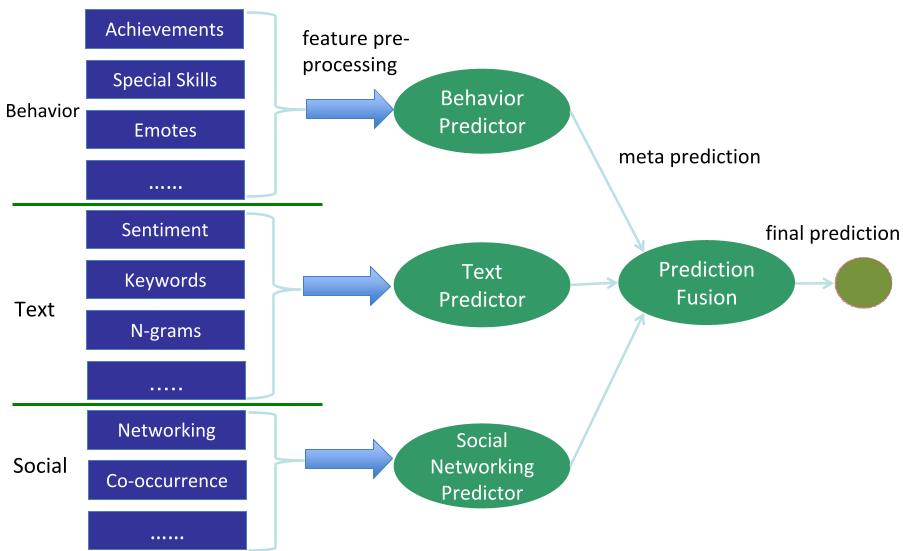 The Fusion Process: Training separate regression trees for each view and then integrating them via linear regression.
Experimental Insights: What Your Character Says About You
The team validated their model using a dataset of 1,040 WoW players. The results were striking:
- Names Win: Text analysis was the strongest individual predictor. Unlike behavior, which changes based on the game's current "meta," a name is a stationary, carefully chosen marker of identity.
- Extraversion: Highly reflected in the diversity of group vs. solo activities (raids vs. cooking).
- Agreeableness: Closely tied to "emote" usage (like /hugs) and specific PvP behaviors.
- Information Gain: The study used Information Gain (IG) to rank features. Interestingly, a feature that predicts "Openness" well is often also a good predictor for "Neuroticism," suggesting these traits share similar digital manifestations.
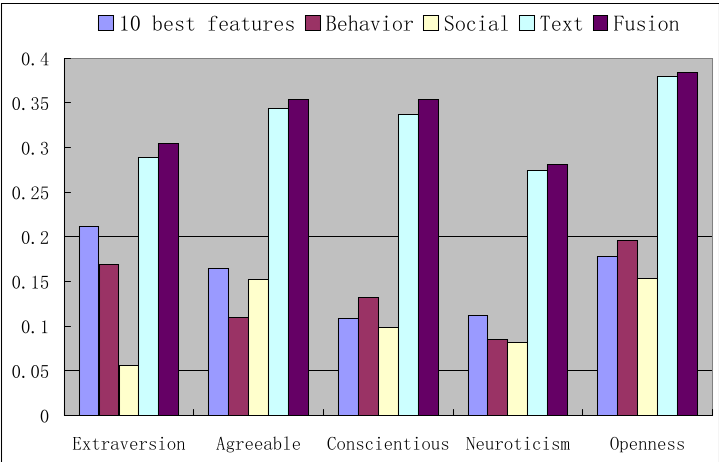 Comparison of predictive power: Fusion of all three sources (Behavior + Text + Social) consistently yields the highest correlation across all Big Five traits.
Critical Analysis & Future Outlook
Takeaway: This research proves that "Zero Acquaintance" personality profiling is possible in digital spaces. You don't need to meet a person or have them fill out a survey; you just need to observe their "digital shadow."
Limitations: The study relies on hand-crafted features. Today, we might replace Regression Trees with Deep Learning or LLMs to extract even more nuanced sentiment from text. Additionally, the data is specific to WoW; how these traits translate to other genres (like FPS or Simulation games) remains an open question.
Future Work: The authors hint at a compelling (and perhaps slightly chilling) application: using these models in corporate networks to detect "anomalous" behavior. If a person's digital behavior suddenly shifts away from their established personality profile, it could trigger an early warning for burnout or malicious intent.
Final Thought
Whether you are a "Conscientious Gnome" or an "Introverted Orc," your digital footprints are louder than you think.