
Your Social Circles Leak Your Secrets: Inferring Privacy via Bipartite Social Relations
Inferring privacy information via social relations
This paper introduces an iterative Bayesian label classification framework to infer missing privacy information (e.g., gender) in social networks by modeling data as a bipartite graph. By specifically identifying and leveraging "discriminative social groups," the method achieves high-accuracy inference using only social affiliation data.
TL;DR
Think deleting your gender or birthday from your social media profile keeps you anonymous? Think again. This paper demonstrates that by analyzing the groups you join and the friends you keep, an iterative Bayesian algorithm can guess your private information with over 80% accuracy. The researchers move beyond simple graph models to use the natural "bipartite" structure of social networks (Users <--> Groups) to peel back the curtain of digital privacy.
The "Anonymity" Illusion
Most privacy research focuses on what we reveal. However, a massive portion of the social media population leaves profiles incomplete—either by choice or by omission. The central question of this study is: Are these users safe?
The answer is a resounding "No." The authors identify a core vulnerability: Homophily. This is the sociological tendency for people with similar traits to associate. Boys play with boys; classmates are the same age. In the digital world, this translates to specific social groups (fan clubs, professional organizations, hobbyist circles) acting as massive statistical beacons for sensitive traits.
Methodology: Thinking in Bipartite Graphs
Unlike previous methods that flattened social networks into simple "user-to-user" links, these authors model the data as a Bipartite Graph.
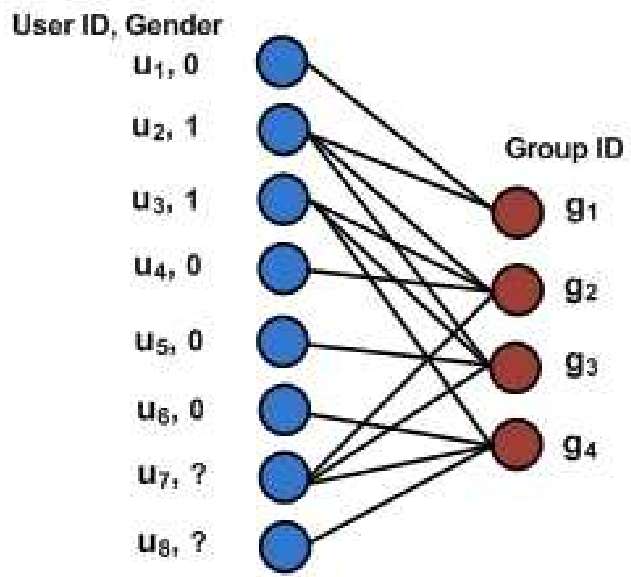
1. Bayesian Label Classification
The core of the inference is a Bayesian approach. Instead of just looking at the majority label of a user's friends, the model calculates the probability of a label given the set of groups a user joins: This accounts for the "weight" of different groups. If you join three groups that are 90% male, the likelihood of you being male increases exponentially.
2. The Power of Discriminative Groups
Not all groups are created equal. Some groups are "neutral," while others are discriminative (e.g., a "Women in Tech" group is highly discriminative for gender). The authors use a null hypothesis test to identify groups where the label distribution significantly deviates from the global average.
3. The Iterative Loop
The "magic" happens in the iteration.
- Identify highly discriminative groups.
- Infer labels for users in those groups.
- Use these new "predicted" labels to identify more discriminative groups that were previously too sparse to analyze.
- Repeat until no more users can be unmasked.
Experimental Proof: High Accuracy, High Risk
The researchers tested this against a real-world community of 6,563 users.
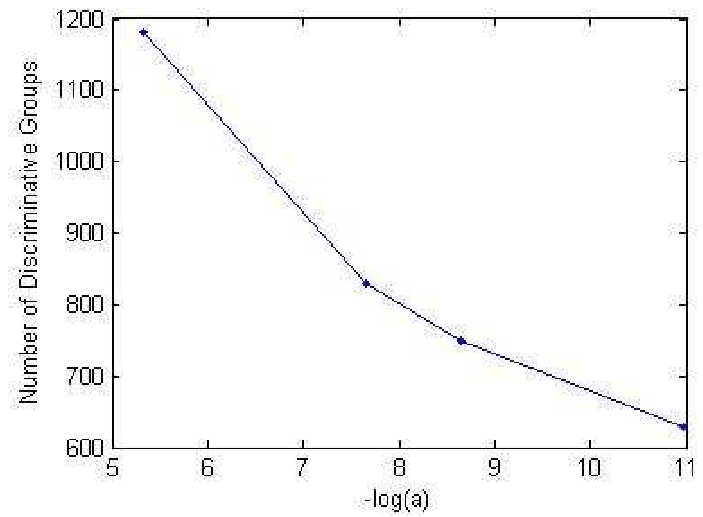 Note: Visualizing how the number of discriminative groups affects user coverage.
The results are sobering:
- Accuracy: The Bayesian method achieved ~82% Accuracy.
- Coverage: Even with a strict significance level (), they could still classify 70% of the entire network.
- Vs. Baselines: It significantly outperformed the "Global Method" (guessing based on total population frequency) which sat around 65%.
Critical Insight: The Bipartite Advantage
The primary reason this method succeeds where others struggle is its respect for the Group Entity. Traditional methods connect all members of a group to each other, creating a "clique." In a group of 10,000 people, this creates millions of useless edges. By maintaining the bipartite structure, the authors preserve the specific "participation relationship," allowing the Bayesian model to filter out the noise and focus on the groups that actually matter.
Conclusion and Future Outlook
This work serves as a stark reminder: Privacy is not an individual setting; it is a collective one. Even if you share nothing, your associations speak for you.
The authors suggest that future work could incorporate "Centrality" measures—looking at who the most influential members of a group are—to further refine accuracy. For the tech industry, this is a double-edged sword: it offers incredible potential for targeted advertising and personalization, but presents a massive ethical hurdle for user data protection.
Takeaway: Your digital identity is a puzzle, and your social relations are the pieces. Even if you hide the most important piece, the surrounding ones can often recreate the picture perfectly.