
GCNN-Inference: Breaking the Illusion of Privacy in Online Social Networks
Inferring Private Attributes Based on Graph Convolutional Neural Network in Social Networks
The paper introduces a Graph Convolutional Neural Network (GCNN) based inference model designed to predict hidden private attributes (e.g., marital status, occupation) in Online Social Networks (OSNs). By leveraging both visible user profiles and topological structure, the method achieves 80.8% accuracy on citation networks and demonstrates effectiveness on large-scale datasets like Soc-Pokec.
TL;DR
Social network "Privacy Settings" might be less effective than you think. This paper proposes a Graph Convolutional Neural Network (GCNN) approach to infer hidden user attributes (like marital status or political views) by analyzing the "company you keep." By treating the social web as a graph, the model achieves high-accuracy predictions even when users have explicitly hidden their personal data.
Background & Motivation: The Homophily Trap
Online Social Networks (OSNs) are built on the principle of Homophily—the tendency of individuals to associate with similar others. If most of your connections are software engineers in their 30s, an algorithm can guess your career and age with startling accuracy, even if your profile is blank.
Previous inference methods (like MLP or basic node embeddings) struggled with the high dimensionality and topological complexity of modern social graphs. The authors of this paper argue that Graph Convolutional Networks (GCNs) are the superior tool for this "passive attack," as they can systematically aggregate features from a user's multi-hop neighborhood.
Methodology: How GCNN "Sees" Your Secrets
The core of the approach is a semi-supervised GCNN model. It doesn't just look at who you are; it looks at what your connections imply about you.
1. The Input Layer
The model takes two primary inputs:
- Feature Matrix (): One-hot encoded vectors of visible public profile data (e.g., location, hobbies).
- Adjacency Matrix (): The raw map of social links between users.
2. Spectral Convolution & Renormalization
To ensure the model learns from the node itself as well as its neighbors, the authors use the Renormalization Trick: This ensures numerical stability and prevents gradient vanishing/exploding issues during training.
3. Depth vs. Over-smoothing
The authors utilize a 2-layer GCNN. Why not deeper? In graph learning, too many layers lead to "over-smoothing," where all node representations become identical. The paper notes that a 2-3 hop radius usually covers the most relevant local feature information in social graphs.
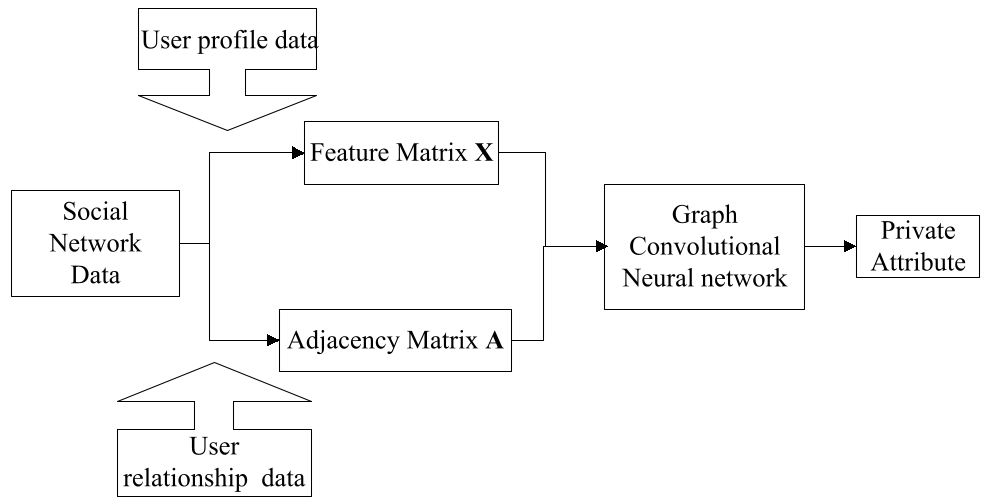 Figure 1: The architecture of the GCNN-based inference attack, moving from raw social graph to attribute classification.
Experimental Battleground
The researchers tested their model on two fronts: real social data (Soc-Pokec) and formal Citation Networks (Cora, Pubmed, Citeser).
Key Findings:
- Citation Networks (SOTA Performance): On the Cora dataset, the model achieved ~88% accuracy in predicting the category of a paper just by looking at its citations and keywords.
- Real-World Social Challenges: On the Soc-Pokec dataset (predicting Marital Status), accuracy dropped to 61.6%.
| Dataset | Nodes | Edges | Accuracy |
|---|---|---|---|
| Cora | 2,708 | 5,429 | ~88% |
| Pokec-subset | 4,000 | 41,367 | 61.6% |
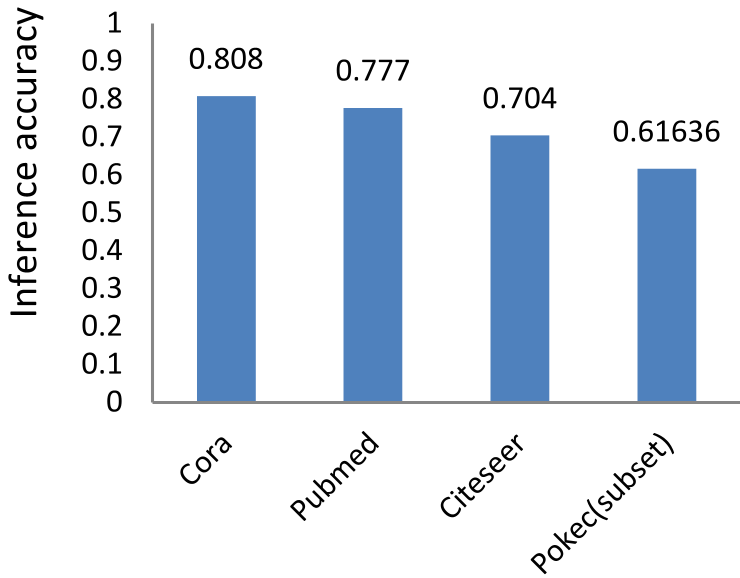 Table 1: Statistical breakdown of the datasets used to validate the inference model.
Why the gap in social network performance?
- Linguistic Noise: The Soc-Pokec data is in Slovak. The authors noted that "affirmation and negation of keywords are extremely similar," leading to noisy feature extraction.
- Impurities: Real social networks are much messier than citation graphs; people follow "strangers" or "celebrities" who don't reflect their own attributes, weakening the homophily signal.
Critical Insight: The Future of Privacy
The paper effectively demonstrates that privacy is a collective effort. Even if you hide your data, the "leaked" information from your friends and the structural patterns of the network can be recombined by GCNs to rebuild your profile.
Limitations: The current model relies heavily on manual feature extraction and "One-hot" encoding, which is less efficient than modern Large Language Model (LLM) embeddings. The authors suggest that future work must combine Natural Language Processing (NLP) with GCNs to better parse the nuances of social media posts.
Final Takeaway
This work serves as a warning for OSN administrators: hiding attributes is a shallow defense. Robust privacy-preserving social networks will need to go beyond "access control" and investigate graph-level obfuscation to truly protect user identity from deep learning-based inference.