
Your Friends Betray You: How Social Networks Leak Private Traits
Inferring private information using social network data
This paper investigates the threat of private information leakage in social networks, specifically focusing on inferring undisclosed user traits like political affiliation using a modified Naïve Bayes classifier. The authors introduce a "Links" and "Average" classification approach that leverages both personal profile details (node traits) and friendship structures (link data) to predict private data on a real-world dataset of 167,000 Facebook profiles.
TL;DR
Even if you hide your religious or political views on social media, your friends and your public "likes" can give you away. This paper demonstrates that a modified Naïve Bayes classifier can infer hidden traits with nearly 80% accuracy by analyzing the social graph. To stop these attacks, users must sanitize both their profile details and their friendship links, as hiding one while leaving the other is rarely enough to protect privacy.
The "Privacy Paradox" in Social Graphs
In the early days of social media (circa 2009), the "Privacy Paradox" became a central research theme: users claimed to value privacy but shared immense amounts of data. This paper targets a specific vulnerability—Inference Attacks.
The core insight is that individuals are not isolated data points. We exist in a "manifold" of social connections where Homophily (the tendency of individuals to associate with similar others) allows algorithms to fill in the blanks. If all your friends are "Conservative" and you share specific "traits" with them, your "Liberal" label is likely just a missing field waiting to be predicted.
Methodology: Beyond Simple Classifiers
The researchers didn't just use standard Naïve Bayes; they adapted it to handle the massive, interconnected nature of Facebook's DFW (Dallas/Fort Worth) network.
- Details Only: Uses profile attributes (e.g., music, books, movies).
- Links Only: Uses the link structure (who you are friends with).
- Average Classifier: A hybrid approach that balances both node traits and graph structure.
Architecture of the Attack
The authors crawled 167,000 profiles to build a real-world testbed. They focused on political affiliation as the target "private" variable.
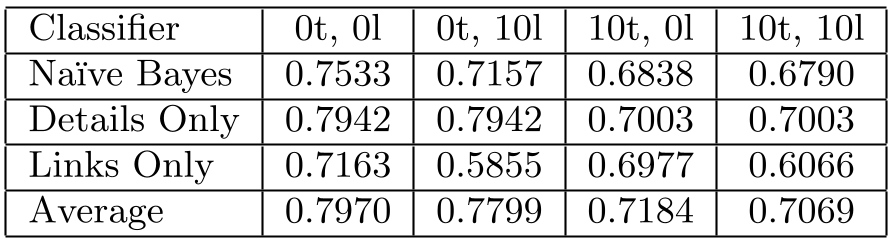 The table shows the "Average" classifier consistently outperforming simpler models, reaching 0.7970 accuracy.
Experiments: Sanitization vs. Inference
The most fascinating part of this study is the "Sanitization" experiment. How much data do you have to delete to be "safe"?
1. Removing Traits (The Profile Scrub)
The authors identified the most "telling" traits (those with the highest information gain).
- The Findings: Deleting just the #1 most predictive trait caused a massive drop in accuracy. Why? Because the classifier lost its primary indicator for "Liberal" users, causing it to default to "Conservative." However, removing more traits (top 2, top 3...) showed diminishing returns.
2. Removing Links (The Friend Scrub)
Unlike traits, which are removed globally, links are removed locally.
- The Findings: Deleting friendship links is highly effective at confusing the "Links Only" classifier, but it has a lower impact on the "Details" classifier.
Critical Insight: The "10t, 10l" Rule
The paper concludes that to truly defeat an inference engine, you need a combined strategy.
- 0t, 0l (Baseline): ~80% Accuracy.
- 10t, 10l (Sanitized): ~70% Accuracy.
While a 10% drop in accuracy might seem small, in a population of millions, it significantly increases the "noise" and protects a larger segment of the population from automated profiling.
Summary and Future Outlook
This 2009 work was a canary in the coal mine for the privacy scandals of the following decade (like Cambridge Analytica). It proved that:
- Links are Data: Your social graph is as revealing as your survey answers.
- Sanitization is Hard: To remain private, you would have to break so many social links and delete so much content that the social network might become useless to you.
Limitations: The study uses Naïve Bayes, which is a "local" classifier. Modern Graph Neural Networks (GNNs) and Collective Inference (looking at the whole graph simultaneously) would likely find even higher accuracy today, making the "sanitization" task even more desperate for the average user.
Takeaway: In a connected world, privacy is no longer an individual choice—it is a collective state determined by the people you know.