
Boosting Relationship Inference: Dual-View Co-Training in Social Networks
Inferring Relationship Semantics in Social Networks with Dual-View Features Semi-Supervised Learning
This paper introduces a semi-supervised co-training framework for inferring relationship semantics (e.g., friend vs. non-friend) in social networks. By leveraging dual-view features—interaction behaviors and automated network structural embeddings via node2vec—the model achieves superior classification performance even with limited labeled data.
TL;DR
Inferring whether two people are friends or mere acquaintances usually requires a mountain of labeled data. This paper presents a dual-view semi-supervised learning framework that combines "how people interact" with "where they sit in the network." By using node2vec for automated feature extraction and co-training to exploit unlabeled data, the authors achieve SOTA results with minimal human supervision.
The Motivation: Moving Beyond Manual Feature Engineering
The "semantics" of a relationship—the difference between a family member, a friend, or a colleague—is buried in digital footprints. While previous research used interaction frequency (how often you call) or local network structures (common friends), two problems remained:
- Feature Exhaustion: Manually defining local loops or structural "dispersion" is tedious and often misses higher-order patterns.
- The Label Scarcity: In the real world, 99% of social ties are unlabeled. We know people interact, but we don't know why.
The authors' insight is brilliant yet simple: Why choose between interaction data and network structure when you can use both to teach each other?
Methodology: The Dual-View Architecture
The core of the paper is the Co-Training Framework. It treats interaction and structure as two independent "views" of the same relationship.
1. View 1: Interaction Behaviors
The model tracks 64 features, such as Bluetooth proximity, tower registrations, and call frequencies. This captures the intensity of the bond.
2. View 2: Network Structural Embeddings
Instead of manually counting triangles, the authors use node2vec. This algorithm treats a social network like a corpus of text, performing random walks to learn a latent vector for every person.
- The Innovation: To represent an edge (the relationship) between two people, they tested several binary operators. They found that Weighted-L2 (the squared difference of vectors) was the only one that clearly separated friends from non-friends in the feature space.
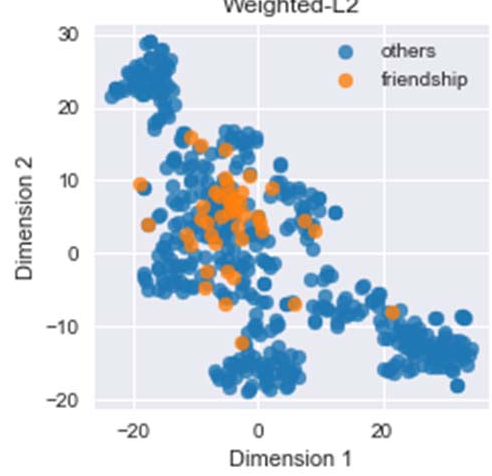 Figure 1: Visualization of edge embeddings. Notice how Weighted-L2 (bottom right) provides the most distinct clustering.
3. The Co-Training Loop
The model trains two classifiers (one for each view). In each round:
- Each classifier labels the unlabeled data it is most "sure" about.
- These high-confidence labels are added to the training set of the other classifier.
- The process repeats, allowing the two views to correct and improve each other.
Experiments & Results
Testing on the MIT Media Lab dataset, the results were conclusive. The semi-supervised co-training approach consistently outperformed supervised baselines (GBDT) and other semi-supervised methods like TSVM.
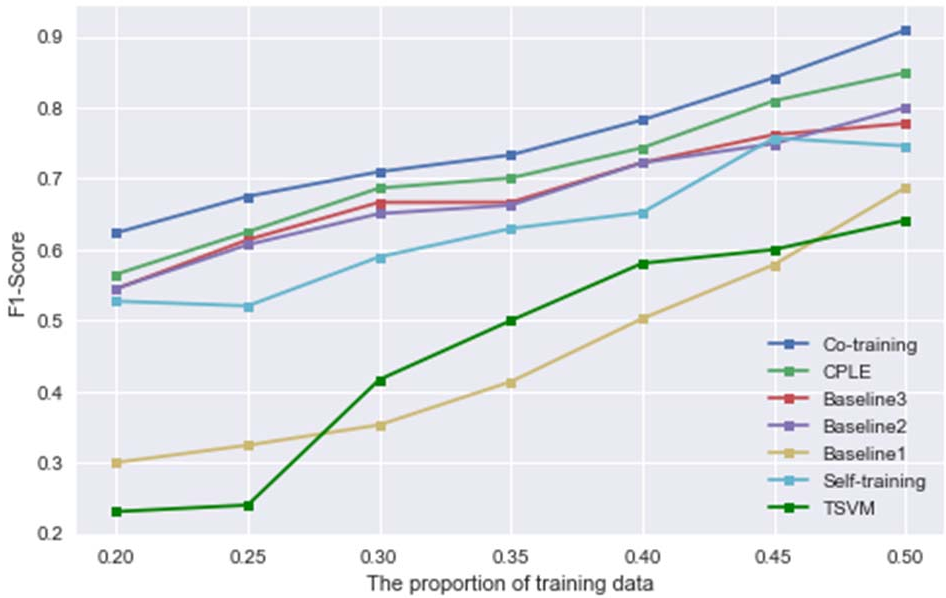 Figure 2: Performance comparison. The co-training model (purple) maintains the lead as more data is introduced.
One key finding was the Impact of Random Walk Length. The authors discovered that a walk length of 60 was the "goldilocks" zone—long enough to capture meaningful community structure, but short enough to avoid noise.
Critical Analysis & Conclusion
This work is a strong reminder that multi-view learning is underutilized in social computing. By letting structural embeddings and behavioral statistics "talk" to each other, we can bypass the need for massive labeled datasets.
Limitations: The model assumes the network is static. However, social ties are dynamic—a friend today might be a stranger next year. Incorporating Temporal Dynamics into the co-training framework is the logical next step for this research.
Future Outlook: As privacy concerns make it harder to access detailed interaction logs, relying more on structural "anonymized" embeddings via node2vec or Graph Neural Networks will be the key to the next generation of social recommendation engines.