
Your Devices are Gossiping: Inferring Social Ties from System Logs
Inferring social relationships from technology-level device connections
This paper explores "owner-device coupling" by using system log-files (syslogs) to infer social relationships between individuals. By applying Social Network Analysis (SNA) to technology-level metadata like USB, Bluetooth, and WiFi connections, the authors successfully reconstructed social clusters among university students and researchers.
TL;DR
Can a computer's diagnostic log reveal who your friends are? This paper proves that "owner-device coupling"—the deep link between our digital tools and our physical lives—is so strong that low-level metadata (like a USB serial number or a WiFi MAC address) can be used to reconstruct offline social networks with startling accuracy. By combining Computer Forensics with Social Network Analysis (SNA), researchers from Oxford demonstrated that they could distinguish between different social cohorts (undergraduates vs. researchers) just by looking at how their devices "interact" with the environment.
The "Invisible" Digital Footprint
We usually worry about privacy on Facebook or Twitter. However, every time you plug in a thumb drive or join a coffee shop WiFi, your Operating System (OS) creates a permanent record. These logs are intended for debugging, but they serve as a perfect "passive logger" of your social life.
The authors argue that existing work focuses too much on what users do (content) and not enough on how devices connect (context). The problem is that these "inadvertent" digital footprints are often unencrypted, persistent, and highly unique.
Methodology: From Syslogs to Social Graphs
The researchers proposed a three-step workflow to turn raw text files into social insights:
- Data Acquisition: Extracting
/var/logfiles (syslog, kern.log) from participants. - Feature Extraction: Using regex to find "technological foci"—events like
New USB device foundorWiFi connected. - Graph Construction: Mapping these events into a bipartite graph (Devices ↔ Foci) and subsequently into a co-affiliation network of people.
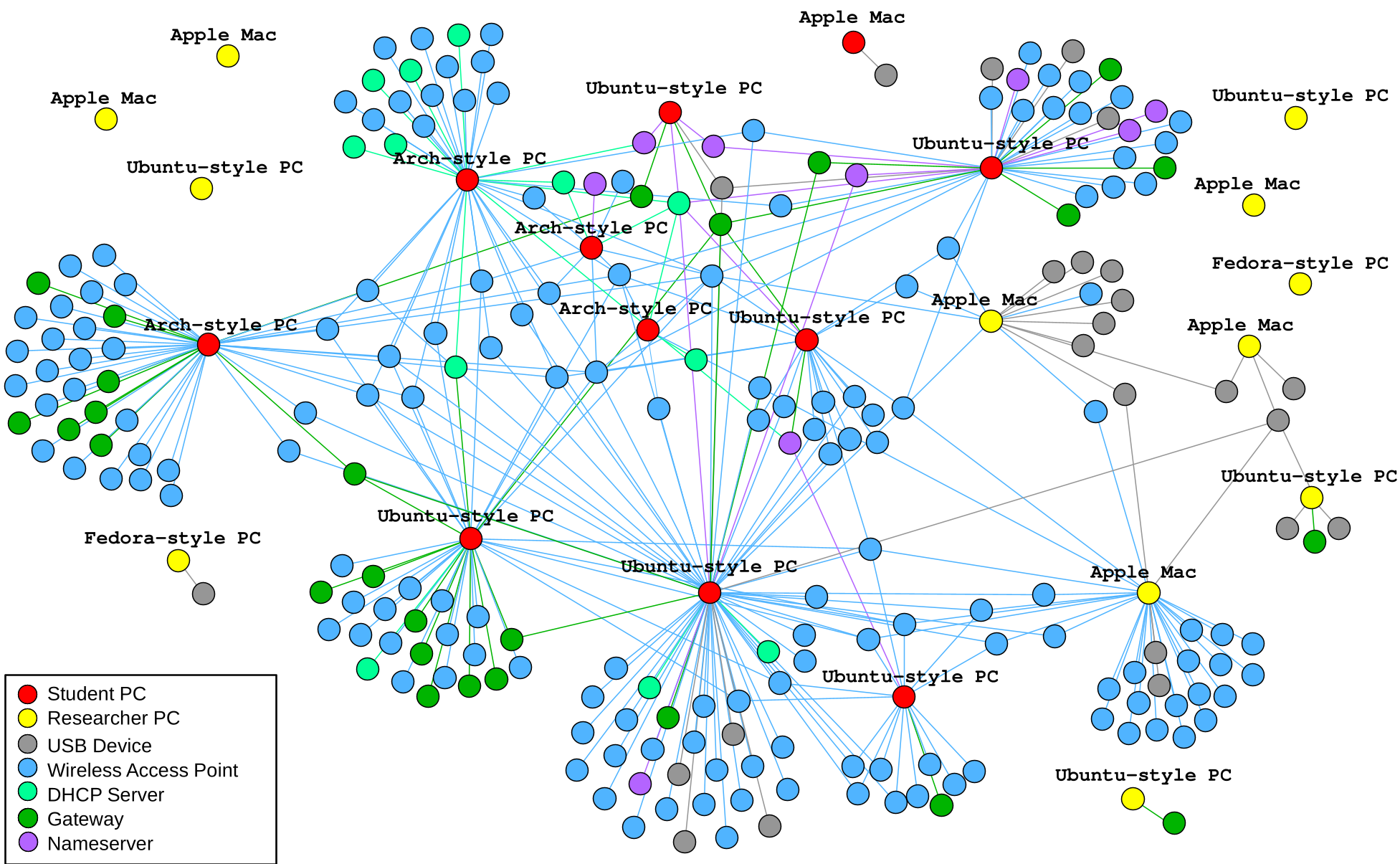 Fig 1: Network A - The bipartite view showing scanned devices (red/yellow) and the infrastructure/peripherals (other colors) they share.
The Logic of "Technological Foci"
The study defines different "weights" for social bonds:
- Shared WiFi Access: Shows you were in the same building (Weak tie).
- Simultaneous WiFi Access: Suggests you were in the same room at the same time (Stronger tie).
- Shared USB/Bluetooth: Implies a high level of interpersonal trust and physical collaboration (Intimate tie).
Experimental Results: Roles and Relationships
The experiment involved 23 devices from two distinct groups. The SNA metrics revealed clear behavioral differences:
- The Undergraduate Cluster: Highly connected via shared WiFi, reflecting a collaborative, mobile social environment.
- The Researcher Cluster: More isolated "nodes," but with a higher preference for sharing physical USB devices, indicating deep, trust-based collaboration.
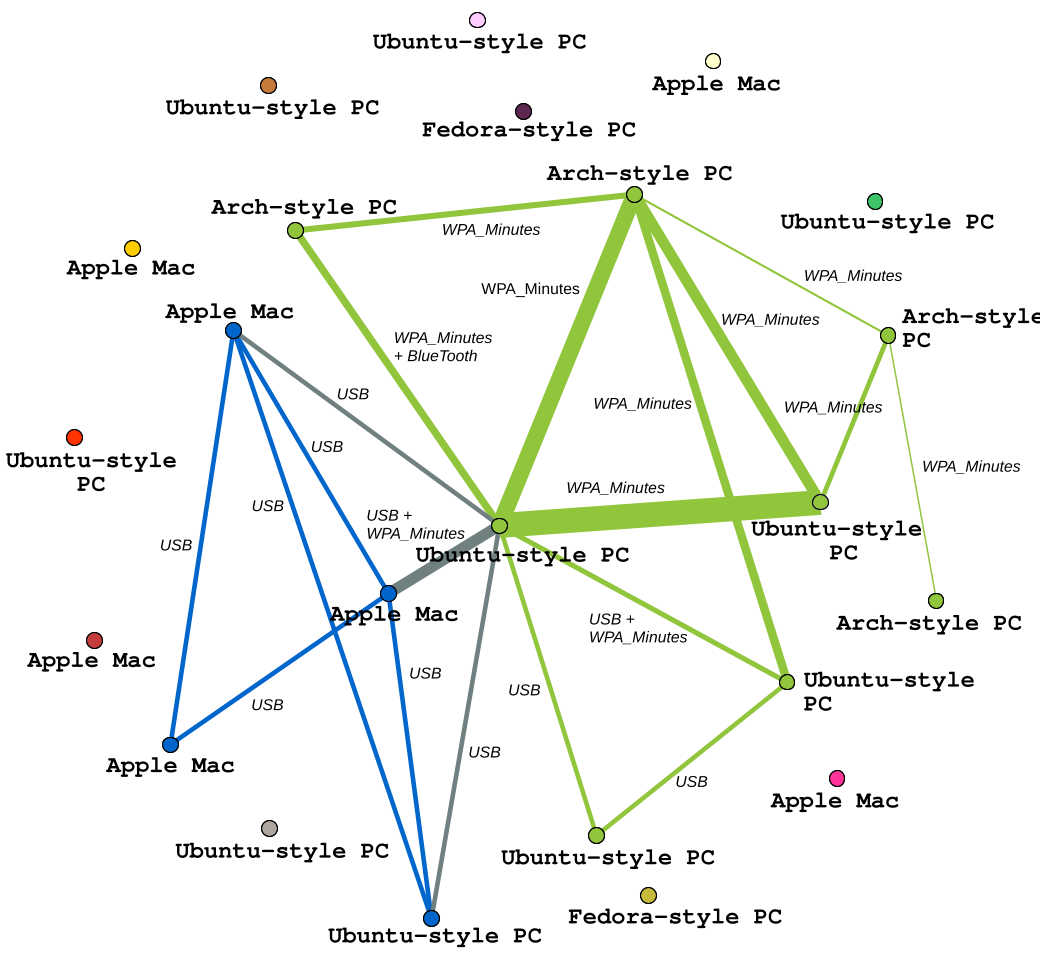 Fig 2: Community Detection - The algorithm successfully auto-clustered the nodes into the two real-world groups (Blue for Researchers, Green for Undergrads).
Critical Insight & Future Outlook
The most striking takeaway is the uniqueness of secondary devices. While WiFi SSIDs might be common (e.g., "Starbucks"), the specific hardware identifiers (BSSIDs and USB Serial Numbers) are nearly unique markers of location and association.
Limitations: The study notes that different OSs have different "logging cultures." For instance, Arch Linux doesn't log USB serials by default. However, as we move toward a world of "Always-On" IoT and mobile devices, the volume of this metadata will only grow.
The Takeaway for the Industry: Privacy is not just about your messages; it’s about your metadata. To truly protect user privacy, we need to rethink how OS-level logs are stored, pruned, and accessed by third-party applications.