
Beyond the Screen: Inferring the "Hidden" Social Network via Mobile Sensors
Inferring social relationships from mobile sensor data
This paper presents a two-phase supervised learning framework to infer hidden social relationships using mobile sensor encounter data. By analyzing spatio-temporal interaction patterns and applying graph-based refinement, the methodology achieves a 73.3% Precision and 71.4% Recall on real-world datasets.
TL;DR
Social networks aren't just lists of Facebook friends; they are built on physical interactions. This paper proposes a dual-phase supervised learning model that transforms raw mobile sensor "encounter" records—instances where two devices are in proximity—into a highly accurate map of social relationships, achieving a significant 71.4% Recall even for friends who never actually "met" during the data collection period.
Problem & Motivation
Most social network research focuses on digital platforms like Facebook or Twitter. However, the most fundamental social bonds occur in the physical world. While mobile phones act as ubiquitous sensors, translating proximity into relationship is notoriously difficult:
- The "Incident" Trap: How do you distinguish between two people who work in the same office building (incidental) and two people who are actually lunch-time friends?
- The "Sparsity" Gap: If two close friends don't happen to meet while their sensors are active, how can a model ever know they are connected?
The authors argue that by combining temporal interaction patterns with graph structural properties, we can bridge these gaps.
Methodology: The Two-Phase Intelligence
The proposed system moves from the "Physical" to the "Structural."
Phase 1: Temporal and Statistical Patterns
Initially, the model looks at direct evidence. It extracts:
- CDT (Cumulative Duration of Encounter Time): How long were they together?
- Encounter Frequency: How often do they see each other?
- Contextual Timing: Is this happening during work hours (colleagues) or on weekends/nights (family/friends)?
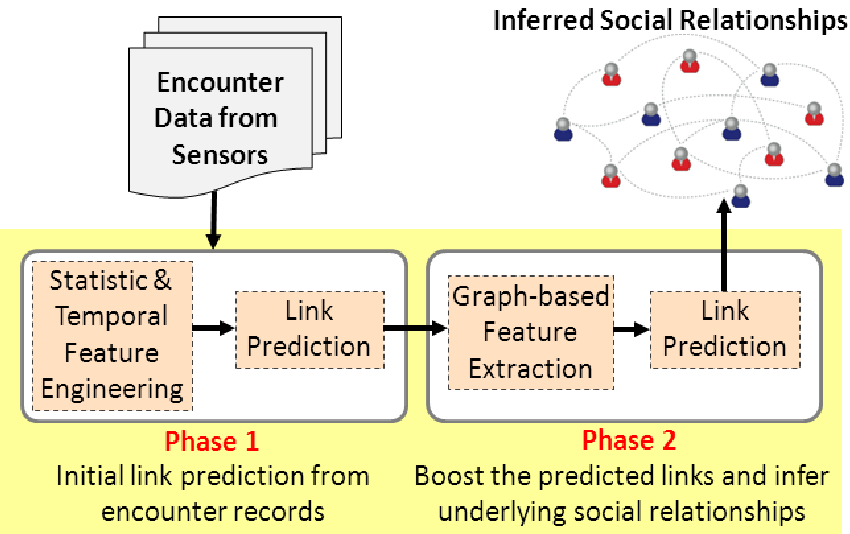
Phase 2: Graph-Based Refinement
This is the "secret sauce" of the paper. Even if individual A and individual B never met, if they share many mutual "physical" friends, the model uses graph metrics (like Jaccard coefficient and Kitting Time) to infer a missing link. It treats the initial predictions as a graph and uses network topology to fill in the blanks.
Experimental Performance
The researchers validated their model using CRAWDAD data and Facebook ground truth.
Comparison of Results
In Phase 1, using standard classifiers like AdaBoost, precision was respectable, but Recall was low (max 41.7%). The model missed too many real friendships because it only looked at direct sensors.
However, once the Phase 2 Graph Features were added, the results shifted dramatically:
| Method | Precision | Recall |
|---|---|---|
| Baseline (Rule-based) | 57.9% | 43.3% |
| Ensemble (Proposed Phase 2) | 73.3% | 71.4% |
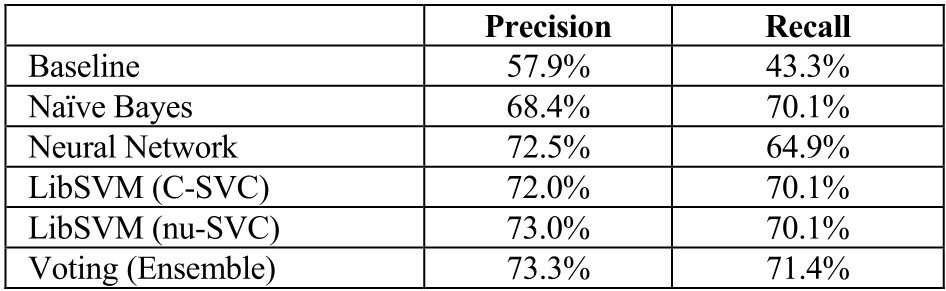
The significant jump in Recall (from ~40s% to 71.4%) proves that social networks follow a "Triadic Closure" property in the physical world—where friends of friends are likely friends, even if the sensor misses them.
Critical Analysis & Conclusion
Takeaway
This work demonstrates that mobile sensors are more than just distance-checkers; they are proxies for social dynamics. By integrating graph theory with sensor data, researchers can infer the "dark matter" of our social lives—those connections that exist but aren't always digitally recorded.
Limitations
A key limitation is the small sample size (25 devices). While the methodology is sound, scaling this to thousands of users introduces "Noise" in graph-based features (e.g., "The Stranger Paradox" in high-density areas like subways).
Future Outlook
This approach has massive implications for Epidemiology (predicting virus spread through hidden social clusters) and Context-Aware Recommendations (identifying your "real-world" circle versus your "digital-only" circle).