
Inferring the Invisible: How AI Peeks Behind the Wikipedia Editor Curtain
Inferring Sociodemographic Attributes of Wikipedia Editors: State-of-the-art and Implications for Editor Privacy
This research evaluates state-of-the-art machine learning models, including BERT and Tf-idf, to infer the sociodemographic attributes (gender, age, education, religion) of Wikipedia editors from their public profile pages. The study demonstrates that sensitive traits can be predicted with high precision—specifically achieving 82% precision for women—identifying significant privacy risks for the Wikipedia community.
TL;DR
Can your Wikipedia profile page betray your secret identity? This study proves it can. By applying state-of-the-art NLP models like BERT to the short "About Me" sections of Wikipedia editors, researchers successfully predicted gender with 82-91% precision. While this helps quantify Wikipedia’s known "gender gap" and "content bias," it exposes a massive privacy loophole: you don't need to "tell" the world who you are for a machine to figure it out.
Problem & Motivation: The Price of Knowledge
Wikipedia is the world’s digital library, yet the "librarians" (the editors) remain largely anonymous. Previous surveys suggests a massive skew—roughly 90% male. But surveys are slow and biased.
The researchers faced a paradox: To fix the Topical Bias (e.g., why are science articles more comprehensive than arts articles?), we need to know who is writing. However, the automated tools required to map these demographics create a Privacy Crisis. If an AI can infer your religion, age, and education from a few sentences, "anonymous" editing is a myth.
Methodology: Mining "User Boxes" and Textual DNA
The authors treated Wikipedia as a goldmine of pre-labeled data. They utilized several distinctive features:
- Label Acquisition: They didn't just guess. They used "User Boxes" (mini-badges like "This user is a woman") and category memberships to build a high-fidelity ground truth dataset.
- Feature Embedding: They compared three distinct philosophical approaches to understanding text:
- Tf-idf: Traditional word-frequency counting.
- Doc2Vec: Converting whole documents into spatial vectors.
- BERT (The Winner): A bidirectional transformer that understands context (e.g., it knows if "he" refers to a specific person mentioned earlier in the paragraph).
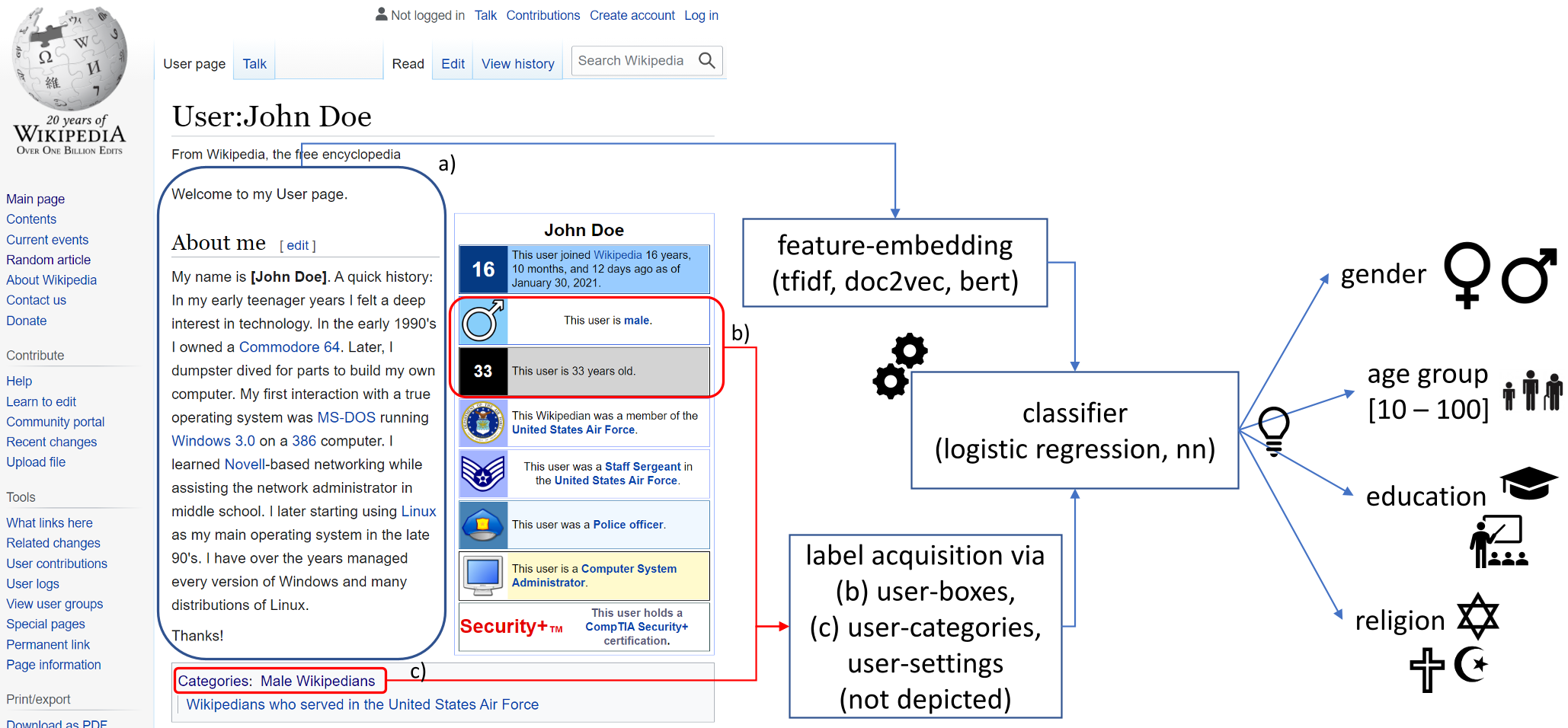 Figure 1: The pipeline from profile text/user-boxes to final sociodemographic classification.
Experiments: BERT Sees What You Don't
The results confirm that gender is the most "visible" attribute to AI. Even when editors tried to be neutral, BERT achieved an F1-score of 0.78 for gender.
| Attribute | Best Model | Precision (Minority Class) | Insight |
|---|---|---|---|
| Gender | BERT | 82% (Female) | Highly predictable due to linguistic markers. |
| Education | BERT | 60% (PhD) | Undergraduates are the easiest to identify. |
| Religion | BERT | 75% (Judaism) | Misclassifications often occur between Christians and Atheists. |
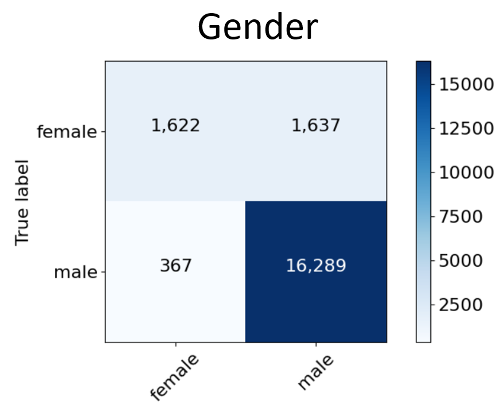 Figure 2: Confusion matrices showing the high accuracy for gender vs. the "noisy" but significant predictions for age and education.
Critical Insights: The End of Editorial Anonymity?
The paper offers a sobering conclusion for the Open Web:
- The "Disclosure Bias": The models are trained on people who choose to share labels. If you are a "private" person, your writing style might still match those who are "public," allowing the AI to bridge the gap.
- Malicious Profiling: While the researchers want to use this to fix Wikipedia’s bias, "bad actors" could use it to target specific demographics (e.g., harassing female editors or religious minorities).
- Collective Privacy: Privacy isn't just an individual choice. If enough people like you reveal their data, they effectively reveal yours by helping the AI build a more accurate model of your demographic group.
Conclusion
This work is a double-edged sword. It provides a SOTA toolkit for sociologists to study the "Wikipedia Gender Gap" at scale, but it serves as a "Final Warning" to the community. To protect editors, the authors suggest the community should reconsider the use of structured "User Boxes" and be mindful that every word written on a profile page is a digital fingerprint.