
Hierarchical Decoupling: Scaling Entity Type Inference in Massive Knowledge Graphs
Inferring Types on Large Datasets Applying Ontology Class Hierarchy Classifiers: The DBpedia Case
The paper presents a Local Classifier Per Level (LCL) approach to infer missing entity types in large knowledge graphs like DBpedia. By leveraging the ontology class hierarchy and machine learning (specifically C5.0 and Deep Learning), the method achieves a 56% increase in new type assignments compared to the SOTA SDType algorithm.
TL;DR
In the world of the Semantic Web, DBpedia acts as a structured backbone, yet its data is surprisingly "shallow." This paper proposes a novel Maching Learning-based approach called Local Classifier Per Level (LCL). By treating an ontology as a series of hierarchical classification steps and solving the "partial depth" stopping problem, the authors achieved an massive 39% improvement in F-measure over the previous industry standard, SDType.
The "Shallow" Data Problem
Knowledge Graphs (KGs) are only as useful as their metadata. In DBpedia 3.9, while we have millions of resources, nearly half of them are stuck with generic types like Agent or Place (Level 1) without further specialization into Writer, Engineer, or SubMunicipality (Levels 3+).
The problem is twofold:
- Noise: Collaboratively generated data contains transformation errors.
- The Connectivity Gap: SOTA methods like SDType rely on property distributions that fail when a resource has very few connections.
Methodology: The Hierarchical Approach
The authors' core insight is that entity types typically follow a coherent path through the ontology tree. For instance, Cervantes isn't just a Writer; he is a Thing -> Agent -> Person -> Artist -> Writer.
1. Feature Engineering
Unlike prior work that looked at outgoing properties, this study reinforces the insight that ingoing properties (how other entities refer to the target) are far more predictive of an entity's type.
2. The LCL Architecture
The system utilizes 11 distinct models:
- 6 Multi-class Models: One for each level of the hierarchy (Level 1 to Level 6).
- 5 Binary Models: These act as "gatekeepers" to decide if the resource should have a type at the next level, effectively preventing over-fitting and solving the Partial Depth Problem.
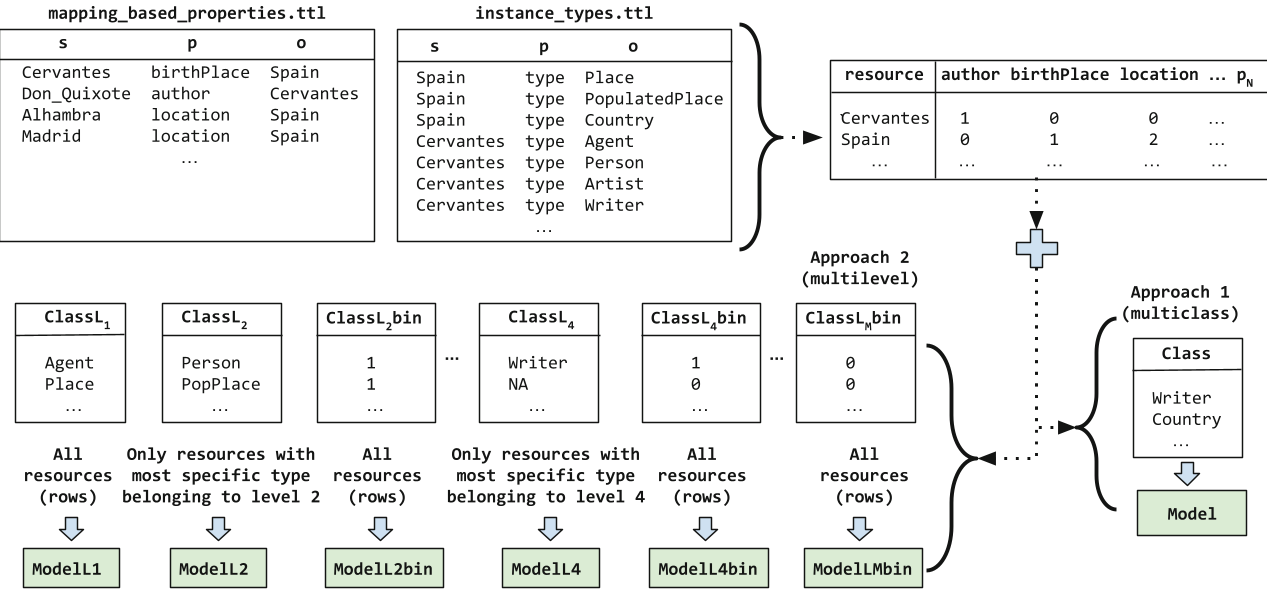 Fig 1: The feature extraction and model training workflow for multi-level typing.
Experiments & Critical Results
The authors tested their approach against SDType and SLCN. The results were particularly striking in "Test 1" (resources with minimal connectivity), where traditional statistical methods usually fail.
- Precision Boost: For the most specific types (Leaves), the precision climbed from 43.43% to 83.03%.
- Coverage: The approach generated 56.7% more types than SDType, covering a much wider variety of classes (256 vs 133 distinct classes).
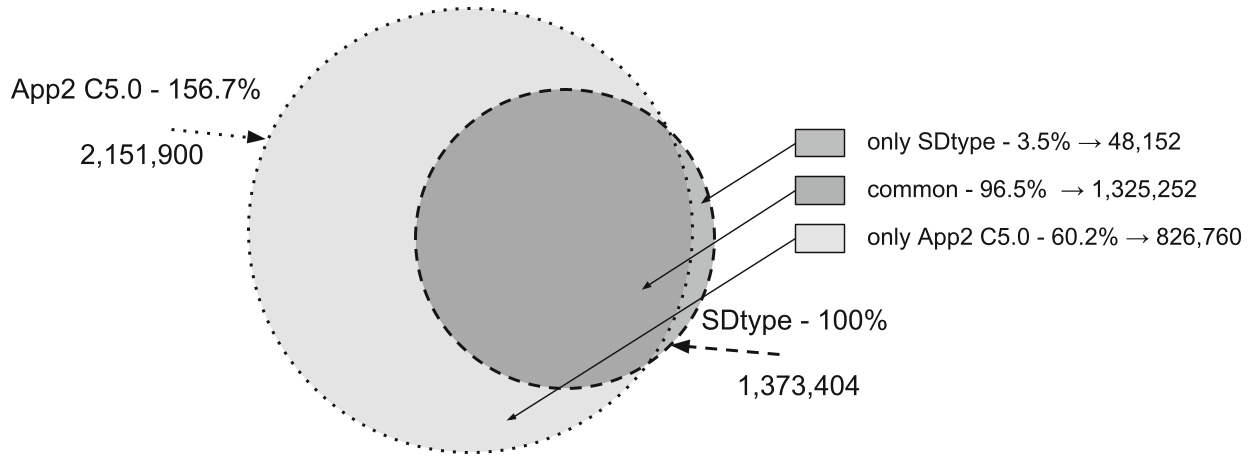 Fig 2: Overlap analysis between LCL and SDType, showing the massive increase in newly discovered types.
The choice of algorithm also mattered; while Deep Learning performed well, the C5.0 decision tree algorithm yielded the highest overall accuracy, likely due to its robustness in handling the specific categorical feature space of RDF triples.
Critical Insight: Why This Matters
Most Knowledge Graph completion tasks treat typing as a flat classification or a link prediction problem. This paper proves that respecting the hierarchy is not just a semantic requirement, but a performance booster. By decomposing a complex ontological path into discrete level-based decisions, the model reduces the search space and improves "type depth."
Limitations
- Taxonomy Consistency: While the LCL approach is efficient, it doesn't strictly guarantee that a child type is always logically consistent with the parent without a post-processing step.
- Connectivity Dependency: Although it outperforms SDType on low-connectivity data, it still relies on at least one ingoing property to function.
Conclusion
This work represents a significant step forward in KG quality. By moving away from purely statistical property counts and toward structured hierarchical classifiers, we can move the "Typed DBpedia" from a shallow list to a deep, specialized knowledge source. For anyone working in Semantic Search or RAG (Retrieval-Augmented Generation), these "Deep Types" are the keys to better entity disambiguation.