
Beyond Questionnaires: Mining the "Social DNA" of Personality on Facebook
Inferring user personality in social networks: A case study in Facebook
This paper presents a method for unobtrusively inferring user personality by analyzing interaction patterns on Facebook. Using the "TP2010" application and the Alternative Five model (ZKPQ-50-cc), the authors trained a C4.5 decision tree classifier on a large-scale dataset of over 11,000 users.
TL;DR
Researchers have developed a way to predict your personality by looking at how you use Facebook—specifically your friend count and wall activity. By analyzing data from 11,000+ users, they proved that machine learning can identify traits like Sociability and Neuroticism with over 80% accuracy, all without you ever filling out a boring survey.
Background Positioning
In the landscape of User Modeling, this work sits at the intersection of Psychometrics and Social Data Mining. While previous works focused on small-scale lab studies or text analysis of blogs, this paper leverages the massive scale of Facebook to establish a behavioral baseline for personality, moving from "active" assessment (asking users) to "passive" inference (watching behavior).
Problem & Motivation: The "Questionnaire Fatigue"
Adaptive systems—whether they are e-commerce engines or intelligent tutors—thrive on knowing the user. However, there is a fundamental paradox:
- Intrusiveness: Users hate long surveys (like the 50+ question ZKPQ).
- Reliability: If you make the survey shorter, you lose accuracy.
- Cold Start: Systems can't adapt until they know who you are.
The authors' insight was simple: Personality is stable through time and manifests in social relationships. If you are an extrovert, it will show up in your "Wall" statistics and "Active Friend" count.
Methodology: Turning Clicks into Traits
The study used the Alternative Five Model, which tracks five specific traits:
- Sociability (Sy)
- Activity (Act)
- Aggression-Hostility (Agg-Host)
- Impulsive Sensation Seeking (ImpSS)
- Neuroticism-Anxiety (N-Anx)
Architecture of Inference
The researchers built a Facebook app called TP2010. While users took a legitimate personality test, the app captured their metadata in the background.
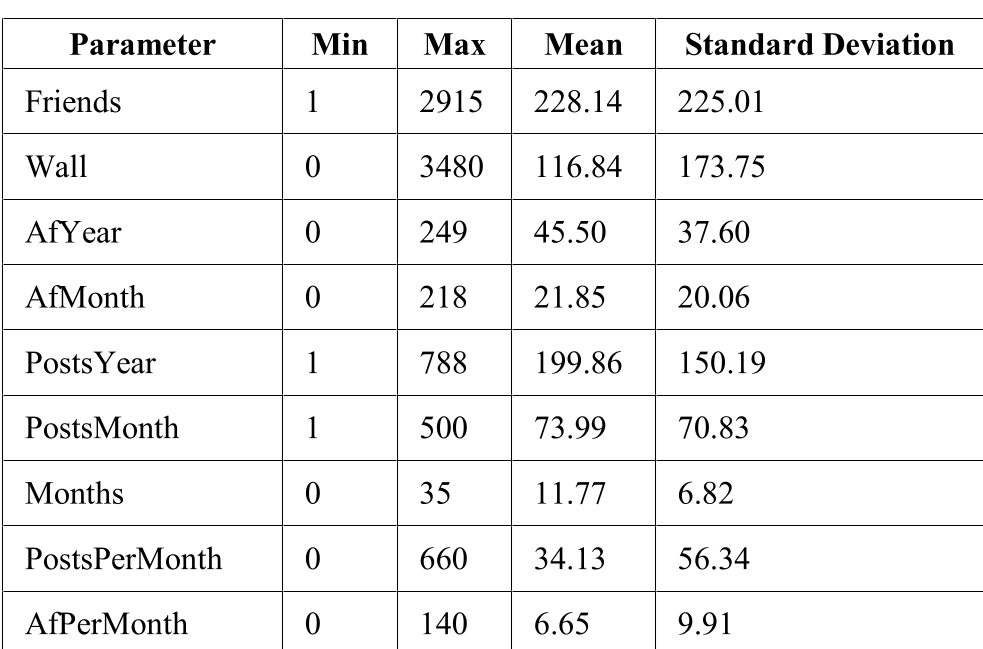 Key features included total friends, posts per month, and "Active Friends" (friends who actually write on your wall).
The core of the prediction engine used Decision Trees (J48/C4.5 algorithm). This was chosen for its interpretability—allowing researchers to see the specific "thresholds" of social activity that trigger a classification.
Experiments & Results
The study processed 11,148 valid records. Interestingly, the data showed that the average user has 228 friends but only interacts with about 20% of them annually (AfYear = 45.5).
Accuracy Breakthrough
The researchers tested three classification strategies:
- 3-Class (Low, Med, High): ~70-71% accuracy.
- 5-Class (Strict): ~62-64% accuracy.
- 5-Class (Adjacent Error Tolerant): 79-82% accuracy.
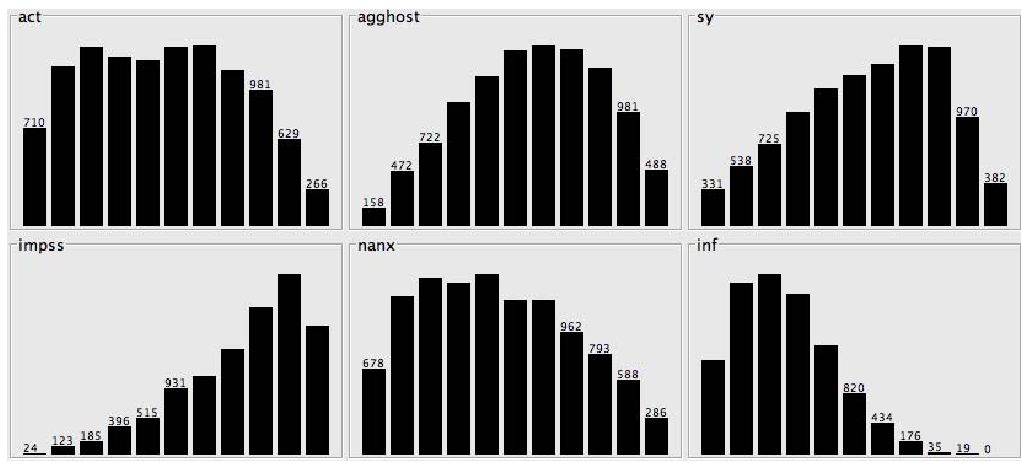 Figure 1: Frequency distribution of personality traits across the dataset.
The "Adjacent Error" model is particularly clever for the tech industry. In a real-world application, misclassifying a "Very High Sociability" person as "High Sociability" is a minor error that rarely breaks a recommendation engine, whereas misclassifying them as "Low" would be a failure.
Critical Analysis & Conclusion
Takeaway
This method allows for Offline Inference. A system can analyze a user's past 12 months of Facebook history the moment they Sign Up via Facebook Connect, providing a personalized experience instantly without a single question asked.
Limitations
- Privacy Ethics: While the study focused on accuracy, the "unobtrusive" nature of this mining raises significant privacy concerns in a post-Cambridge Analytica world.
- Feature Depth: The internal "content" of posts (sentiment, keywords) was not analyzed, only the "metadata" of the interactions.
Future Outlook
The authors suggest combining these structural metrics with Natural Language Processing (NLP) and even Mouse Movement Patterns. The future of UI is not just responsive to screen size, but "Psychometrically Responsive"—adjusting its tone, complexity, and speed to match the soul of the user behind the glass.