
Social Mass Diffusion: Breaking the Cold-Start Ceiling via Social Physics
Inferring users' preferences through leveraging their social relationships
The paper introduces Social Mass Diffusion (SMD), a recommendation algorithm that integrates social network structures with user-item bipartite networks. By simulating a mass diffusion process across both social ties and historical interactions, SMD achieves superior accuracy and effectively addresses the cold-start problem for new or inactive users.
TL;DR
Recommender systems often fail when they don't know enough about you—a classic "Cold-Start" dilemma. This paper introduces Social Mass Diffusion (SMD), an algorithm that treats social networks as a conduit for "resource allocation." By letting your friends' preferences flow to you via a physics-inspired diffusion process, SMD drastically improves recommendation accuracy for inactive users and provides a personalized experience for newcomers where traditional models offer only generic "popular" items.
The "Information Overload" vs. the "Data Desert"
In an era of information overload, we rely on algorithms to filter our choices. However, most SOTA methods (like Collaborative Filtering) suffer from a paradox: they need massive amounts of data to tell you what you like, but they are most needed when you have no data at all. This is the Cold-Start problem.
Current diffusion-based models (MD, HC) treat users as isolated islands in a sea of items. The authors' core insight is that homophily—the tendency of individuals to associate with similar others—can be used as a "preference bridge." If the system knows who your friends are, it can infer your tastes even if your purchase history is a blank slate.
Methodology: How SMD Distributes "Preference Mass"
The SMD model operates on a hybrid network: a user-item bipartite graph merged with a user-user social graph. The process follows a specific "physics" of resource distribution:
- Initialization: Items already liked by a user start with a resource value of 1.
- First-Step Diffusion: This mass flows from items to the users who collected them.
- Social Diffusion: Here lies the innovation. A user keeps a fraction of the resource and passes to their social contacts. This allows the signal to jump across the social graph.
- Final Diffusion: The accumulated resource (original + social) flows back to items.
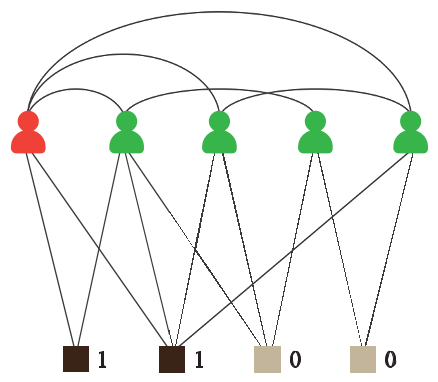 Figure 1: Illustration of the SMD process showing (a) Initialization, (b) Bipartite diffusion, and (c) Social diffusion.
Mathematically, the transition matrix combines the standard bipartite projection with a social propagation term:
Experimental Battleground: Friendfeed & Epinions
The researchers tested SMD against three baselines: Mass Diffusion (MD), Heat Conduction (HC), and the Hybrid method.
Key Findings:
- Accuracy Boost: In the Friendfeed dataset (which has a denser social graph), SMD achieved a Ranking Score (RS) of 0.0948, significantly outperforming MD (0.1064).
- The Power of Small : The authors discovered that even a tiny amount of social information (a very small ) breaks the "degeneracy" for inactive users, assigning non-zero scores to items that would otherwise be invisible to the algorithm.
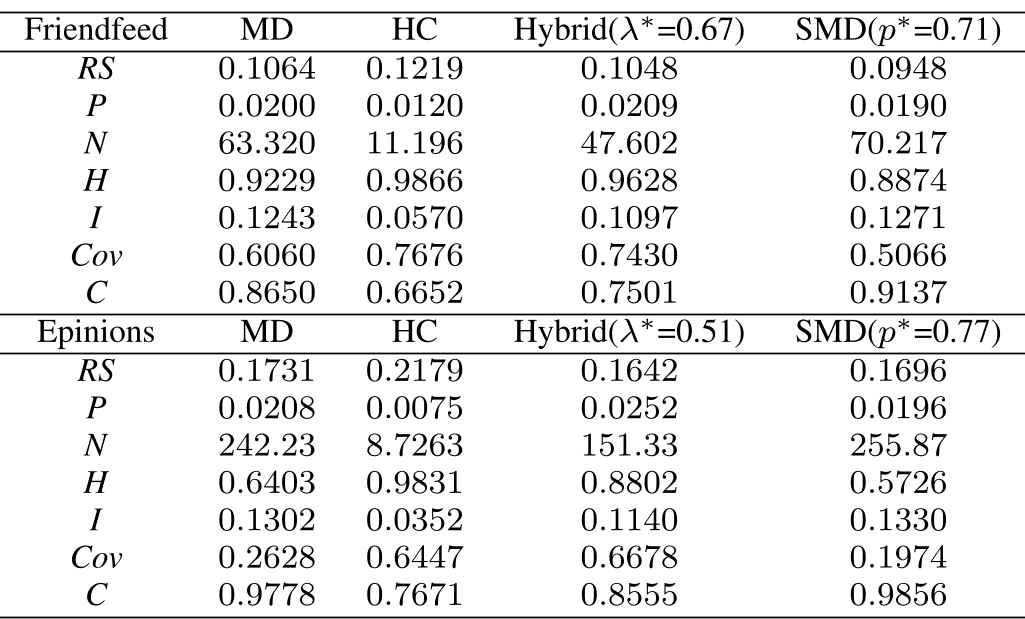 Table II: Comparison showing SMD leading in Ranking Score (accuracy) for the Friendfeed dataset.
Solving the Cold-Start Problem
The most impressive feat of SMD is its performance on "New Users." Traditionally, platforms use Global Ranking Methods (GRM)—simply showing everyone the most popular items.
SMD replaces this "one-size-fits-all" approach with Social Personalization. Even with zero purchase history, SMD uses a new user's social links to provide recommendations that are significantly more diverse and accurate than the general popularity list. As shown in the results, SMD outperformed GRM across almost all metrics, especially in Inter-user Diversity (H), meaning different new users actually received different, relevant suggestions.
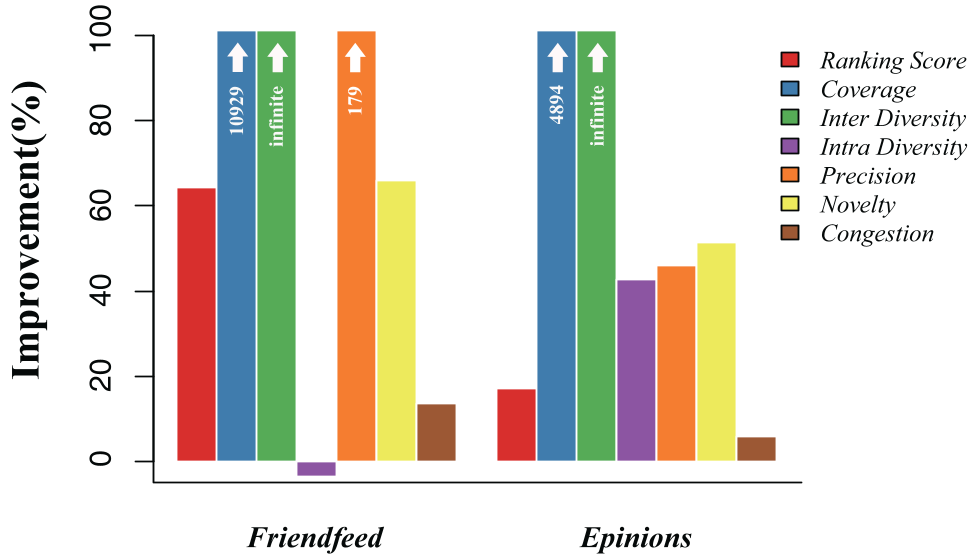 Figure 9: Massive fractional improvements of SMD over the Global Ranking Method for new users.
Critical Insight: The Sparsity Sensitivity
While SMD is a powerhouse for dense social graphs, its edge narrows in sparser environments like Epinions. This suggests that the value of SMD is directly proportional to the Social-Interest Correlation of the platform. For products where social influence is high (books, movies, lifestyle), SMD is an essential upgrade over pure bipartite models.
Conclusion
Social Mass Diffusion proves that in the world of big data, "who you know" is just as important as "what you've done." By integrating social physics into the recommendation pipeline, we can finally bridge the gap for inactive users and turn a "Cold Start" into a warm, personalized welcome.