
Beyond Static Spread: Mastering Influence Diffusion with Dynamic Propagation Rates
Influence Diffusion in Online Social Networks With Propagation Rate Changes
The paper introduces the Dynamic Influence Propagation (DIP) model, a novel framework where information propagation rates increase after a topic reaches a popularity threshold. It formulates the Threshold Activation Problem under DIP (TAP-DIP) and proposes the FAST algorithm, which achieves a approximation ratio for finding the minimum seed set needed to reach influence targets within a time limit.
TL;DR
Information doesn't spread at a constant speed—when a topic "goes viral," it moves faster. This paper introduces the DIP (Dynamic Influence Propagation) model to capture this reality. To solve the challenge of minimizing marketing costs (seeds) under this model, the authors present FAST, an algorithm that finds the "sweet spot" of viral acceleration to reach influence targets with efficiency.
The "Trending" Intuition: Why Static Models Fail
In classical viral marketing research, we assume the probability of influencing is a fixed number. However, the authors analyzed 4,000 Twitter trending topics and found a "heavy-tailed" distribution of speedups: once a topic hits the trending list, retweet delays drop dramatically.
The Problem: If you use a static model to plan a campaign, you will choose too many seeds because you aren't accounting for the fact that the network will "help" you spread the message faster once it gains momentum. This is a waste of budget.
Methodology: The FAST Framework
The core challenge of TAP-DIP (Threshold Activation Problem under DIP) is that computing influence is #P-hard, and the dynamic rate change breaks standard sampling techniques.
1. The Global Optimization Insight
The authors treat the time at which the speedup occurs () as a variable. By analyzing the relationship between the seed set size and this time, they discovered it follows a Lipschitz-alike property. This allows the FAST algorithm to iteratively narrow down the optimal time to trigger a "speedup" without checking every possible second.
2. Time Limit Conversion (TLCA)
To make Sampling (RIS) work again, the authors developed a "relativity" trick: they convert the dynamic rate period into a "standardized" time limit.
- Logic: Moving faster for a short time is mathematically equivalent to moving at a normal speed for a longer time.
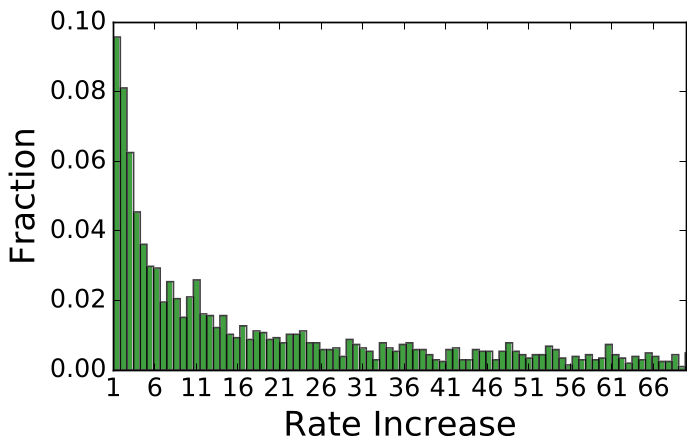 Figure 1: The piecewise function defining how propagation rate shifts as popularity thresholds are met.
Efficiency and Scalability
The authors implemented Multi-IM, a subroutine that solves the Multi-Threshold Influence Maximization problem. Unlike previous SOTA methods like IMM which can be over-cautious in sampling, Multi-IM adaptively determines sample requirements.
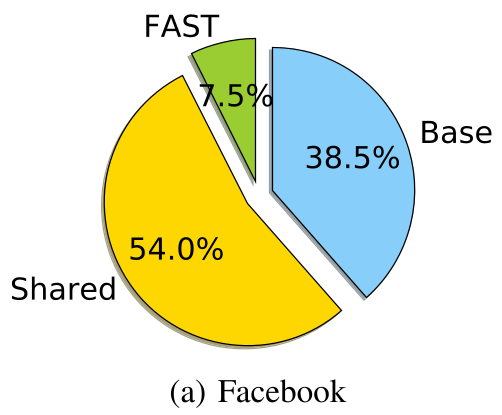 Figure 2: MMinSeed with Multi-IM significantly outperforms IMM-based approaches in execution time across diverse datasets.
Experimental "Alpha":
In massive networks like LiveJournal (4.8M nodes, 138M edges), the FAST algorithm proves its industrial viability by scaling linearly with the number of edges.
Deep Insight: Spend Less by Knowing When to Accelerate
One of the most tactical findings in the paper is the Seed Set Distribution. The seeds selected by FAST are often a subset of those chosen by static models. By strategically timing the "trending" moment, marketers can achieve 90%+ coverage while using significantly fewer resources.
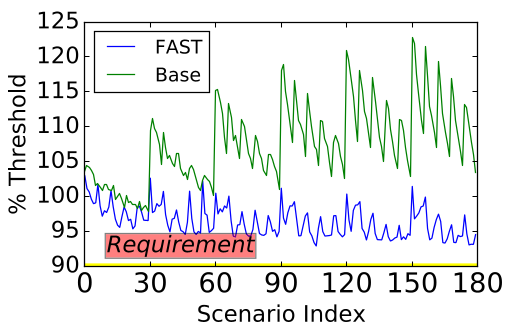 Figure 3: Sensitivity analysis showing how the algorithm adjusts speedup times based on the required "Trending Node" count and "Activation" thresholds.
Conclusion & Critical Analysis
Takeaway: This paper bridges the gap between theoretical influence maximization and the empirical reality of social media "trending" mechanics.
Limitations:
- The model assumes a linear increase in rate during the transition period (), which might still be a simplification of complex platform algorithms.
- It relies on the expectation of influence rather than the variance, which might lead to under-performance in highly volatile networks (as seen in some LiveJournal trials).
Future Work: Integrating this with Reinforcement Learning to dynamically adjust seeding strategies in real-time as the propagation rate shifts would be the next logical frontier.