
Positivity as an Antidote: How Emotional Shifts Shape Social Media Diffusion
On the Influence of Emotional Valence Shifts on the Spread of Information in Social Networks
This paper investigates how emotional valence shifts influence information spread on Twitter by analyzing 4.4 million tweets across 24 real-world events. Using Plutchik’s wheel of emotions, the authors demonstrate that while users generally conform to an event's dominant emotion, "shifted" positive emotions frequently emerge during negative events as a psychological "antidote."
TL;DR
Analyzing 4.4 million tweets, this study uncovers a fascinating psychological phenomenon in digital spaces: while we usually tweet in sync with world events, we often inject "shifted" positive emotions into negative crises. This serves as a digital "antidote," supporting the Undoing Hypothesis—the idea that positive emotions help us socially bond and "undo" the lingering effects of negative stressors.
Problem & Motivation: The Conflict of Clicks
Does a "happy" tweet spread further than an "angry" one? Academic literature is divided. Some researchers point to the Pollyanna Hypothesis, suggesting humans have a natural preference for positivity. Others argue that "negative" news—fueled by outrage or fear—spreads with greater velocity and reach.
The authors of this paper noticed a gap: most studies look at the what (the sentiment of the tweet) but ignore the context (the nature of the event). They sought to understand why positive messages often emerge and thrive even during tragedies like the Aleppo bombings or Italian earthquakes.
Methodology: Mapping the Emotional Landscape
The research team tracked 24 world events across five domains (Politics, Pop Culture, War, etc.). Key to their approach was Plutchik’s Wheel of Emotions, which goes beyond simple +/- scores to track eight core emotions: Joy, Trust, Fear, Surprise, Sadness, Disgust, Anger, and Anticipation.
The Concept of Valence Shifts
The study defines two types of content:
- Expected Emotions: A positive tweet about a trailer release.
- Shifted Emotions: A positive, hopeful tweet during a natural disaster or war.
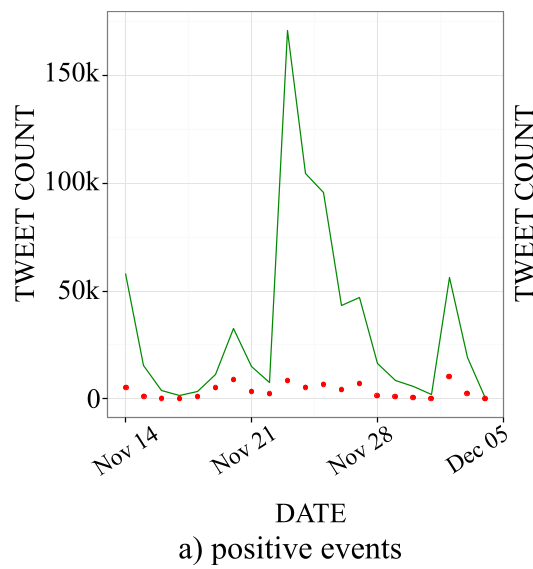 Fig 1: Relative intensity of emotions across polarizing, positive, and negative events.
Key Insights: The "Undoing" Effect
The data revealed a striking pattern. In positive events, negative tweets are rare and consistent. However, in negative events, positive "shifted" tweets are highly dynamic and occasionally outnumber negative ones.
1. The Undoing Hypothesis in Action
The authors found empirical evidence for the Undoing Hypothesis in OSNs. During "emotionally tough" events, users don't just vent; they use Twitter to seek Social Connection. Examples included:
- Compassion: "Oh dear world, I am crying tonight" (Aleppo).
- Hope: "Please join us as we #PrayforItaly" (Earthquake).
Positive emotions in these contexts act as a survival mechanism, helping the community regulate the collective stress of the event.
2. Engagement Metrics
Engagement followed the "expected" sentiment. While negative events saw more tweets per user (2.86), positive events drove significantly higher retweet counts and likes.
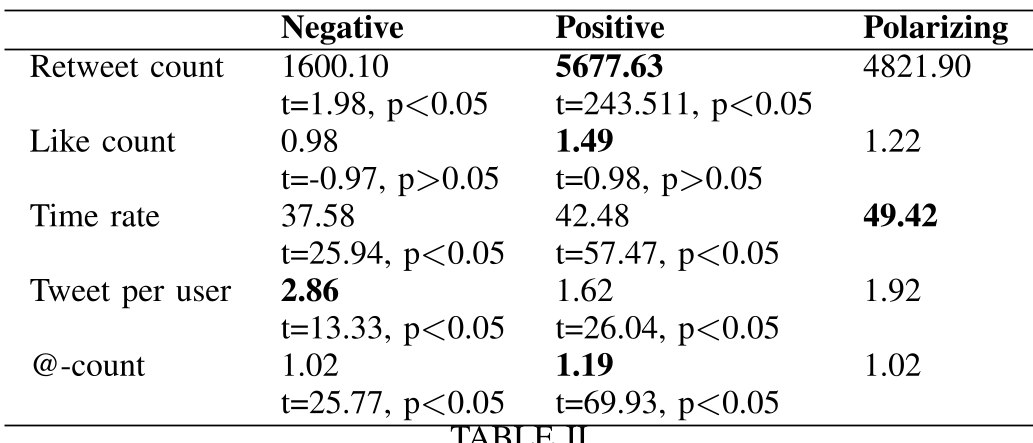 Table 1: User behavior metrics showing that positive events trigger higher retweet counts and social interaction (@-counts).
Critical Analysis & Conclusion
Takeaway
The study proves that Online Social Networks are more than just information conduits; they are emotional regulation tools. The prevalence of shifted positivity during crises suggests that social bonding is a fundamental human drive that persists even in the face of tragedy.
Limitations & Future Work
- Language Bias: The study was restricted to English, potentially missing cultural nuances in emotional expression.
- The Bot Factor: The authors acknowledge that automated accounts (bots) might play a role in shifting valence, a topic slated for future research.
- Platform Specificity: While Twitter is high-velocity, platforms like Facebook or YouTube might exhibit different bonding patterns due to their varied social structures.
By bridging the gap between social network analysis and classical psychology, this work provides a more nuanced view of how we communicate under pressure.