
IMPP: Strategic Information Diffusion—Maximizing Reach While Sidestepping Competitors
An algorithm for influence maximization in competitive social networks with unwanted users
This paper introduces the Influence Maximization with Limited unwanted users (IML) problem and proposes IMPP, a path-based propagation strategy. By utilizing independent paths and a propagation increment function, the method achieves state-of-the-art results in competitive social networks under the Independent Cascade (IC) model.
TL;DR
Information propagation isn't always about "the more, the merrier." In competitive environments, reaching the wrong people (unwanted users) can trigger countermeasures. This paper proposes IMPP (Influence Maximization based on Path Propagation), an algorithm designed to maximize influence among target users while strictly limiting leakage to unwanted ones, all while bypassing the massive computational cost of traditional simulations.
The "Unwanted User" Dilemma
In classic Influence Maximization (IM), the goal is simple: pick seeds to trigger the largest cascade. However, the real world is competitive. If you are launching a secret marketing campaign, you want your customers to know, but you don't necessarily want your competitors to see your strategy immediately.
The technical hurdles are twofold:
- Metric Conflict: Balancing the activation of "Wanted" vs. "Unwanted" users is mathematically complex; the resulting objective function is neither monotonic nor submodular.
- Efficiency Bottleneck: Standard greedy algorithms use Monte-Carlo simulations to estimate influence, which is #P-hard and notoriously slow.
Methodology: Moving from Simulation to Probability Paths
Instead of "rolling the dice" thousands of times (Monte-Carlo), the authors use a Path Propagation Strategy.
1. Independent Path Estimation
The core idea is to find a set of paths between nodes that do not share edges. By calculating the probability of activation along these independent paths, the algorithm can estimate the likelihood of node A activating node B without exhaustive simulation.
2. The IML Objective Function
The authors define the influence of a seed set as: Where represents unwanted users. This effectively penalizes the model for every unwanted user it accidentally "infects."
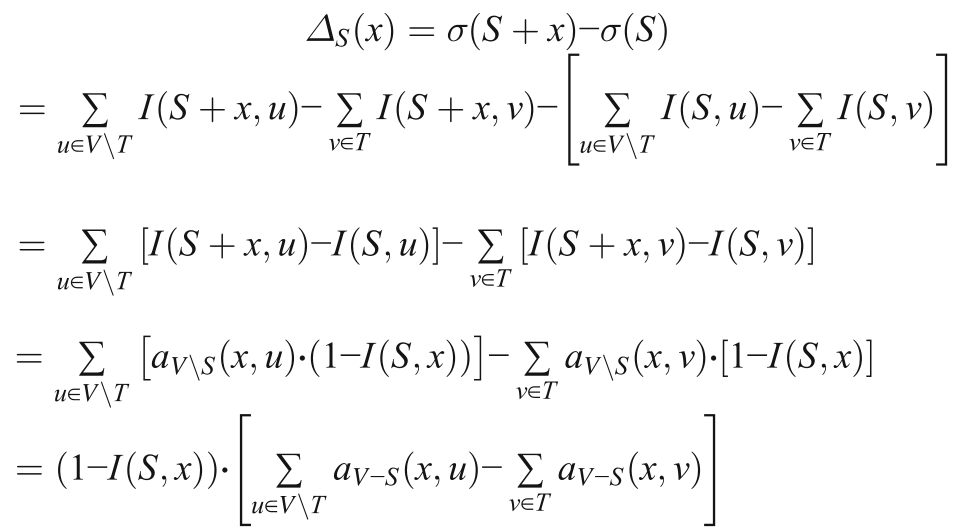 The propagation increment formula used to sequentially select seeds.
Experimental Battleground
The researchers tested IMPP against several heavyweights, including Greedy (Monte-Carlo based), Meta-Heuristics (MH), and Simulated Annealing (SA).
Performance Mastery
Across datasets like BlogCatalog and Gnutella, IMPP consistently achieved higher influence spreads. Even as the number of unwanted users () increased, IMPP maintained a stable lead, demonstrating superior "surgical" precision in seed selection.
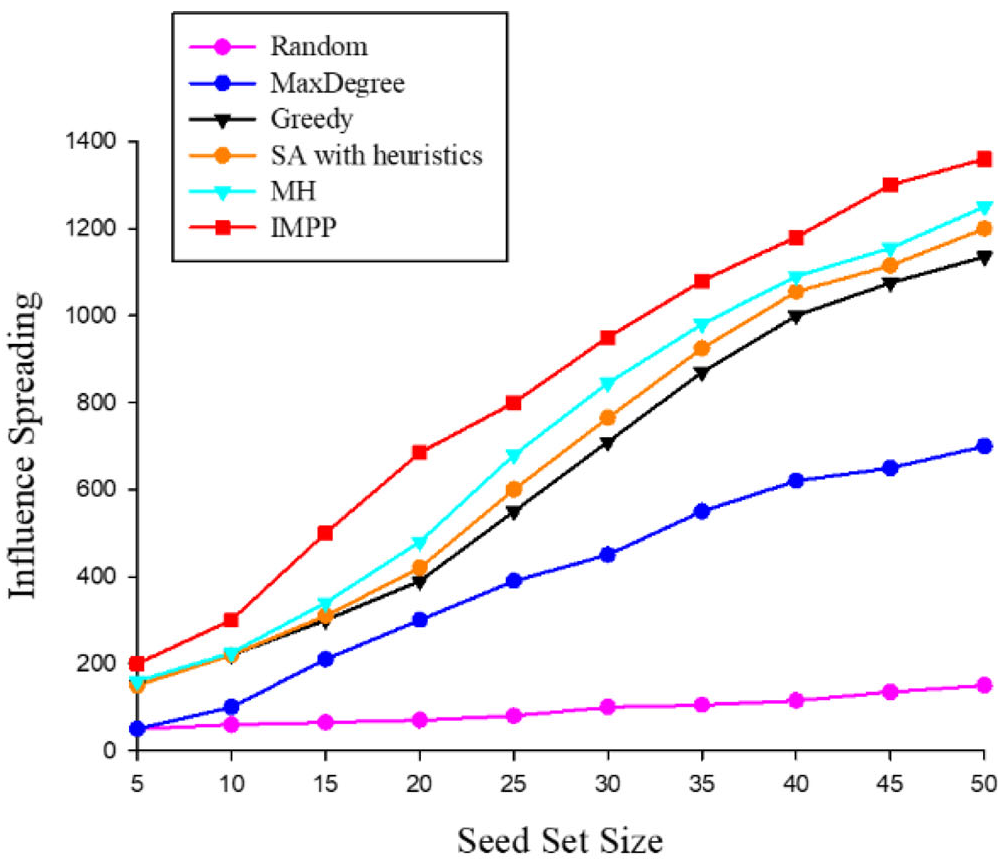 Performance comparison showing IMPP (red line) outperforming baselines as seed size increases.
The Speed Advantage
The most striking result is the efficiency. While the standard Greedy algorithm takes hours to process 50 seeds on moderate networks, IMPP finishes in a fraction of the time. By using the Propagation Increment Function, the model updates its state iteratively without restarting the simulation process.
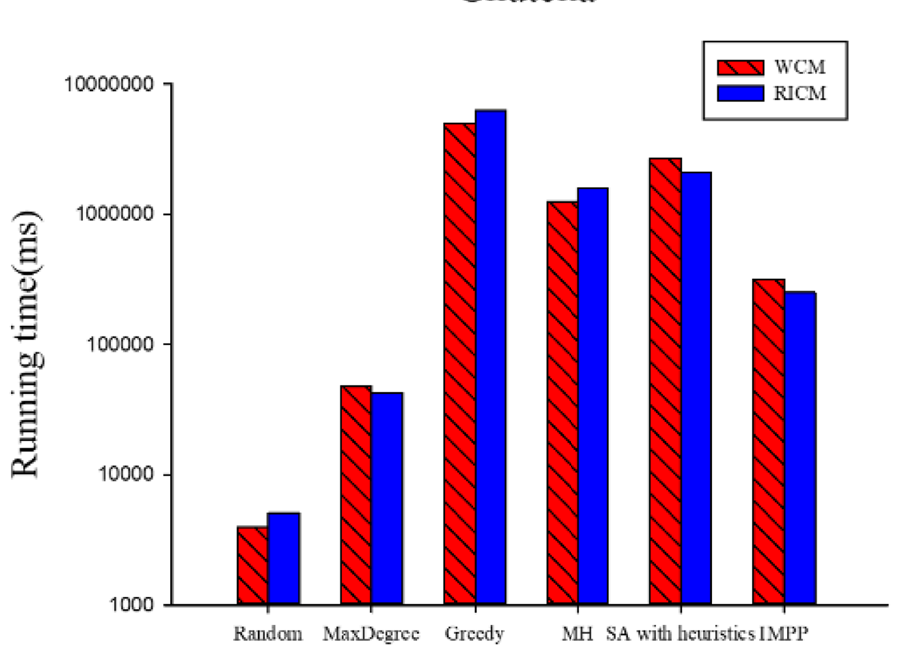 Running time analysis: IMPP maintains high efficiency compared to Greedy and SA-based methods.
Critical Insight & Conclusion
The genius of this work lies in the physical intuition of paths. By treating social influence as a collection of independent probabilistic paths rather than a chaotic "black box" simulation, the authors transformed an NP-hard problem into a manageable greedy optimization.
Takeaway: For modern CMOs or social media researchers, this paper highlights that whom you avoid is just as important as whom you reach. IMPP provides the first truly scalable tool for "precision-guided" information warfare in social networks.
Future Directions: The next frontier is Signed Networks, where relationships are explicitly "friend" or "foe" (+/-), adding another layer of complexity to the probabilistic paths explored here.