
MaxG: Bridging the Gap in Dynamic Influence Maximization
Influence Maximization in Dynamic Social Networks
This paper introduces the problem of Influence Maximization (IM) in dynamic social networks where structural changes are only partially observable through limited node "probing." The authors propose Maximum Gap Probing (MaxG), a selection strategy that prioritizes probing nodes likely to cause the largest shift in the estimated optimal seed set, effectively approximating SOTA performance on fully observed networks.
TL;DR
Social networks are moving targets. Traditional Influence Maximization (IM) assumes we can see the whole board, but in reality, millions of edges disappear and reappear daily. This paper introduces Maximum Gap Probing (MaxG), an algorithm that decides which few nodes to "check in on" to keep our influence predictions accurate. By focusing on nodes that might drastically change our marketing strategy (the "performance gap"), MaxG achieves near-perfect results even when we are largely blind to the network's evolution.
Background: The Blind Spot of Static Influence
Influence Maximization is the "Word of Mouth" problem: select seed users to trigger the largest adoption cascade. While we've solved this for static graphs, real-world networks like Twitter are dynamic.
The authors identify a critical bottleneck: Visibility. We cannot see the whole graph at once; we can only "probe" a few nodes to see their current neighbors. The challenge isn't just picking the seeds, but picking the right nodes to watch so that our seed selection remains valid as the graph evolves.
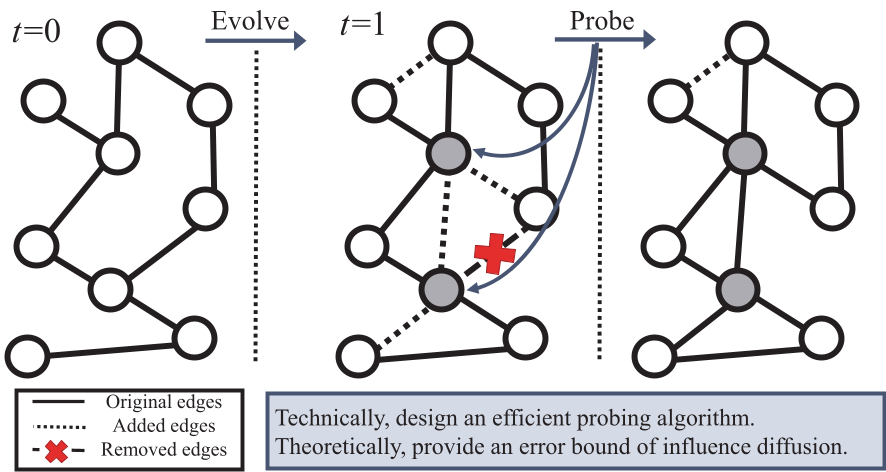 Figure 1: The challenge of reconstructing the real network (Gt) into a partially observed network (Ĝt) via probing.
The Insight: Don't Just Probe High-Degree Nodes
A common intuition is to probe "VIP" nodes—those with the most followers. However, high degree doesn't always equal high volatility. If a celebrity's network is stable, probing them is a waste of a budget.
The authors' core insight is the Performance Gap. Instead of asking "How much has this node changed?", they ask: "If this node has changed, how much would it break my current influence strategy?"
The Mathematics of "Surprise"
To quantify this, they use the Azuma-Hoeffding inequality. They model the in-degree of a node as a martingale (essentially assuming its growth is relatively stable over short periods). The algorithm calculates , the maximum possible gain in our influence estimate if we were to probe node and find a surprise.
If a node is currently not a seed but has been unprobed for a long time, its potential to "jump" into the top-tier influence group increases. MaxG prioritizes these high-uncertainty, high-impact nodes.
Methodology: Algorithm 1 (MaxG)
The algorithm maintains an "observed" graph and updates it iteratively.
- Estimation: For every node, estimate the potential performance gap using the time since its last probe ().
- Probing: Selection of nodes that maximize this gap.
- Maximization: Run a degree-discount heuristic on the updated graph to choose the best seeds.
Results: Dominating the Baselines
The researchers tested MaxG against four baselines: Random (Rand), Round-Robin (Enum), and Frequency-based probing (Deg/DegRR).
In the Coauthor dataset, which represents a academic collaboration network:
- MaxG achieved an expected influence spread of 61.74 with a budget of 500.
- Random Probing only achieved 20.35.
- This represents a massive 203% improvement, proving that where you look is as important as how you calculate.
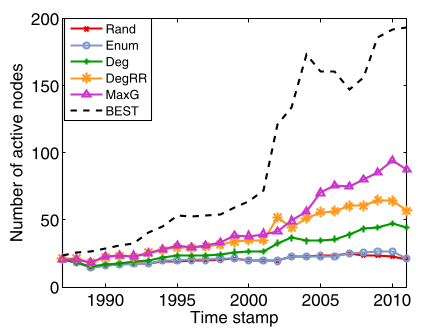 Figure 2: On the Twitter dataset, MaxG (red line) consistently stays closest to the 'BEST' (theoretical limit) compared to other heuristics.
Critical Analysis & Conclusion
Takeaway
MaxG effectively turns a structural monitoring problem into an optimization problem. Its value lies in its task-awareness—it doesn't try to reconstruct the entire graph perfectly (which is impossible); it tries to reconstruct the relevant parts for influence spread.
Limitations & Future Work
- Uniform Probability: The study assumes a uniform influence probability (). Real networks have heterogeneous influence weights, which would add another layer of complexity to the gap estimation.
- Exploration vs. Exploitation: While MaxG handles the "gap," it relies on the degree-discount heuristic. Integrating this with more robust submodular optimization could further close the gap to the "BEST" theoretical performance.
Ultimately, this work provides a vital framework for any social media manager or researcher dealing with "Streaming Graphs"—where the truth is always moving and observation is expensive.