
EPN: Why Targeting "Middlemen" Outperforms Hubs in Social Influence
Influence maximization of informed agents in social networks
The paper introduces the Effective Potential Nodes (EPN) algorithm for influence maximization within social networks using the bounded confidence model. By strategically connecting informed agents to specific nodes, the method achieves superior opinion consensus in both synthetic (Scale-free, Small-world) and real-world (Facebook, Flickr) networks compared to standard centrality heuristics.
TL;DR
In the chess game of social influence, most people try to capture the King (the hubs). This paper argues for a different strategy: influence the "Pawns" who have the King's ear. By introducing the Effective Potential Nodes (EPN) metric, the authors demonstrate that connecting informed agents to low in-degree "bridge" nodes that lead to hubs is the most efficient way to achieve a network-wide consensus.
Academic Standing: This work bridges the gap between traditional graph centrality and agent-based social simulation, providing a localized, computationally efficient alternative to global metrics like Betweenness Centrality.
The "Hub" Trap: Why Powerful Nodes Resist Change
In social network analysis, we are taught that high-degree nodes (hubs) are the key to diffusion. However, the authors point out an "Inertia" problem:
- Social Power: Hubs typically have higher "prestige" and are less likely to be swayed by a single new connection.
- Uncertainty: In the Bounded Confidence Model, individuals only listen to those whose opinions are already close to their own. Hubs often act as "extremists" with very low uncertainty, making them rigid.
- Efficiency: If you only have a limited budget (informed agents), spending them on nodes that won't budge is a waste of resources.
Methodology: The EPN Strategy
Instead of brute-forcing the hubs, the EPN (Effective Potential Nodes) algorithm looks for a specific signature in the network:
- Low In-Degree: These agents are "sociable" or "malleable"—they are easy to convince.
- High Out-Degree: Once convinced, they have the reach to spread the message.
- Connections to High In-Degree Nodes: Crucially, these nodes act as the entry point to the actual hubs.
The Mathematical Intuition
The EPN metric for a node is defined as:
This formula balances personal reach () with susceptibility () and the prestige of the immediate neighborhood.
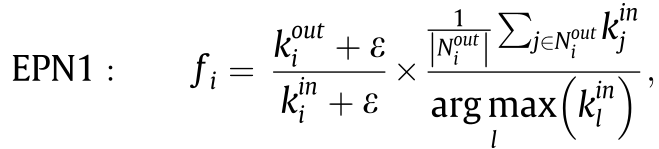 Figure 1: The EPN1 metric calculation focuses on the local ratio of out-degree to in-degree scaled by neighbor prestige.
Experimental Showdown
The authors tested EPN against Degree, Betweenness, Closeness, and Chen's Local Centrality across several environments:
- Model Networks: Barabasi-Albert (Scale-free), Watts-Strogatz (Small-world), and Erdős–Rényi (Random).
- Real Data: Facebook friendship circles, Google Plus, and Advogato.
Key Result: Beating the Social Power Resistance
As the "Social Power" of agents increases (modeled by exponent ), traditional methods see a sharp decline in performance. Because EPN targets susceptible nodes, it maintains a significantly higher final average opinion across the network.
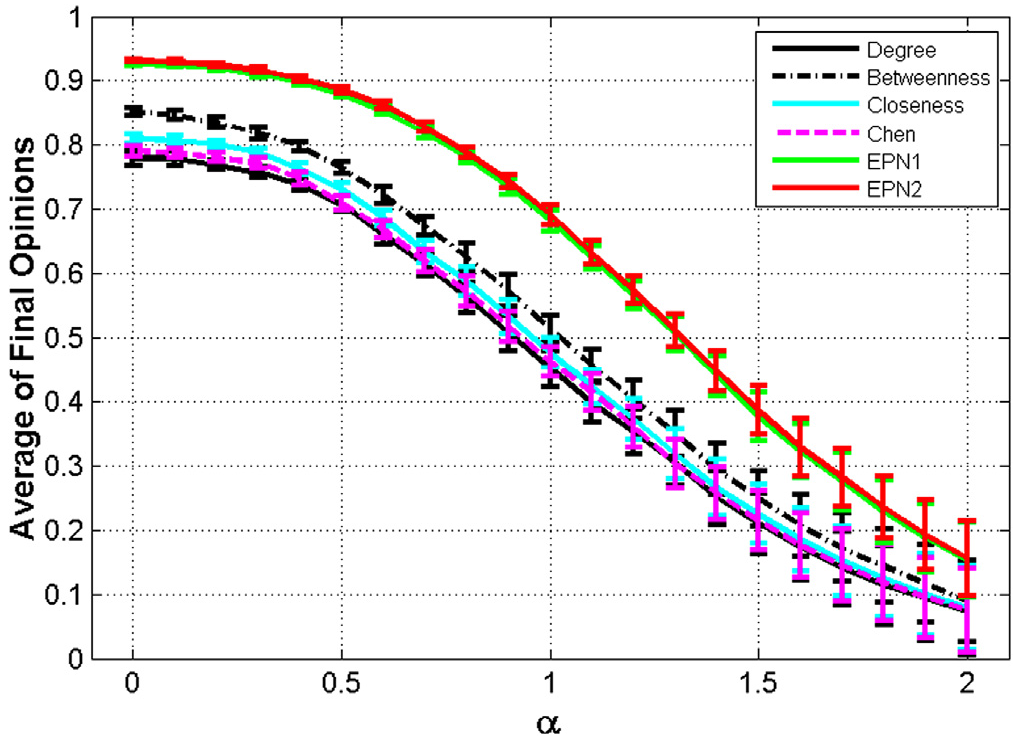 Figure 2: Average final opinion vs. Social Power Exponent. EPN (1-level and 2-level) consistently stays at the top.
Deep Insights
- Assortativity Matters: EPN performs exceptionally well in disassortative networks (where low-degree nodes tend to connect to high-degree nodes). This confirms the "bridge" hypothesis.
- Local vs. Global Information: While Betweenness Centrality is powerful, it requires global knowledge of the entire graph (NP-hard or ). EPN only requires local degree information, making it highly scalable for massive real-world datasets like Flickr ().
- The Role of Community: In networks with strong communities, the "2-level EPN" (looking at neighbors of neighbors) provides a slight edge by ensuring the influence doesn't get trapped in a local cluster.
Conclusion & Limitations
The takeaway for practitioners in social mining or digital marketing is clear: Don't just buy the biggest influencer; find the ones the influencers trust.
Future Outlook: The authors acknowledge that initial opinion distributions were uniform in this study. In the real world, "echo chambers" are often biased from the start. Adapting EPN to handle biased initial states (e.g., a society already leaning toward -1) is the next frontier for this research.
Senior Editor's Note: This paper elegantly identifies a fundamental flaw in "hub-centrism" by incorporating the psychological reality of opinion resistance. It's a must-read for anyone working on network control and collective behavior.