
Scaling Influence: A Divide-and-Conquer Approach to Viral Marketing in Mobile Networks
Influence Maximization on Large-Scale Mobile Social Network: A Divide-and-Conquer Method
This paper introduces a divide-and-conquer framework for Influence Maximization (IM) in large-scale Mobile Social Networks (MSN). It proposes two key algorithms: the Community-based Greedy Algorithm (CGA) and its parallelized version (PCA), achieving high scalability on networks with millions of nodes while maintaining submodular approximation guarantees.
TL;DR
Finding the most influential people in a social network to trigger a "viral" cascade is a classic NP-hard problem. While Greedy Algorithms offer the best theoretical accuracy, they crawl to a halt on large datasets. This paper presents PCA (Parallelized Community-based Algorithm), which breaks massive networks into diffusion-aware communities, selects seeds via Dynamic Programming, and handles cross-community overlaps to maintain high accuracy with massive speedups.
Background: The Scalability Wall
Influence Maximization (IM) asks a simple question: "If I can only give free samples to people, which should I choose to maximize the eventual adoption?"
The mathematical gold standard is the Greedy Algorithm, which provides a approximation. However, on a mobile network with millions of users and tens of millions of calls (edges), the Greedy approach requires simulating thousands of cascades for every potential candidate. It simply doesn't scale to the "Big Data" era.
Methodology: Divide, Conquer, and Parallelize
The authors propose a structural shift: instead of treating the network as one giant monolithic block, they exploit the Community Structure.
1. Diffusion-Aware Partitioning
Unlike standard community detection (like Louvain or Infomap), this paper’s partitioner cares about how influence flows. It uses a label propagation approach where a node joins the community where it has the highest probability of activating its neighbors under the Independent Cascade (IC) Model.
2. The Dynamic Programming Strategy
How do you decide whether to pick a seed from Community A or Community B? The authors use a DP approach to calculate the marginal gain across communities: This ensures that we aren't just picking the "local heroes" of each community, but globally optimal influencers.
3. Crossing the Borders (PCA)
The biggest risk in divide-and-conquer is "edge loss"—ignoring influence that leaks from one community to another. The Parallelized Community-based Algorithm (PCA) identifies "Border Nodes" and calculates their cross-boundary impact, effectively merging the efficiency of local search with the accuracy of global visibility.
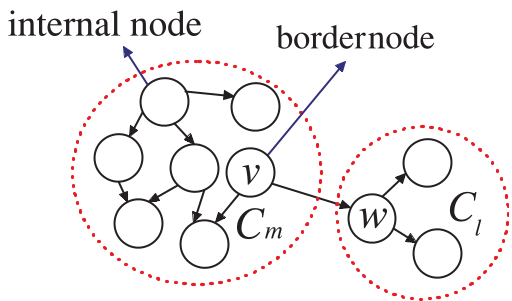 Figure: The interaction between internal and border nodes during the diffusion process across community boundaries.
Experimental Validation
The researchers tested their work on China Mobile CDR (Call Detail Record) datasets, ranging from 95k to nearly 5 million nodes.
Speed vs. Accuracy
While heuristic methods like DegreeDiscount are incredibly fast, their influence spread is significantly lower. PCA bridges this gap:
- Accuracy: PCA achieves nearly the same influence spread as the global MixGreedy algorithm (within a few percentage points).
- Speed: On larger networks where MixGreedy took days (or failed to finish), PCA completed in minutes.
- Scalability: As shown in the charts, PCA’s runtime grows linearly with network size (), while Greedy methods grow exponentially.
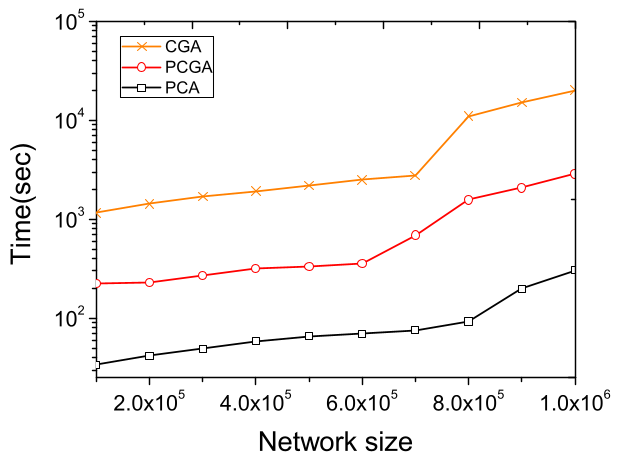 Figure: Scaling PCA vs. MixGreedy as the number of nodes increases to 1 million.
Critical Insight: Why it Works
The "Secret Sauce" of this paper is the Combination Entropy. By quantifying the "leakage" of influence between communities, the algorithm can decide when two communities are too tightly coupled to be separated. If the entropy is too high, they are merged. This theoretical guardrail ensures that the approximation isn't sacrificed for the sake of parallelization.
Conclusion & Future Work
This work demonstrates that for massive graphs, the "Community" is the right unit of analysis for influence. By moving from global optimization to structured local optimization with cross-boundary corrections, we can handle networks that were previously untouchable.
Future directions suggested by the authors include integrating Spatial Data (where are these users physically located?) and Temporal Evolution (how does influence change over a 24-hour cycle?).