
M&M: Unlocking Cross-Platform Influence via Multi-Aligned Heterogeneous Social Networks
Influence Maximization Across Partially Aligned Heterogenous Social Networks
The paper introduces the Aligned Heterogeneous network Influence maximization (AHI) problem and proposes the M&M (Multi-aligned Multi-relational network influence maximizer) model. It addresses the influence maximization challenge across multiple partially aligned social networks (e.g., Twitter and Foursquare) by leveraging both intra-network and inter-network "anchor" user connections.
TL;DR
Modern social influence doesn't happen in a vacuum. Users jump between Twitter, Foursquare, and LinkedIn, carrying ideas across boundaries through "anchor accounts." This paper introduces the M&M model, the first framework to solve Influence Maximization (IM) across partially aligned heterogeneous networks. By extracting complex relations through meta-paths and extending the Linear Threshold (LT) model, M&M manages to outperform traditional single-network and multiplex strategies by over 100%.
The "Single Network" Fallacy and the Anchor User Insight
Most viral marketing research treats social networks as isolated islands. However, the authors observe two critical real-world phenomena:
- Heterogeneity: Users don't just "follow"; they retweet, check-in, and list-share. Each is a different channel of influence.
- Alignment: "Anchor users" bridge different platforms. Data from Twitter and Foursquare reveals that while 81.8% of anchor users repost activities across networks, they only share a small fraction of their total content. Simple network merging fails because it ignores this "leaky" propagation.
Methodology: MMNs and Meta-Paths
The core innovation lies in the Multi-aligned Multi-relational Networks (MMNs). The M&M model uses Social Meta-Paths to define how influence flows.
1. Extracting Multi-Relations
Instead of a simple directed graph, the authors define:
- Intra-network Meta-Paths: e.g.,
User -> Tweet -> Retweet -> User(Twitter) orUser -> Location -> User(Foursquare). - Inter-network Meta-Paths: e.g.,
User(Twitter) -> Anchor Link -> User(Foursquare).
2. The Diffusion Model: Extended Linear Threshold
Standard LT models are binary. M&M extends this by calculating "Diffusion Strengths" for every relation using the PathSim metric. It then aggregates these via a Logistic Function, ensuring that influence from multiple types of interactions is weighted realistically.
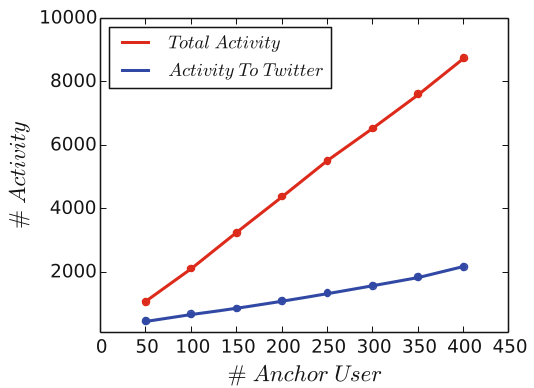 Fig 1: The AHI problem illustration - from raw heterogeneous networks (A) to the constructed MMN (B).
Guaranteed Efficiency: The M&M Greedy Algorithm
Influence maximization is NP-hard. However, the authors prove that their AHI influence function is both monotone and submodular. This is a powerful theoretical guarantee: it means a simple greedy algorithm (Algorithm 1) can achieve an approximation ratio of (roughly 63% of the optimal).
Experimental Battleground: Twitter vs. Foursquare
The authors tested M&M against several baselines, including LCI (multiplex network model) and Greedy (single heterogeneous network model).
Key Findings:
- Global vs. Local: Selecting seeds across both networks (M&M) consistently beat selecting from only one (M&M-F or M&M-T).
- The M&M Advantage: M&M outperformed the leading multiplex model (LCI) by 117% in user activation.
- Cross-Network Superiority: Even with limited anchor links (30% ratio), accounting for cross-network propagation yields better seed sets than ignoring those links entirely.
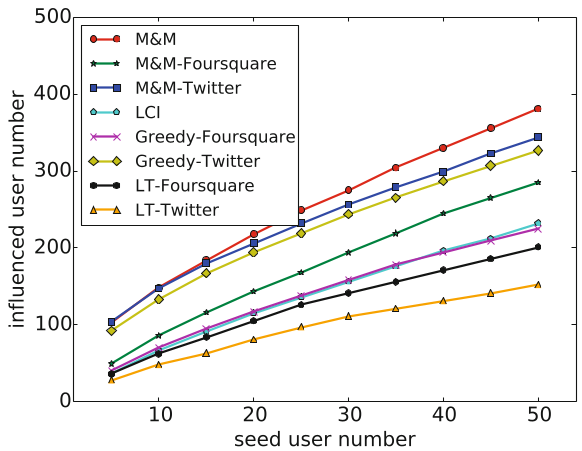 Fig 2: Comparison of influenced users under different seed set sizes (30% anchor ratio).
Critical Analysis & Conclusion
Takeaway
The AHI problem represents a shift from "network-centric" to "user-centric" influence modeling. By treating the user's presence across multiple platforms as a unified identity bridged by anchor links, M&M captures the true reach of viral marketing.
Limitations & Future Work
- Weight Sensitivity: The paper assumes equal weights (0.25) for all relations. In reality, a "follow" might be much more influential than a "shared location."
- Threshold Dynamics: User thresholds are sampled uniformly; incorporating real-world behavioral data could further refine the model.
- Scalability: The meta-path instance count grows exponentially; future work might explore graph embedding techniques to simplify the MMN structure without losing semantic richness.
In conclusion, M&M provides a mathematically rigorous and practically superior framework for navigating the complex web of modern social influence.