
IMUG: Maximizing Social Influence in the Dark
Influence Maximization Problem for Unknown Social Networks
The paper introduces the Influence Maximization for Unknown Graphs (IMUG) problem and a corresponding heuristic algorithm. It aims to identify influential seed nodes in social networks where the topological structure is initially unknown and can only be partially revealed through limited API-like probing.
TL;DR
Most Influence Maximization (IM) research assumes we have a "god view" of the social network. This paper shatters that assumption by proposing IMUG (Influence Maximization for Unknown Graphs). By using a clever probing strategy called SEC, the authors demonstrate that you only need to see 1% to 10% of a network's connections to capture up to 90% of the influence potential compared to having the full map.
Background: The "Full Knowledge" Fallacy
In the classic formulation of Influence Maximization, we are given a graph and must pick nodes to trigger the largest cascade. However, for a practitioner at a startup or a marketing agency, accessing the full Twitter or Facebook graph is impossible due to API limits and privacy silos. We are essentially "blind," allowed only to peek at a few users' friend lists (probing) before deciding where to send our free samples (seeding).
The Core Challenge: Probing vs. Seeding
The authors transition from a static optimization problem to a multi-round strategy:
- Probing: Which node's neighbors should we reveal next to learn the most about the network?
- Seeding: Based on our current "fragmented" map, which nodes should we activate to maximize word-of-mouth?
Methodology: The IMUG Algorithm
The proposed IMUG algorithm relies on the intuition that high-degree nodes (hubs) are the engines of influence. Since we don't know the true degrees, IMUG uses a heuristic approach:
- Sample Edge Count (SEC): A snowball sampling variant. It prioritizes probing nodes that have the highest number of links to already-discovered nodes. This "biased" sampling is remarkably efficient at finding hubs in scale-free networks.
- Iterative Estimation: Every time a node is probed, IMUG updates the "expected degree" of all its neighbors. It then picks the top-ranked inactive nodes as seeds.
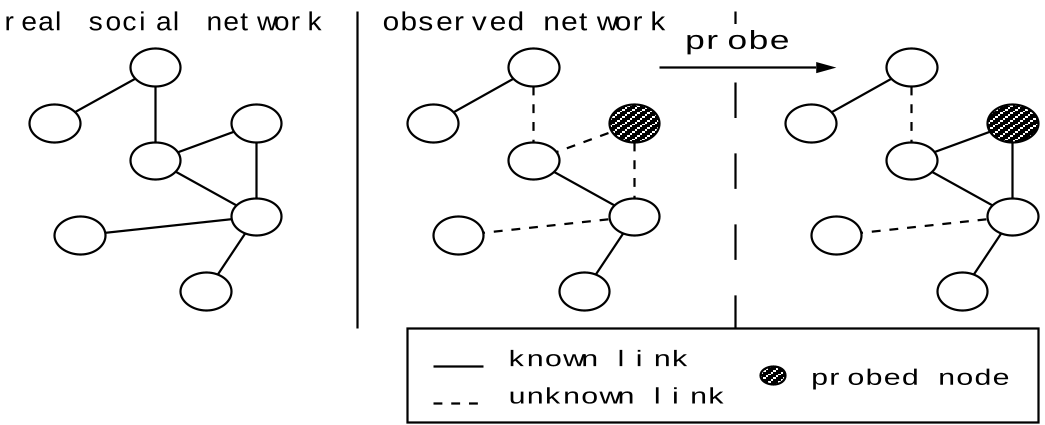 Figure 1: The process of probing an unknown network to reveal local structures.
Experimental Evidence: Success with 1% Knowledge
The authors tested IMUG against DegreeDiscountIC (a SOTA algorithm with 100% knowledge) and several random baselines across networks like DBLP, Amazon, and Facebook.
Key Findings:
- Efficiency: On the NetHEPT and DBLP datasets, IMUG tracked the performance of the full-knowledge baseline almost perfectly, even when only a tiny fraction of the network was known.
- Sensitivity: The algorithm is highly effective at low influence probabilities (), which is the most realistic scenario for viral marketing.
- Structural Impact: On Facebook graphs, which have high clustering and average degrees, the gap between IMUG and full-knowledge algorithms widened, suggesting that "random jumps" might be needed to escape local clusters.
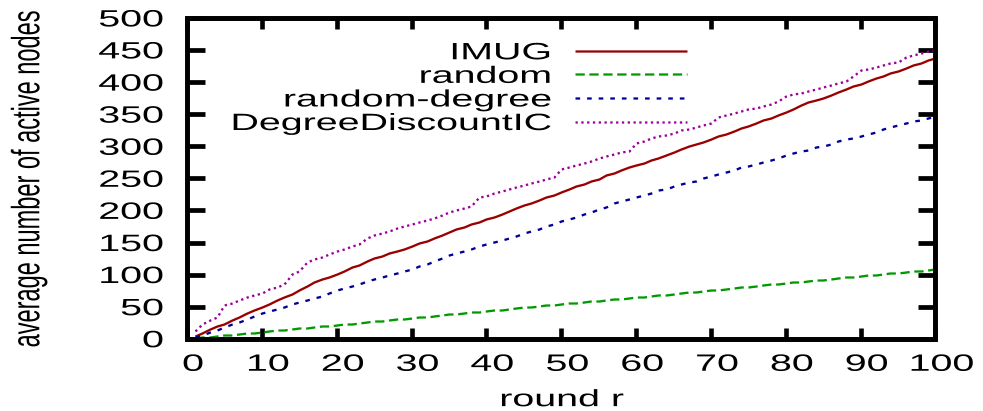 Figure 2: Influence spread on the DBLP network. Note how IMUG (blue) closely follows the SOTA baseline (red) despite its limited view.
Critical Insight: The Small-World Advantage
The success of IMUG is a testament to the Small-World Phenomenon. Because social networks are "narrow" (low path lengths) and contain massive hubs, even a blind search that follows edges (SEC) will inevitably stumble upon the most influential nodes very quickly.
Future Outlook & Limitations
While IMUG is powerful, it is currently a "greedy" heuristic. The authors acknowledge that:
- Exploration-Exploitation: The algorithm can get stuck in one "neighborhood" of the graph. Adding a "Random Jump" (similar to PageRank) could improve its performance on dense networks like Facebook.
- Dynamics: The study assumes a static graph uncovered over time. Future work should address cases where the network itself is evolving.
Conclusion
This paper provides a vital bridge between theoretical influence maximization and practical viral marketing. It proves that you don't need Big Data to achieve Big Influence; you just need a smart way to sample the small data you have.