
Deciphering Influence Maximization: From NP-Hard Complexity to Billion-Scale Efficiency
Influence Maximization on Social Graphs: A Survey
This survey provides a comprehensive synthesis of Influence Maximization (IM) on social graphs, covering classical diffusion models like Independent Cascade (IC) and Linear Threshold (LT). It proposes a fine-grained taxonomy of algorithms (Simulation, Proxy, and Sketch-based) and highlights the Reverse Reachable (RR) sketch-based IMM algorithm as a near-linear time SOTA achievement.
TL;DR
Influence Maximization (IM) is the task of finding "seed" nodes to maximize information spread in a network. This paper is a definitive survey that categorizes a decade of research into Simulation, Proxy, and Sketch-based approaches. The gold standard has shifted toward Sketch-based algorithms (like IMM), which offer near-linear time complexity and a provable approximation ratio.
Problem & Motivation: The Complexity Wall
Why is IM so difficult? It isn't just about finding the most connected people; it's about predicting a stochastic diffusion process.
- NP-Hardness: Selecting the optimal nodes is a combinatorial explosion problem.
- #P-Hardness: Even if you pick nodes, calculating exactly how many people they will influence is #P-hard—meaning exact calculation is intractable even for medium-sized graphs.
Traditional methods relied on Monte-Carlo (MC) simulations, running thousands of "what-if" scenarios for every single candidate node. On modern social graphs with billions of edges, this is like trying to compute the weather for the next century atom-by-atom.
Methodology: The Three Pillars of IM Algorithms
The authors categorize the evolution of IM into three generations:
1. Simulation-based (The Brute Force)
These rely on MC simulations within a greedy framework. While they offer the guarantee, they are slow. Optimizations like CELF use submodularity to "lazy evaluate" marginal gains, effectively pruning nodes that clearly aren't top candidates.
2. Proxy-based (The Heuristic Speedsters)
Algorithms like PMIA or SIMPATH simplify the world. Instead of full diffusion, they look at "shortest paths" or "maximum influence arborescences" (local trees). They are lightning-fast but lack a global theoretical safety net—in certain graph topologies, their performance can crash.
3. Sketch-based (The Theoretical Peak)
This is where the field stands today. The breakthrough idea is the Reverse Reachable (RR) Sketch.
- The Intuition: Instead of starting from a seed and looking forward (Forward Influence), pick a random node and look backward to see who could have influenced it.
- The SOTA: Algorithms like IMM (Influence Maximization via Martingales) use this to solve IM in near-linear time relative to the graph size.
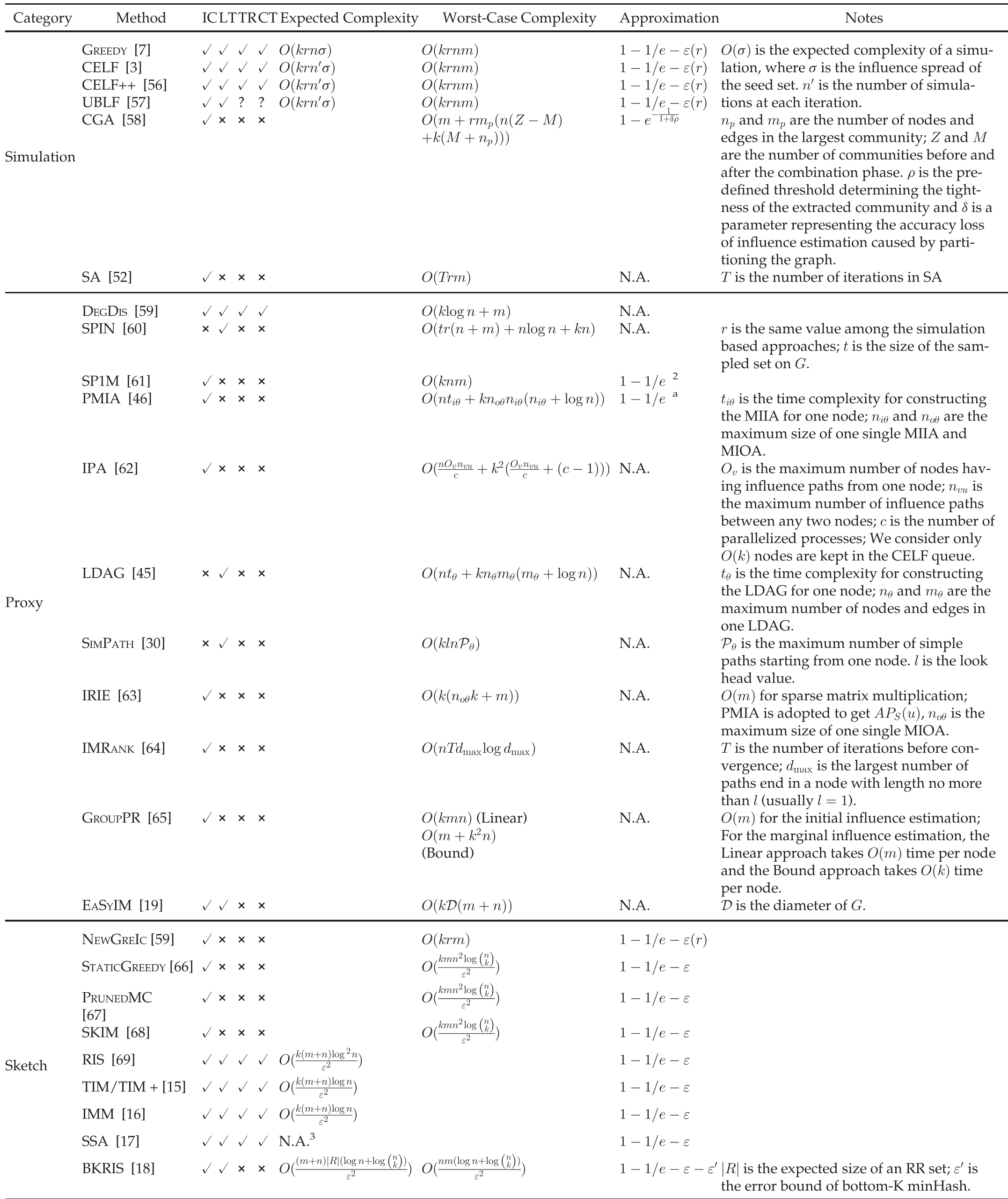 Table 1: Theoretical comparison highlighting the shift from in simulation to near-linear in sketching.
Experiments & Results: Billion-Scale Reality
The survey synthesizes results showing that while Proxy methods (like IRIE) are fast, Sketch-based methods (like IMM) provide better influence spread while remaining competitive in time. Crucially, the RR-sketch allows these algorithms to handle graphs that were previously "unsolvable" for greedy simulation.
A key highlight is Context-Aware IM, which handles:
- Topic-Awareness: Influence depends on the subject (e.g., a tech influencer has no power in a cooking forum).
- Location-Awareness: Vital for local businesses using Geo-Social networks.
- Continuous Time: Modeling how influence decays over hours or days.
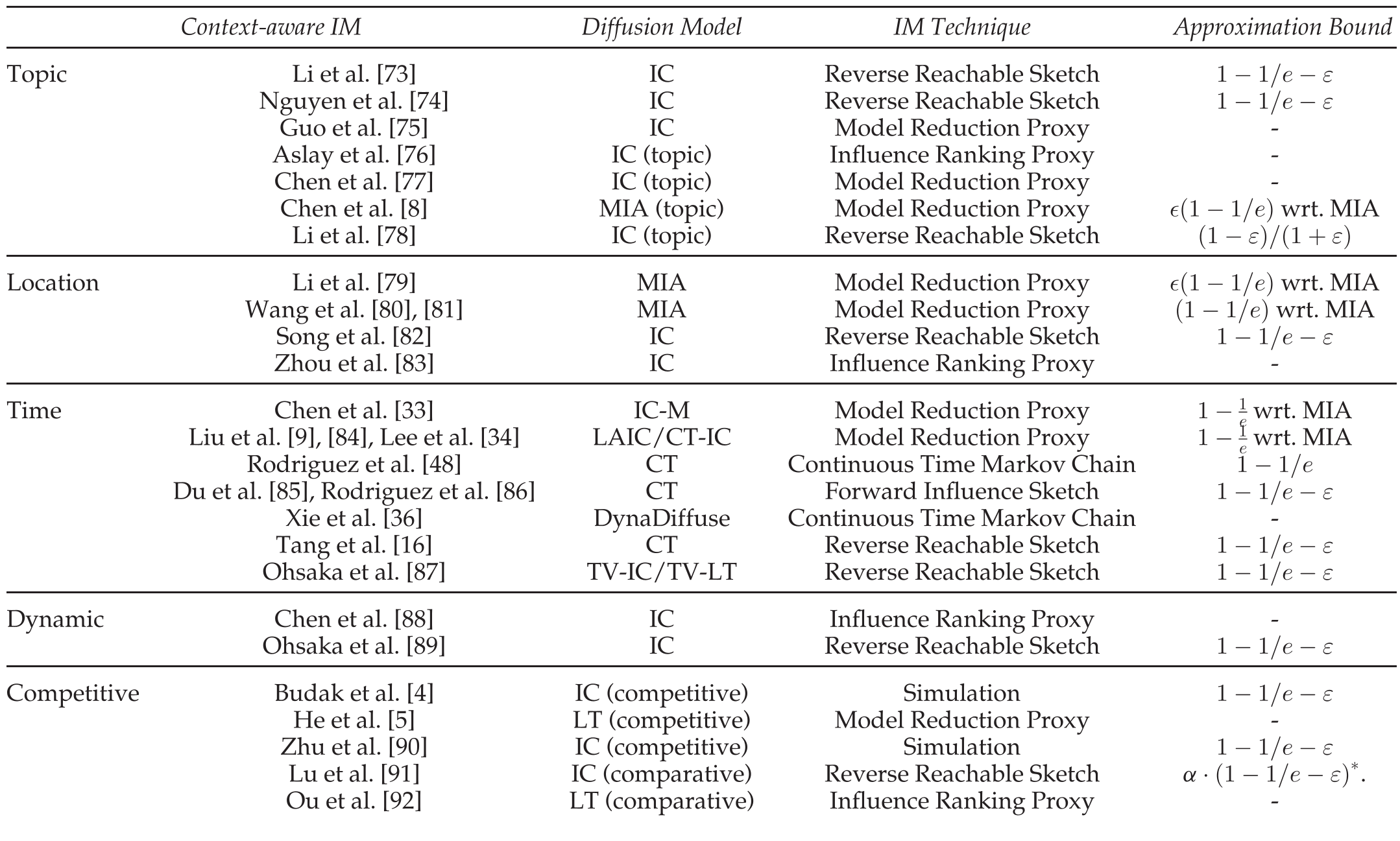 Table 2: Taxonomy of Context-Aware IM research, mapping context features to diffusion models and techniques.
Critical Analysis & Conclusion
The Good: The paper succeeds in unifying a fragmented field. It moves beyond "which algorithm is best" to "why certain architectures (Sketching) inherently beat others (Simulation)."
The Limitations: The authors acknowledge that the field relies heavily on Submodularity. If an influence function is not submodular (e.g., if "group-think" or complex "opinion-aware" dynamics are involved), the guarantee vanishes.
Future Outlook: The next frontier is Dynamic IM—processing social graphs that change every second (like Twitter/X) without recomputing the entire sketch from scratch. The survey suggests move towards "Stay-and-Stare" or "Lazy Sampling" techniques to bridge the gap between static theory and dynamic reality.