
NBRW: Breaking Backtracking Loops to Maximize Social Influence
Influence Maximization in Social Networks Based on Non-backtracking Random Walk
This paper introduces NBRW, an optimized algorithm for Influence Maximization (IM) that utilizes Non-backtracking Random Walks to identify seed nodes. By combining community-based sampling with a mechanism that prevents immediate returns in walks, NBRW achieves state-of-the-art performance, particularly under the Linear Threshold (LT) diffusion model.
TL;DR
Influence Maximization (IM) is the task of finding the most "contagious" individuals in a social network. This paper introduces NBRW, an algorithm that uses Non-backtracking Random Walks within detected communities. By preventing "echo chamber" effects in influence estimation, NBRW achieves O(n) linear complexity and significantly outperforms traditional heuristics, particularly under Linear Threshold (LT) diffusion models.
The Problem: The "Hub" Trap and Backtracking Bias
The IM problem is notoriously difficult because it is NP-hard. Most existing solutions fall into two camps:
- Greedy Algorithms: Accurate but computationally expensive (even with CELF++ optimizations).
- Heuristic Algorithms: Fast (like Degree or PageRank) but often get trapped by "high-degree hubs" that have high local connectivity but poor global reach.
The authors identify a specific flaw in standard random walk heuristics: Backtracking. A standard walker often bounces back and forth between two high-degree nodes, leading to an overestimation of their influence while ignoring "bridge" nodes that connect different communities.
Methodology: Non-Backtracking and Community Constraints
The researchers leverage the Non-backtracking operator (also known as the Hashimoto matrix). In a non-backtracking walk, if a walker moves from node to , it is forbidden from returning to in the very next step.
1. The Physics of Non-Backtracking
By stripping away the ability to return immediately, the walk is "pushed" further into the network. This has three critical effects:
- Avoiding Hub Over-accumulation: It prevents high-degree nodes from hogging all the "traversing counts."
- Identifying Cut-Vertices: It forces the walk to find bottlenecks and bridges that are essential for spreading information between clusters.
- Ignoring Leaf Nodes: Since leaf nodes have nowhere to go but back, the non-backtracking operator naturally de-prioritizes them.
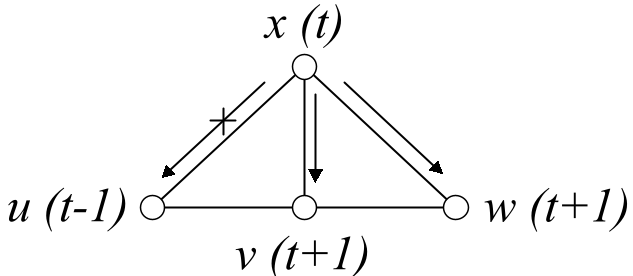 Fig 1: Illustrating how a non-backtracking walk is forced to explore new nodes rather than oscillating.
2. Divide and Conquer
NBRW doesn't just walk the whole graph. It first partitions the network into communities. This ensures that the algorithm doesn't ignore smaller, dense clusters that might be missed if the walker gets "stuck" in the largest community of a massive graph.
Experiments: Dominating the Linear Threshold Model
The authors tested NBRW against SOTA methods like MDD (Mixed Degree Decomposition) and Local Centrality (LC) on the Facebook, HepTh, and CondMat datasets.
Key Performance Insights
- Linear Threshold (LT) Supremacy: NBRW showed a "sudden rise" in influence spread. In the Facebook dataset, it activated 111% more nodes than simple degree-based selection.
- Efficiency: Because the complexity is reduced to , it is suitable for massive real-world social networks where greedy algorithms would fail.
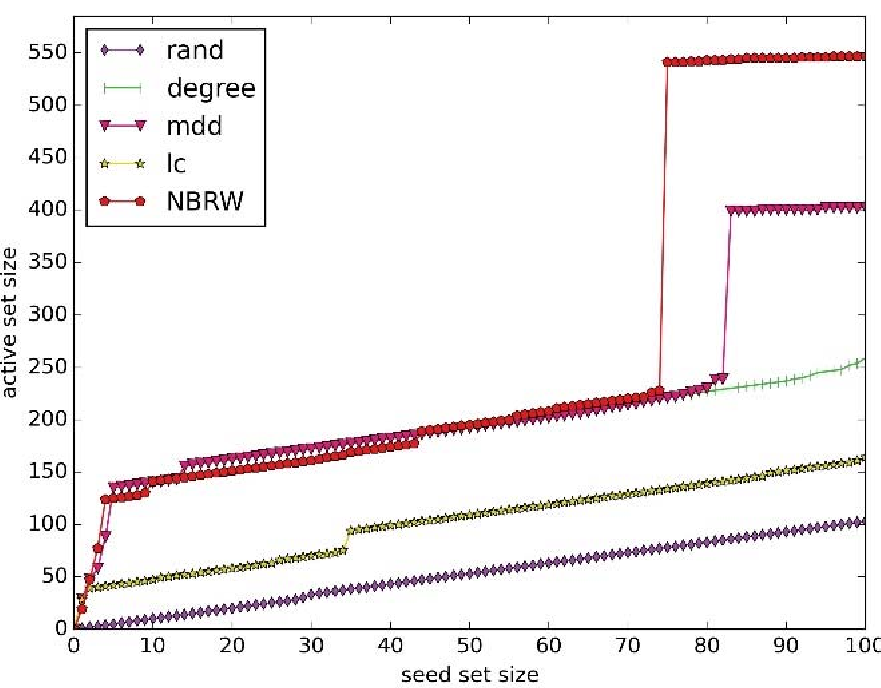 Fig 2: Under the Linear Threshold model, NBRW (red line) indicates a much faster and higher reach compared to other heuristics.
Critical Analysis & Future Outlook
The primary strength of NBRW is its inductive bias regarding network flow. By using non-backtracking, the authors align the "influence estimation" more closely with how information actually flows in real-world cascades—it moves forward, not backward.
Limitations: While NBRW dominates in the Linear Threshold model, its performance in the Weighted Cascade (WC) model is more competitive but not always the absolute winner. This suggests that the "structural bottleneck" insight is most valuable when activation requires a "tipping point" (threshold) rather than just a single probabilistic hit.
Conclusion: NBRW proves that sophisticated structural graph theory (non-backtracking matrices) can be simplified into a highly efficient sampling algorithm that solves a major optimization bottleneck in social network analysis.