
Beyond Friendship: Maximizing Positive Influence in Networks with Friends and Foes
Influence maximization in social networks: Considering both positive and negative relationships
This paper introduces a novel influence maximization framework tailored for Signed Social Networks (SSNs), termed the Positive Opinion Influential Node Set (POINS) problem. It proposes a diffusion model that accounts for both positive (friendship) and negative (foe) relationships to maximize the spread of a target opinion.
TL;DR
The research addresses the Positive Opinion Influential Node Set (POINS) problem. Unlike standard models that treat all social links as positive, this work introduces a diffusion model designed for Signed Social Networks. It leverages the insight that social influence is not just about who you follow, but also who you disagree with, aiming to maximize a specific "Positive Opinion" in a world of conflicting relationships.
Problem & Motivation: The Reality of Social Friction
Most classic influence maximization models (like the Independent Cascade or Linear Threshold models) operate on the "contagion" metaphor: if I see my friend buy a product, I am more likely to buy it. However, real human networks are riddled with negative edges.
The authors argue that ignoring these "foe" relationships is a significant oversight. In an Online Social Network (OSM), if someone you distrust adopts Opinion A, you might be more inclined to adopt Opinion B out of spite or defensive skepticism. To be practical, viral marketing must navigate this minefield of trust and distrust.
Methodology: A Threshold Model for Dueling Opinions
The core of the paper is a modified diffusion model that redefines how nodes change status at time based on their neighbors' opinions at time .
The Calculus of Influence
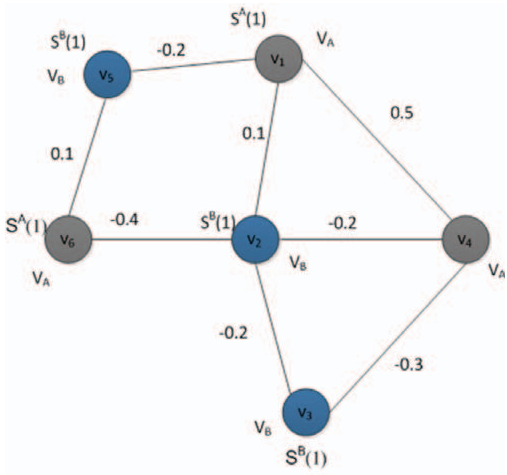
A node adopts Opinion A (Positive) if the sum of influence from friends holding Opinion A plus the sum of influence from foes holding Opinion B exceeds a specific threshold .

Logic breakdown:
- (Positive weight): Reinforces the same opinion.
- (Negative weight): Pushes the neighbor toward the opposite opinion.
This elegantly captures the "enemy of my enemy" intuition. If my foe (negative edge) adopts a negative stance (Opinion B), it actually increases my likelihood of adopting the positive stance (Opinion A).
Architecture Visualization
The diffusion process is illustrated through a state-transition framework where nodes transition from Inactive () to either Opinion A () or Opinion B ().
Algorithm: Selecting the Seed Set
To solve the POINS problem—finding nodes to maximize the spread of Opinion A—the authors suggest a selection strategy based on:
- Connectivity: Favoring nodes with a high degree of neighbors ().
- Threshold Sensitivity: Selecting nodes where the resistance to Opinion A () is minimal compared to Opinion B.
- Relationship Context: Identifying nodes that already align with the positive influence goals based on their existing friendship/foe structure.
Critical Analysis & Future Outlook
The paper provides a needed expansion of influence theory into the realm of signed graphs.
Key Strength: By quantifying the "foe" weight as a driver for the opposite opinion, the model provides a more robust simulation for polarizing environments (e.g., political discourse or brand rivalries).
Limitations:
- The current algorithm is somewhat heuristic; the paper briefly mentions a solution without an extensive comparative complexity analysis against greedy or submodular optimization techniques typically used in this field.
- It assumes a weighted undirected graph, whereas many social filters (like Twitter) are inherently directed.
Conclusion: This work acts as a foundational step toward more "socially aware" AI agents and marketing algorithms that don't just look for "popular" nodes, but for nodes that are strategically positioned within the complex web of human trust and animosity.