
Scaling the Wall of Strategic Diffusion: Why Network Geometry Dictates Seeding Speed
Influence maximization over strategic diffusion in social networks
This paper investigates Diffusion Speed Maximization within strategic social networks modeled by Networked Coordination Games and Logit Dynamics. The authors provide polynomial-time algorithms with provable approximation guarantees across three distinct graph topologies: Erdős-Rényi, Planted Partition, and Geometrically Structured graphs.
TL;DR
In strategic social networks where individuals adopt behaviors based on utility (Coordination Games), the question isn't if an innovation will spread, but how fast. This paper moves beyond traditional "Influence Maximization" to "Diffusion Speed Maximization." The authors reveal that in dense networks, seed choice hardly matters, but in clustered or geometric networks, the "border" nodes between communities are the secret to breaking through energy barriers.
The Shift from Epidemics to Games
Early social diffusion research treated ideas like viruses—if you touch an infected person, you might catch it (Independent Cascade model). But human behavior is often strategic. You might only switch to a new OS or join a social platform if a sufficient number of your friends do (Coordination Effect).
The authors use Logit Dynamics to model this, where individuals occasionally make "noisy" or irrational choices. In this framework, the entire network eventually adopts the innovation. The bottleneck isn't the final reach; it's the Metastability—the tendency of the network to get "stuck" in the old state for a long time.
The Core Challenge: The Energy Barrier
To maximize speed, one must minimize the Diffusion Exponent (). Intuitively, think of the network state as a ball in a valley. To transition to the "New Innovation" valley, it must be pushed over an energy barrier.
The mathematical difficulty is that is neither submodular nor supermodular. This means the classic greedy algorithm (which works for Llama or GPT-based prompt optimization and epidemic models) provides no guarantees here.
Methodology: Insights Across Graph Classes
The authors categorize social structures into three types and provide specific strategies for each:
1. Erdős-Rényi (Globally Well-Connected)
In highly symmetric and dense graphs, the specific location of seeds doesn't matter. The high connectivity ensures that once a few seeds are placed, the "symmetry" of the graph allows the innovation to flow uniformly.
- Finding: Any seed set is nearly optimal.
2. Planted Partition (Big Clusters)
Social networks often have dense communities (clusters) with sparse connections between them. Here, the diffusion speed is limited by the slowest cluster.
- Strategy: Use a min-max approach to allocate seeds proportionally across clusters to ensure no single community becomes a bottleneck.
3. Geometrically Structured (Local Connections)
In graphs like Random Geometric Graphs or Planar Graphs, connections are local and clusters are small. The bottleneck is the inter-cluster correlation.
- Strategy: The PaS Algorithm:
- Partitioning: Break the graph into small, manageable components.
- Seeding: Specifically seed the "border" nodes that connect these components.
 Figure 1: The definition of the Diffusion Exponent - the "Energy Barrier" that seeding must overcome.
Experimental Insights & Stability
The authors prove that their PaS (Partitioning and Seeding) algorithm provides a -approximation. This is a significant theoretical result because it shows we can achieve near-optimal speed by slightly increasing the seed budget or accepting a tiny error in the exponent, even without submodularity.
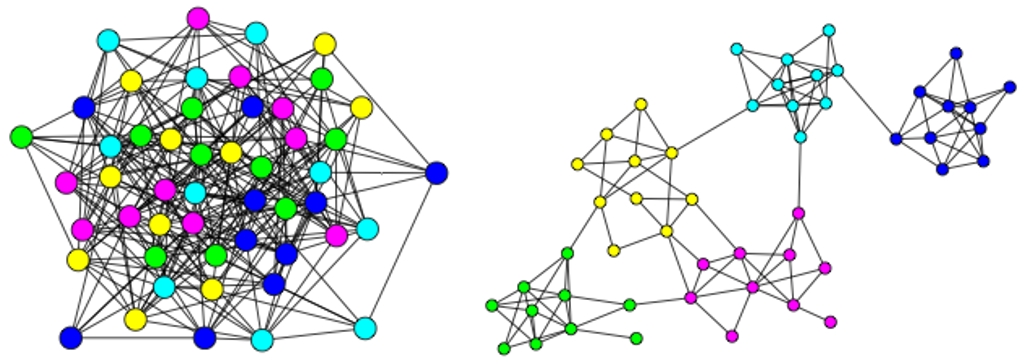 Figure 2: Understanding topological impact - from Globally Well-Connected to Geometrically Structured.
Critical Analysis & Professional Perspective
The paper’s greatest strength is its topological sensitivity. It recognizes that a "one-size-fits-all" greedy seeding strategy is suboptimal for strategic games. By linking social diffusion to the physical concept of Ising Models and Glauber Dynamics, it provides a rigorous mathematical foundation that epidemic-style models lack.
Limitations:
- The model assumes a static network. In reality, social edges appear and disappear (Temporal Graphs).
- It assumes a Binary Choice. Most modern social strategic shifts involve multiple competing innovations (e.g., several different social media apps simultaneously).
Future Outlook
This work paves the way for "Diffusion Minimization"—how to stop the spread of harmful misinformation or viruses by identifying and "vaccinating" the same structural bottlenecks (border nodes) identified in the PaS algorithm. As social networks become more polarized (increased clustering), understanding these geometric bottlenecks will be crucial for both marketing and public safety.