
Digital Tools vs. Tradition: Shaping the Image of Rural Destinations
The Influence of Digital Marketing Tools Perceived Usefulness in a Rural Region Destination Image
This study investigates how the perceived usefulness of various digital marketing tools influences the destination image of the Douro rural region in Portugal. Using Structural Equation Modeling (SEM) on a sample of 555 tourists, the research identifies that websites, booking platforms, and mobile devices significantly enhance destination image, while traditional travel agencies surprisingly exert a negative influence.
TL;DR
In the digital age, a rural destination's reputation isn't just built on its scenery, but on the perceived utility of the technology used to find it. This study of 555 tourists in Portugal's Douro Valley reveals that websites, booking platforms, and mobile devices are the true architects of modern destination image, while traditional travel agencies may actually detract from it in the eyes of tech-savvy travelers.
Background: The Rural Struggle for Visibility
Rural regions like the UNESCO-listed Douro Valley face a unique challenge: they possess rich natural and cultural resources but lack the massive marketing budgets of capital cities. This research positions Digital Marketing Tools not just as channels for sales, but as fundamental cognitive pillars that help a tourist "construct" the image of a place before they even arrive.
Problem & Motivation: The Gap in the Digital Journey
While previous literature has touched upon destination image, few have looked at the synergy of multiple technologies. The authors recognized a paradox: as tourists become more independent and technology-dependent, the role of traditional intermediaries (like travel agencies) is shifting. They sought to understand if "Trust" in digital platforms and a positive "Attitude" toward tech actually translate into a better mental image of a rural destination.
Methodology: Mapping the Tourist Mindset
The researchers utilized a quantitative approach, applying a questionnaire to 555 tourists. They employed Partial Least Squares Structural Equation Modeling (PLS-SEM) to validate a complex web of 18 hypotheses.
The Conceptual Model
The model treats Destination Image (DI) as a formative construct—meaning it is shaped by the cumulative utility of various tools:
- Digital Tools: Websites, E-mail, Social Word-of-Mouth (s-WOM), Booking sites, and Mobile devices.
- External Factors: General trust in technology and overall attitude toward digital marketing.
- Contrast: Traditional travel agencies were included to act as a baseline for "conventional" information sources.
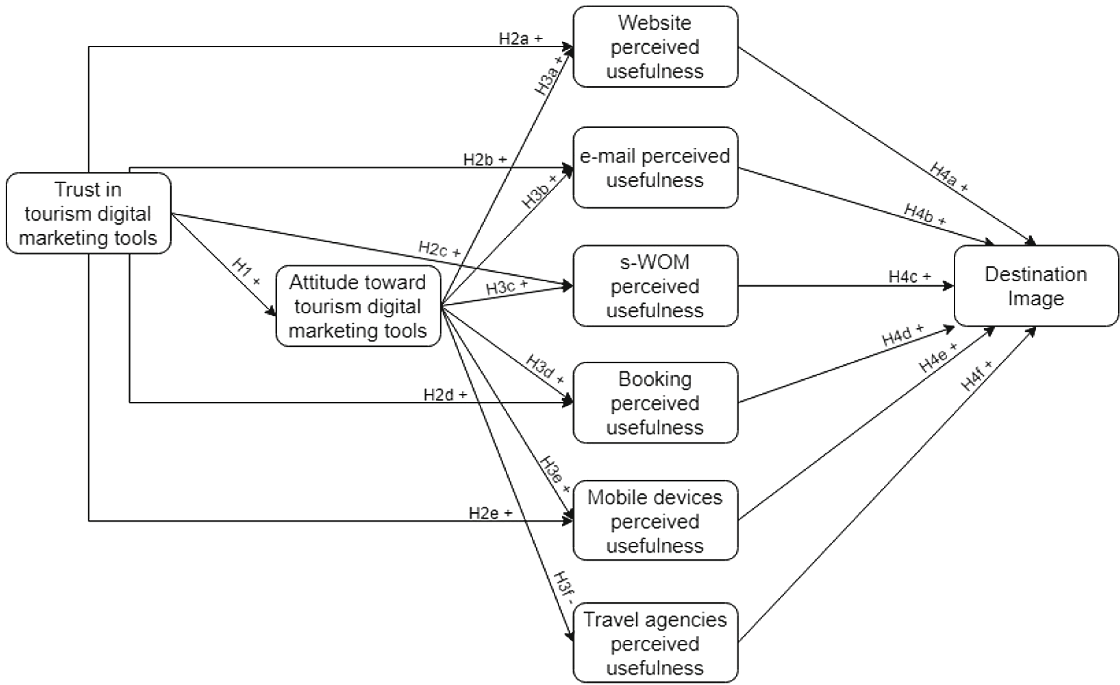 Figure 1: The conceptual model highlighting the paths from Trust and Attitude to specific tool usefulness, and finally to Destination Image.
Key Results: What Drives the Image?
The study provided several counter-intuitive and striking results:
- Mobile Dominance: Mobile device usefulness had one of the highest impacts on destination image (0.341), confirming that "on-the-go" information is vital for rural explorers.
- The Agency Backlash: Perceived usefulness of travel agencies had a negative effect (-0.088). This suggests that tourists who find traditional agencies "useful" might perceive the destination as less modern or harder to access independently.
- The E-mail and s-WOM Ghosting: Interestingly, E-mail and Social Word-of-Mouth did not significantly impact the Douro destination image. The authors suggest this might be due to a Lack of Douro-specific content on social media (s-WOM) and "email fatigue" among travelers.
 Table 1: Hypothesis testing results showing Path Coefficients and significance levels.
Depth Insights: The "Trust" Multiplier
One of the most profound takeaways is the role of Trust. The authors found that trust doesn't just make a person more likely to buy; it acts as a "filter" that enhances the perceived usefulness of every other digital tool. If a tourist trusts the digital ecosystem, they view the website and booking app as more helpful, which in turn leads to a more positive and robust mental image of the destination itself.
Critical Analysis & Conclusion
Takeaway
For rural tourism managers, the message is clear: Digital utility equals Brand Equity. Investing in a seamless mobile experience and a high-trust booking environment does more for your "image" than a glossy brochure in a physical travel agency.
Limitations & Future Work
The study is cross-sectional (a "snapshot" from 2018). Future research should look at the longitudinal effect—how does the image change after the visit? Additionally, as AI and Virtual Reality enter the marketing mix, their role in "simulating" the rural experience will be the next frontier for Destination Image research.
Final Thought
In the battle for the tourist's mind, the interface is the destination. If your mobile site is difficult to use, the Douro Valley looks less beautiful before the tourist even sees a grapevine.