
Twitter: A Serendipity Engine or an Echo Chamber?
The Influence of Features and Demographics on the Perception of Twitter as a Serendipitous Environment
This paper investigates the empirical relationship between the usage of specific Twitter features, demographics, and user perceptions of Twitter as a serendipitous environment. By analyzing survey data from 184 participants, the study identifies that age and active interaction (tweeting, searching, and timeline checking) are significant predictors of experiencing serendipity.
TL;DR
Is serendipity—the faculty of making fortunate discoveries by accident—a built-in feature of social media, or a skill users must cultivate? This paper quantifies how age and specific behaviors like searching and tweeting influence our perception of Twitter as a "serendipitous environment." The findings suggest that active engagement is the key to breaking out of digital stagnation.
Problem & Motivation: The Threat to "Happy Accidents"
In the early 2010s, Twitter was often described as the "serendipity engine for the web." Its reverse-chronological feed allowed for a raw, unfiltered stream of diverse perspectives. However, the shift toward algorithmic curation (showing "best posts" first) raised a critical concern: The Echo Chamber Effect.
If an algorithm only shows you what it thinks you like, do you lose the ability to "bump into" the unexpected? The authors sought to move beyond anecdotal praise and empirically test what actually fuels the perception of serendipity on the platform.
Methodology: Quantifying the Unexpected
The researchers surveyed 184 users—predominantly Canadian university students—using a validated scale for "Perception of Serendipity." This scale measured how often users encountered useful ideas or resources they weren't looking for.
To find the "secret sauce," they analyzed:
- Demographics: Age and Gender.
- Platform Features: Timeline checking, Tweeting, Retweeting, Hashtags, Mentions, Searching, and Direct Messaging (DMs).
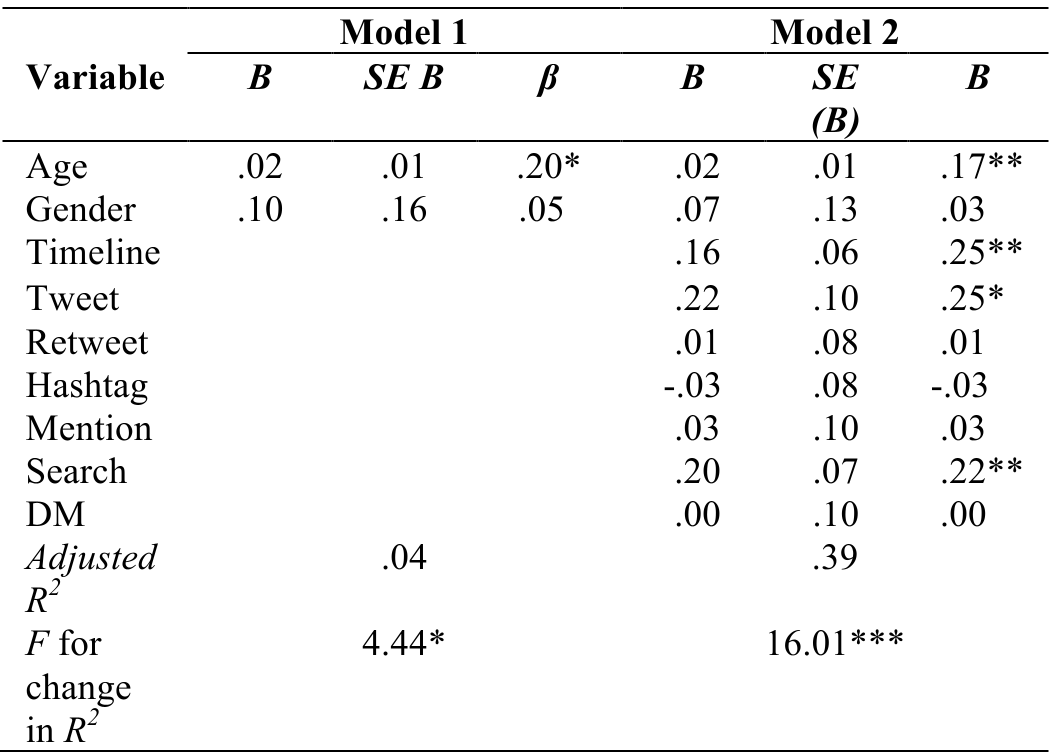
Key Findings: The "Active User" Advantage
The study revealed that serendipity isn't just something that happens to you; it’s something you trigger.
1. The Power of the Search and the Tweet
The most striking result was that Searching () and Tweeting () were among the strongest predictors of serendipity. This suggests that users who actively look for topics or contribute their own thoughts create more "surface area" for fortunate accidents to occur.
2. The Timeline Matters
Checking the Timeline () remains a core driver. Even in a digital age, the simple act of "witnessing" the flow of information remains a primary source of unexpected discovery.
3. The Age Factor
Interestingly, Age was a positive predictor. Older users reported higher levels of perceived serendipity. The authors suggest this might be due to a different understanding of what constitutes a "valuable accident" or perhaps more refined information-seeking strategies developed over time.
Critical Analysis & Conclusion
The core takeaway for designers is clear: Engagement facilitates discovery. While modern platforms are moving toward "lean-back" experiences (passive consumption), this research proves that "lean-forward" features—like searching and active posting—are what actually make a platform feel magical and serendipitous.
Limitations: The sample was skewed toward young Canadian students (average age 25). Serendipity for a 20-year-old student might look very different from serendipity for a 50-year-old professional. Additionally, as Twitter (now X) has undergone massive structural changes since this study (2016), the "echo chamber" risks identified by the authors are now more relevant than ever.
Future Outlook: As we move into an era of LLM-curated feeds, preserving the "trigger-rich" nature of interfaces will be vital. If design sacrifices the "peripheral" for the "relevant," we may lose the very serendipity that makes social media valuable.
Reference: McCay-Peet, L., & Quan-Haase, A. (2016). The Influence of Features and Demographics on the Perception of Twitter as a Serendipitous Environment. HT '16.