
Influence of Influence: How Information Propagation Reshapes the Social Fabric
Influence of Influence on Social Networks: Information Propagation Causes Dynamic Networks
This paper introduces the Extended Linear Threshold (ELT) model, which explores the co-evolutionary causality between information propagation and social network structural dynamics. By analyzing Twitter datasets, the authors demonstrate that information content (attractiveness/sentiment) directly triggers follow and unfollow behaviors, creating a feedback loop where the network structure evolves as information spreads.
## TL;DR
Social networks are usually treated as static "pipelines" for information. This paper flips the script, revealing that the information flowing through the pipes actually changes the pipes themselves. By introducing the **Extended Linear Threshold (ELT) model**, the authors prove that highly attractive or irritating content causes users to dynamically follow or unfollow others, leading to structural shifts like shrinking diameters and network fragmentation.

## The Missing Link: Why Static Models Fail
In the world of viral marketing, we've long used models like the Linear Threshold (LT) or Independent Cascade (IC) to predict how an idea spreads. However, these models have a fatal flaw: they assume the graph is frozen in time. In reality, a single "bad tweet" can trigger a wave of unfollows, while a "viral sensation" creates new connections.

The authors observed that approximately **9% of connections change every month**. If your influence strategy relies on a snapshot of the network from last week, you are likely operating on an obsolete map.

## Methodology: The Extended Linear Threshold (ELT) Model
The authors move beyond the "What" of propagation to the "How" of structural change. They introduce **Tweet-User Similarity (TUS)**, a metric based on TF-IDF cosine similarity, to quantify how much a piece of information resonates with a specific user.
The Propagation Loop
The ELT model breaks down the user experience into two critical stages:
- Receive Stage: When u's neighbor v becomes active. Here, u doesn't just pass info; u evaluates v. If the TUS is low (the content is irritating), u might unfollow v before the info even has a chance to spread further.
- Adopt Stage: If u is influenced and becomes active, there is a probability that u will follow the original source (the seed) of that information.
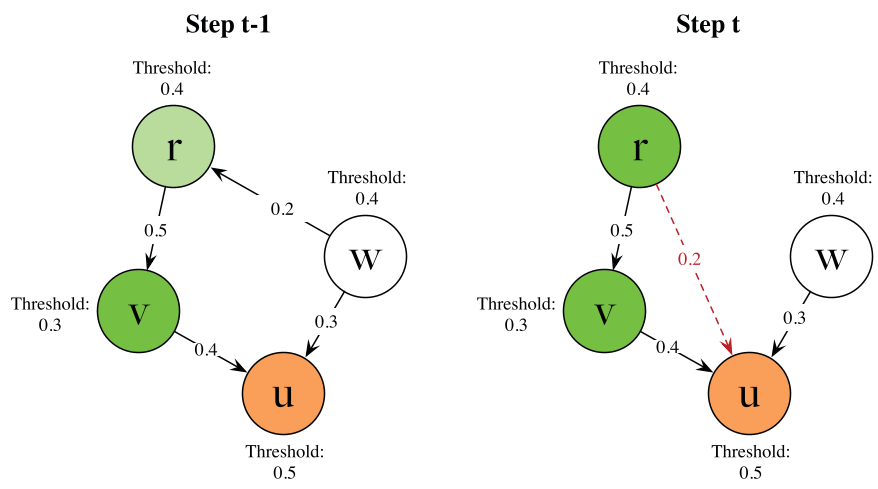 Figure 1: Illustration of the ELT model where user 'w' unfollows their neighbor 'r', while 'r' creates a new link to the original seed 'u'.
Analytical Insights: Measuring "Attractiveness"
The research provides empirical evidence for two intuitive but previously unquantified behaviors:
- The Follow Impulse: The likelihood of a user following a source increases exponentially with TUS ().
- The Unfollow Impulse: Conversely, the likelihood of unfollowing increases as TUS decreases ().
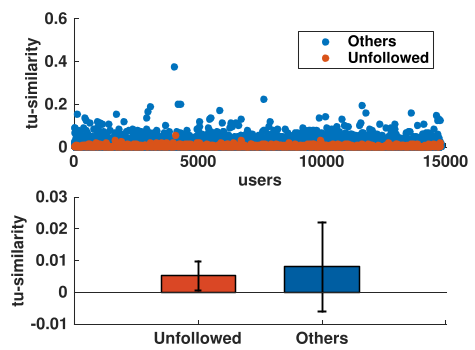 Figure 2: Statistical analysis showing that high TUS scores correlate strongly with new follow actions, while the general population remains at a lower similarity baseline.
Experimental Results: Reshaping the Network
By running simulations on the ego-Twitter dataset (81k nodes, 1.7M edges), the authors discovered that information propagation drives the network toward specific evolutionary states:
- The Rich Get Richer: Seed nodes (influencers) see their in-degree (follower count) skyrocket, while peripheral nodes lose connections.
- Shrinking Diameters: As users "bypass" middle-men to follow original sources directly, the average distance between any two nodes in the graph decreases.
- Fragmentation: Paradoxically, because the average likelihood to unfollow was slightly higher than the likelihood to follow in their dataset, the network became more "discrete" over time, increasing the number of Weakly Connected Components (WCC).
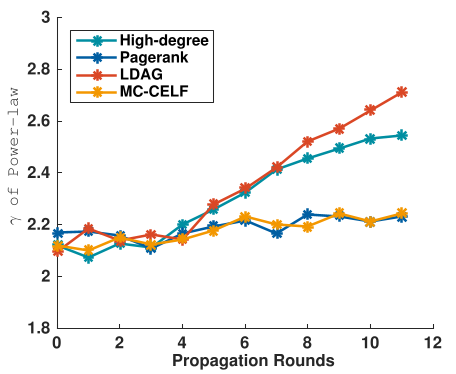 Figure 3: Simulation results displaying the shrinking diameter and the increasing power-law exponent (), confirming that the network becomes more dense and centralized.
Critical Analysis & Conclusion
The core contribution of this work is the formalization of the feedback loop between content and structure. It explains why some influencers can sustain growth (high TUS for their niche) while others trigger "mass unfollow" events.
Limitations:
- The model assumes users follow the original source directly, which simplifies modern recommendation algorithms that might suggest "similar accounts" instead.
- The study focuses on edge dynamics; the birth and death of nodes (users joining/leaving the platform) were not modeled.
Future Outlook: This work paves the way for "Dynamic Influence Maximization," where algorithms must not only pick the most influential nodes but also the most "sticky" content to prevent network erosion during a campaign. For developers building social recommendation engines, the message is clear: Network topology is a symptom of content resonance.