
Unified Influence Modeling: Escaping the Monte Carlo Simulation Trap
Influence in social networks: A unified model?
This paper introduces a Unified Model of Influence to generalize social network diffusion processes. It proposes a vertex-centric, closed-form recurrence relation that approximates infection probabilities across arbitrary directed graphs, effectively unifying Independent Cascade (ICM), Linear Threshold (LTM), and Complex Contagion models.
TL;DR
Social network diffusion research has long been haunted by the computational ghost of #P-hardness. Most researchers resort to thousands of Monte Carlo simulations to estimate how a "virus" or "idea" spreads. This paper presents a Unified Model of Influence, offering a closed-form analytical recurrence that approximates these probabilities with complexity, unifying the Independent Cascade, Linear Threshold, and Complex Contagion models into a single mathematical framework.
Background: The Fragmentation of Diffusion Models
In the study of social dynamics, we usually see two camps:
- Pairwise Models (e.g., ICM): Infection spreads like a biological virus through direct contact.
- Threshold Models (e.g., LTM): Infection requires a certain "pressure" from a neighborhood (complex contagion).
The "holy grail" is a model that accounts for both, along with external factors (like a global news event), without requiring a supercomputer to run simulations.
The Unified Analytical Approach
The core insight of Srivastava et al. is to treat a node's state at time as a function of its own history, its neighbors' history, and a "collective influence" term .
The Recursive Formula
The authors propose a general recurrence for the probability (probability that node is infected by time ):
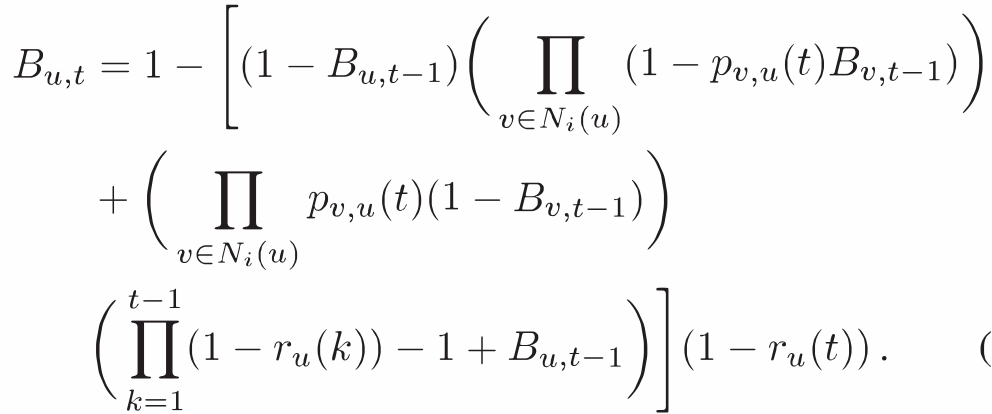
This formula is powerful because it allows (pairwise influence) and (collective/external influence) to be time-dependent. By assuming neighbors are infected independently—a common and necessary simplification in network science—the complexity drops from exponential to linear relative to the number of edges.
One Model to Rule Them All: Reductions
The true strength of this paper lies in its "Reduction" section. The authors mathematically demonstrate that their single formula can transform into:
- Independent Cascade Model (ICM): By setting individual influence to zero and routing all probability through a modified that reflects the "single-chance" infection logic.
- Threshold Models: By defining as a monotone function of the infected neighborhood percentage.
- Complex Contagion: Using an exponential growth law for random infection.
Experimental Validation
Using a subset of the Digg follower graph (1,244 nodes, 28k edges), the authors compared their analytical predictions against the average of 1,000 simulation runs.
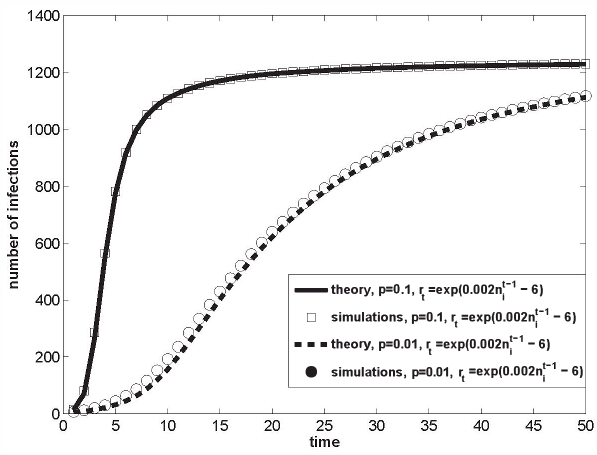
The results (shown above) demonstrate an impressive "goodness-of-fit." Whether dealing with Complex Contagion or Threshold models, the analytical curve tracks the simulation-derived mean almost perfectly. This suggests that the "independence assumption" used in the derivation does not significantly compromise accuracy in real-world graph topologies.
Critical Insight: Why This Matters
The transition from simulation-based to analytical-based modeling allows for:
- Speed: Calculating influence in one pass rather than thousands of iterations.
- Optimization: Mathematical gradients can now be derived from the formula, potentially enabling more efficient "Influence Maximization" algorithms.
- Personalization: Since the model is vertex-centric, each node can have a unique response function to its neighbors.
Conclusion and Limitations
While the model is a significant step toward a General Theory of Influence, it still operates under the progressive diffusion assumption (nodes cannot recover). In environments where "dis-influence" or "recovery" occurs (like the SIS model), this specific recurrence would need further expansion. However, for marketing and information cascade prediction, this unified framework provides a much-needed bridge between disparate social theories.
For those tracking the evolution of social network analysis, this work serves as a foundational piece in reducing the computational overhead of large-scale social simulations.