
Decoding Influencer Marketing: A Network-Based Approach to Sponsorship Prediction
How Do Influencers Mention Brands in Social Media? Sponsorship Prediction of Instagram Posts
This paper investigates the brand mentioning behavior of 18,523 Instagram influencers across over 800,000 posts. It proposes a neural network classification model that utilizes network embeddings and social features to distinguish between sponsored (paid) and non-sponsored (earned) brand mentions with 80% accuracy.
TL;DR
Researchers from UCLA and Amazon have conducted a large-scale study on Instagram brand mentions, analyzing over 800k posts. They discovered key behavioral differences between "paid" and "earned" media and developed a neural network model that uses network embeddings to identify sponsored content with 80% accuracy, proving that who you mention is just as important as how you mention them.
Background & Motivation: The "Trust" Economy
In the digital age, a recommendation from a "friend" or a followed influencer carries more weight than a corporate banner ad. This has led to the rise of Brand Mentioning—where influencers disclose brand names in their posts. However, distinguishing between a genuine recommendation (Non-sponsored) and a paid partnership (Sponsored) is crucial for market transparency and regulatory compliance (e.g., FTC guidelines).
The authors identified a gap: while we know influencers are impactful, we don't fully understand the structural differences in how they engage with brands across different types of media.
Methodology: The Brand Mentioning Network
The core innovation of this paper is the conceptualization of interactions as a Brand Mentioning Network. Instead of just looking at a single post in isolation, the authors look at the tripartite relationship between Influencers, Posts, and Brands.
- Network Construction: A graph where Influencers link to Posts, and Posts link to Brands.
- Structural Embedding: Using the LINE (Large-scale Information Network Embedding) algorithm, the authors converted these complex relationships into 128-dimensional vectors.
- Feature Integration: They combined these structural vectors with:
- Post Features: Likes, comments, hashtags, user tags, and caption length.
- Follower Features: The "clout" of both the influencer and the brand.
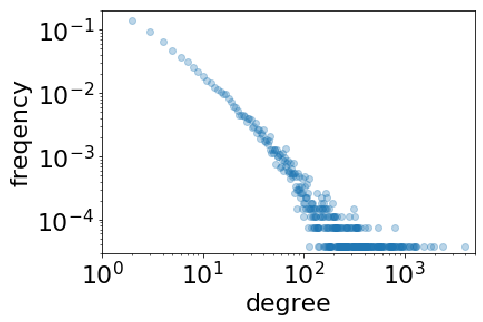 Fig 1. Visual representation of the tripartite brand mentioning network.
Key Insights: How Sponsored Posts Differ
The study yielded several "Aha!" moments regarding influencer behavior:
- The Popularity Match: Famous influencers (millions of followers) almost exclusively mention famous brands. Micro-influencers are more "eclectic," mentioning brands of all sizes.
- The "Exclusive" Tag: Sponsored posts tend to have fewer user tags (often just one—the sponsor) but longer captions. This suggests that paid content is designed to be a "deep dive" into a single product without distractions from other brands.
- Audience Blindness: Interestingly, the number of likes and comments is nearly identical for sponsored and non-sponsored posts. The audience reacts to the content quality, regardless of the
#adtag.
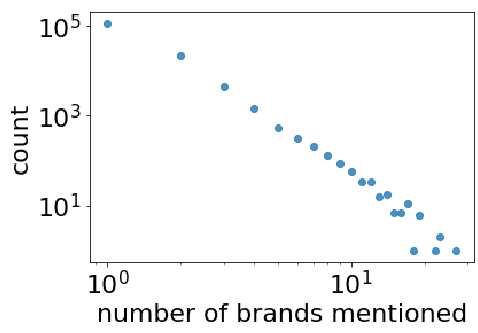 Fig 2. Degree distribution showing that most influencers stick to a small circle of brands.
Performance: Why the Network Matters
The experimental results (Table II in the paper) show that the Network Feature (N) is the "secret sauce."
| Model Configuration | Accuracy |
|---|---|
| Post Features only | 67.7% |
| Post + Follower Features | 69.9% |
| Full Model (Post + Follower + Network) | 80.3% |
This jump from 69% to 80% proves that sponsorship isn't just about the words used in a caption; it's about the latent structural signature of the influencer-brand relationship.
Critical Analysis & Future Outlook
While the model is robust, it relies on influencers following FTC guidelines (using tags like #ad) for its ground truth. The real challenge—and the authors' proposed future work—is detecting undisclosed ads where influencers deliberately hide the sponsorship.
The leap forward here is moving away from simple "keyword spotting" and toward "behavioral mapping." As social media platforms evolve, using Graph Neural Networks (GNNs) to map these commercial ecosystems will become the standard for both marketers and regulators.
Takeaway for Marketers
If you are a brand, realize that your "network position" matters. The exclusive nature of sponsored posts on Instagram (fewer tags, more info) is a proven pattern for engagement, but the "earned" mentions from micro-influencers are what build broader, more diverse brand awareness.