
InfluenceRank: Decoding Social Authority at the Scale of Millions
InfluenceRank: An Efficient Social Influence Measurement for Millions of Users in Microblog
The paper introduces InfluenceRank, an efficient social influence measurement algorithm designed for large-scale microblogging platforms. It provides a dual-metric approach—Relative Influence and Global Influence—and achieves SOTA efficiency with O(e) time complexity, successfully processing a million-user-level dataset from Tencent Weibo.
TL;DR
Social influence is often mistaken for mere popularity. This paper presents InfluenceRank, a highly efficient algorithm with O(e) time complexity that quantifies influence in microblogs by blending network topology with the quality of user interactions and interest similarity. Tested on millions of users from Tencent Weibo, it effectively identifies opinion leaders where simple follower counts fail.
The Problem: The Popularity vs. Influence Paradox
Traditional metrics like "In-degree Centrality" suggest that the user with the most followers is the most influential. However, research into the "Million Follower Fallacy" shows that a high follower count does not necessarily lead to high information propagation.
Existing solutions like PageRank treat all links equally, while online rating services like Klout are "black boxes." The industry needed a model that was:
- Theoretically Sound: Distinguishing between active users (spammers/bots) and influential ones.
- Computationally Efficient: Capable of handling millions of nodes and edges in linear time.
Methodology: The Dual-Layer Influence Model
The authors decompose influence into two distinct but complementary definitions:
1. User Relative Influence (RI)
This is a local metric acting between a follower and a followee. It is calculated as:
- (Quality of Tweets): The ratio of retweets/comments to total tweets.
- (Retweet Ratio): How often user specifically retweets user .
- (Interest Similarity): A cosine similarity measure based on interest tags and content keywords.
2. User Network Global Influence
Unlike the standard PageRank where a node's rank is distributed equally among its neighbors, InfluenceRank uses the Relative Influence (RI) as a weight. This ensures that authority flows through "high-quality" social bonds rather than just any link.
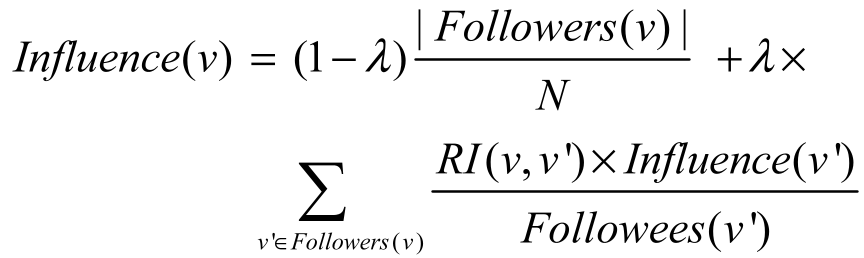
Experiments & Real-World Validation
The model was validated using the Tencent Weibo KDD CUP dataset (2.3M users, 50M edges).
Efficiency and Ranking Performance
The algorithm's complexity is O(e), where is the number of edges. This linear scaling allows it to process millions of users much faster than non-linear recursive models.
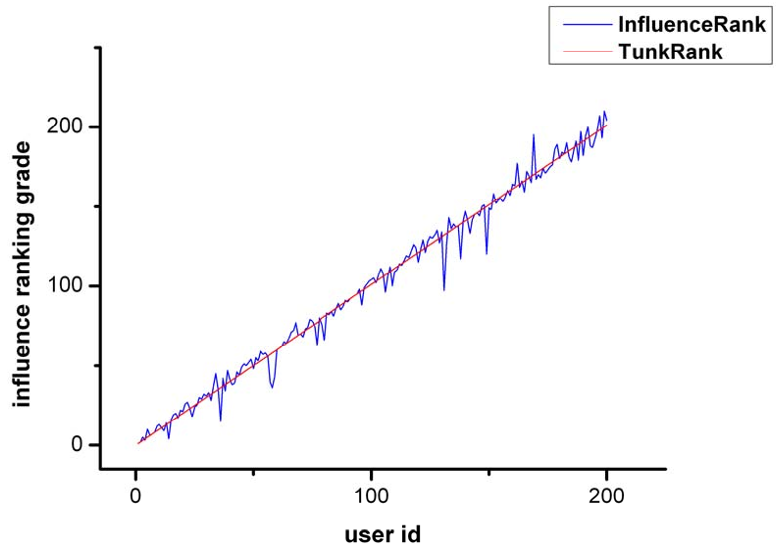 Figure 1: Comparison between InfluenceRank and TunkRank across 200 randomly selected users shows high correlation, yet distinct nuances in behavioral weighting.
Key Findings
- Active Influential: There was zero correlation between the number of tweets posted and influence rank. In many cases, users with the most tweets were identified as spammers or bots.
- Influence Followers: While followers provide the "reach," the interaction metrics (retweets/comments) are what drive the final InfluenceRank score.
- Behavioral Correlation: InfluenceRank shows a much higher sensitivity to "Comment" and "Retweet" counts compared to previous models.
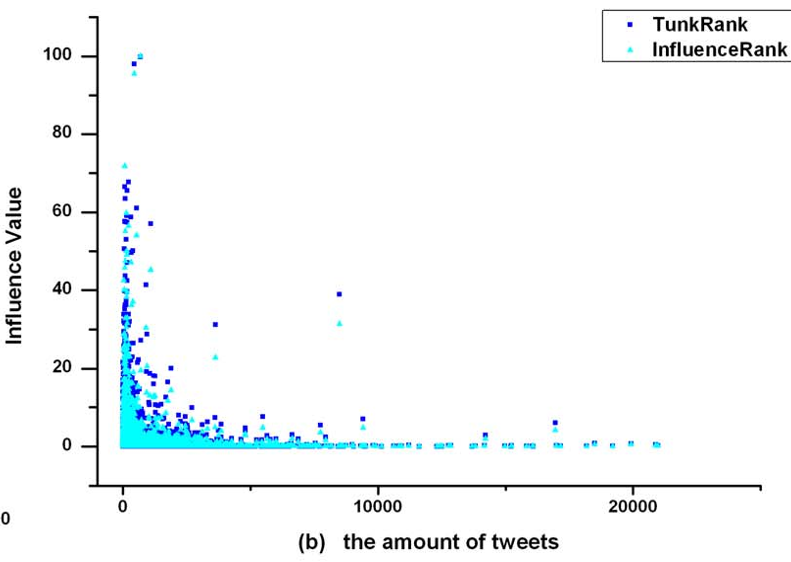 Figure 2: Analysis showing that while followers provide a baseline, interactive behaviors (retweets/comments) are the true differentiators for top-tier influencers.
Critical Analysis & Takeaways
The brilliance of InfluenceRank lies in its computational pragmatism. By pre-calculating the relative influence (RI) and then performing a single-pass iteration, it avoids the heavy overhead of complex graph traversals while still capturing the semantic "closeness" of users.
Limitations:
- The model treats all interests with equal weight, whereas in reality, some topics (e.g., politics or tech) carry more propagation weight than others.
- It assumes influence is static, whereas social influence is highly temporal and dynamic.
Future Work: The next frontier is extending this O(e) efficiency into Dynamic Social Networks, where influence scores can fluctuate in real-time as trends shift.